

Allowing unwanted pharmaceuticals to accumulate in homes increases the likelihood of accidental overdose, illegal diversion, and environmental contamination. It’s time to commit to a solution that works.
The Take Back Solution
Take-back programs provide a safe way for people to remove unwanted medications from their homes.
Existing take-back programs vary widely as to how they are organized and funded. Many happen only a couple days each year. Some local law enforcement agencies have installed permanent drop boxes in their buildings. With the recent withdrawal of federal DEA support, many programs are struggling to find funding to continue this important public service.
A new federal rule for the disposal of unwanted controlled substances allows pharmacies to run their own take-back programs, a convenient option for consumers. However, the new DEA rule does not provide any funding to make participation easier.
Both law enforcement and pharmacy-based take-back programs are severely limited by a lack of consistent funding. While voluntary take-backs are a step in the right direction, these programs simply aren’t enough.
Extended Producer Responsibility (EPR), also known as product stewardship, describes a system where the life cycle costs of a product become part of the cost of manufacturing. EPR is a proven method to sustainably fund the recycling or disposal of fluorescent lights, mercury thermostats, paint, mattresses, household batteries, and other products.
Why, then, is EPR the best solution for pharmaceuticals?
1. Proven
EPR is already being successfully implemented for pharmaceuticals in many European countries as well as some Canadian Provinces. In British Columbia (BC), for instance, 97.5% of pharmacies participate in a drug take-back program due to a solid EPR foundation. These locations collected a total of 112,888 pounds of pharmaceuticals in one year alone, equaling out to 0.02 pounds of meds collected per person. For comparison, Oregon, a state with a similar population but without an EPR program, collected only 0.004 pounds of meds per person in one year, a rate five times lower than British Columbia’s.
2. Economical
A coordinated EPR approach lowers collection and disposal costs per pound. The pharmaceutical EPR program in France, for example, collects an average of 16,237 tons per year, at a cost of just $0.0022 per box. Funded entirely by pharmaceutical manufacturers and run by the non-profit group Cyclamed, this French program is highly effective in collecting unwanted pharmaceuticals. In a recent survey, 77% of French residents claimed to have disposed of unwanted medication via these take-back sites, while 70% said they “always” dispose of pharmaceuticals in this way.
3. Stable
Unlike the current patchwork of funding used by U.S. programs, an EPR program provides secure, long-term funding. The aforementioned program in British Columbia started their mandatory Medications Return Program in 1996 with a program revamp in 2004. The pharmaceutical industry, therefore, has been funding the entire cost of the program for over 19 years.
4. Ready to Go
Momentum is growing: Alameda County, CA; King County, WA; and San Francisco, CA have all adopted EPR laws. Despite having been willing EPR partners in other countries, pharmaceutical manufacturers have challenged the Alameda law in court. Considering the narrow grounds of the appeal and improvements made to subsequent iterations of the law, other communities will soon be passing pharmaceutical EPR laws.
Please consider promoting an EPR bill in your county or state. Each new EPR law brings us one step closer to a national program.
Ed Gottlieb is the Chair of the Coalition for Safe Medication Disposal in Tompkins County, NY. Ed can be contacted at egottlieb@cityofithaca.org.
For those of us in the environmental movement, it might seem as if we are on a long hike, which keeps going and going and going, from peak to peak, and valley to valley. The landscape looks familiar, the challenges commonplace. There are times to rest, and times to move, times to seek shelter, and times to book it across wide open fields. And then there are times when you sit back and notice that you have come a long way, and that the process was enjoyable, and that the long days of trudging in mud got you to a place of beauty, and that the view is nothing like you could have imagined.
On July 1, I attended an event at a Sherwin Williams paint store in Branford, Connecticut, to mark the start of Connecticut’s paint stewardship program. Before Governor Dannel Malloy placed the first gallon of paint into the collection container, he spoke of the importance of keeping paint out of our storm drains and the Long Island Sound, and praised the industry for their product stewardship efforts. Dan Esty, Commissioner of the Department of Energy and Environmental Protection, talked about the “new world of product stewardship” and how the paint program kick off represents the “next step in Connecticut’s move to building the waste management system of the 21st Century.”

Connecticut Gov. Dannel Malloy places a can of paint in a recycling bin in a symbolic kick-off to the PaintCare Program. (L to R: American Coatings Association President Andy Doyle; Connecticut State Sen. Ed Meyer; Connecticut State Rep. Pat Widlitz; and Gov. Dannel Malloy.)
One after the other, speakers walked to the makeshift podium at the corner of the paint store, amidst the colored strips of lavender and mauve, and praised the new paint program and its ability to save resources, save money, and create jobs.
There was a good feeling, and rolling out right in front of me, like a video documentary, was a paradigm shift of immense proportions, as Important People, from the Governor and his Administration, to key legislators, retailers, and paint manufacturers, praised the collaborative nature of this innovative program.
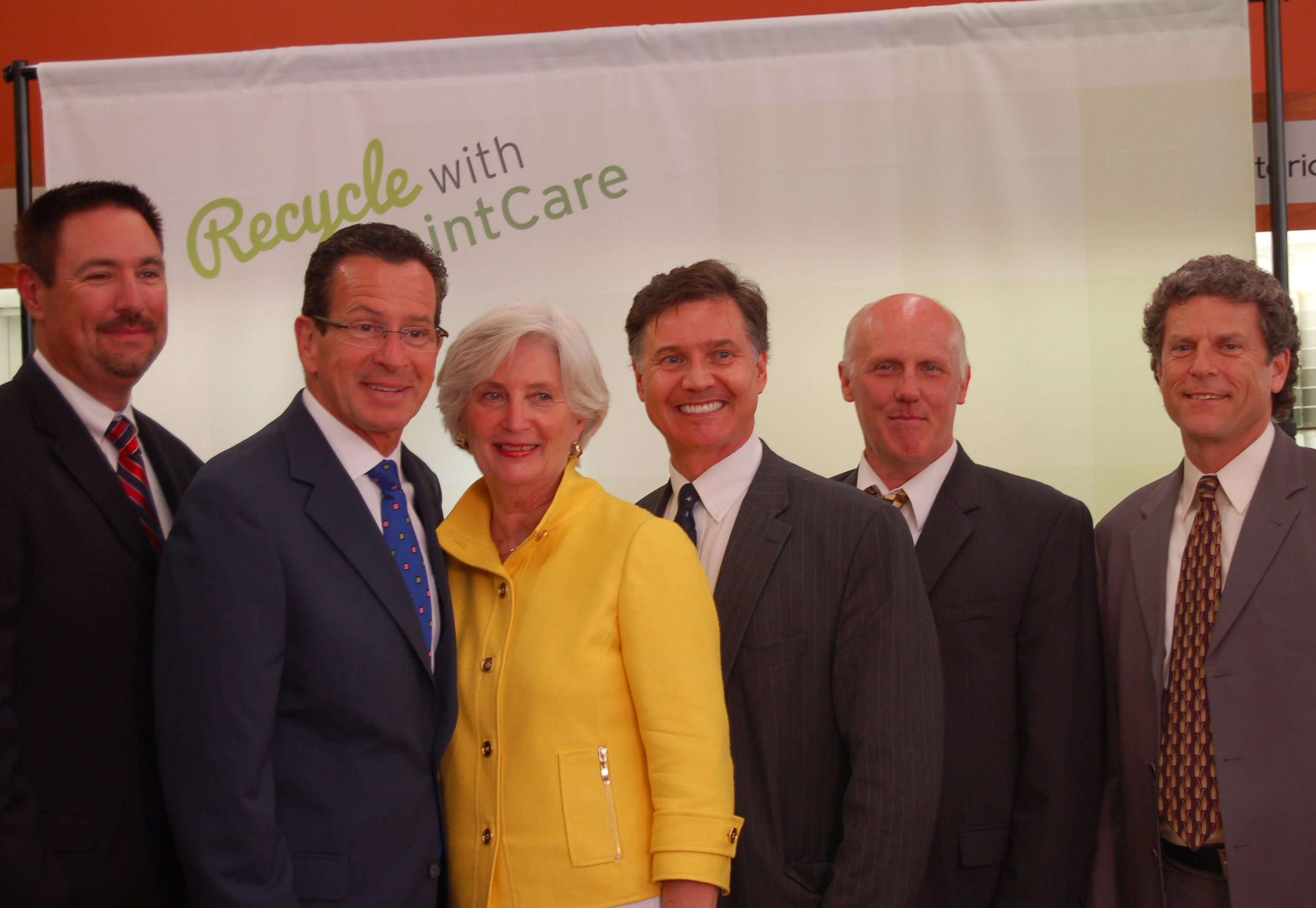
(L to R: Sherwin-Williams District Manager Tom Kelly; Connecticut Gov. Dannel Malloy; Connecticut State Rep. Pat Widlitz; Connecticut Dept. of Energy and Environmental Protection Commissioner Dan Etsy; Connecticut Dept. of Energy and Environmental Protection Environmental Analyst Tom Metzner; Product Stewardship Institute Chief Executive Officer Scott Cassel)
Tom Kelly, Sherwin Williams District Manager, mentioned the calls he already received on the first day of the program from residents seeking a place to bring leftover paint. “They come in just to drop off paint, but then see a clean store, and that we have what they need, and they leave a customer,” he said. Andy Doyle, President of the American Coatings Association, pledged the “support and backing of America’s paint industry” to recycle all the state’s leftover paint. The two chief bill sponsors – Sen. Ed Meyer and Rep. Patricia Widlitz – applauded the Governor and his team, as well as the industry, for their collaborative approach to finding a solution to a significant environmental problem, calling it “something really special.” They talked about the “terrific concept of producer responsibility” in which “paint manufacturers come up with their own plan to recycle.” State Rep. Lonnie Reed said that “…building in recycling and end-of-life elements into all of our products is important, and a sign of things to come.”

(L to R: American Coatings Association President Andy Doyle; Product Stewardship Institute Chief Executive Officer Scott Cassel)
As I stood there listening, it struck me that product stewardship has become commonplace in Connecticut. PSI laid the groundwork for paint product stewardship in Connecticut and across the nation by convening paint manufacturers, retailers, state and local governments, and others in national meetings to hash out the agreements that led to this very moment. But the paint program in Connecticut would not have happened if each of the local stakeholders at that press event did not seize on the opportunity they were presented. The paint industry has now transformed itself from an industry that once saw consumers as the reason for leftover paint to one that has taken a leadership role to make sure leftover paint is recycled.
As our nation debates immigration reform, marriage equality, and voting rights, we can all sense shifts in public opinion that represent sea changes of immense proportion. This year marks a watershed moment in the product stewardship movement. To date, eight producer responsibility laws have passed this past year on four products in eight states: pharmaceuticals (Alameda County, CA; King County, WA); paint (Maine, Minnesota, and Vermont); mattresses (Connecticut and Rhode Island); and thermostats (New York). No, the entire country has not embraced producer responsibility; that will take decades. But we now have Governors and Commissioners speaking about an industry’s responsibility to manage its own waste, and an industry speaking glowingly about its partnership with regulatory agencies that allow it to assume its rightful responsibility.
This is the paradigm shift that many of us predicted in 2000 when the Product Stewardship Institute was created on that cold December day in Boston when over 100 government officials assembled to talk about a little known concept called product stewardship.
The times have changed. Sometimes it is nice to sit back and enjoy the show, and revel in the enjoyment that your hard work has provided to others. For many of us, now is that time.
Last weekend I had the joy and good fortune to watch my daughter graduate from college. Few of my previous life experiences have matched that prideful day.
At Wesleyan University, on commencement day, a commitment to social justice dripped from each graduate’s gown. A stream of red and black marched by the round-topped star-gazing observatory as African drummers pounded soulful renderings under a tent. Professors and other dignitaries mingled around lawn chairs, and flags whipped in the cold wind.
Receiving an honorary degree was former Wesleyan graduate, Majora Carter, whose efforts to economically revitalize poor urban areas are profoundly “Wes.” So was her speech. Her message: Get ready to be uncomfortable. That’s right! Anyone who wants to shake up the status quo will have enemies, even brutal opposition. You will know who your friends aren’t, she said.
As someone who wears product stewardship lenses inside his gl
Over the past 13 years, this space has yielded dividends. In the past two weeks, three new producer responsibility laws have passed – Connecticut’s first-in-the-nation mattress law, and paint laws in Minnesota and Vermont (the 5th and 6th states to pass paint stewardship legislation so far). These laws do not pass solely because of PSI. In many ways, they would never pass if it was all up to us, or up to any one stakeholder. It takes a strong coalition that gets built over time. Starting and maintaining those coalitions is what PSI does – and it often starts in a very uncomfortable place, where we need to convince all stakeholders that the heavy lifting needed to change the status quo is worth the effort.
Thanks to all of our partners for great success these past two weeks, and we hope for many more victories that result in resource savings, job creation, and taxpayer savings. I am starting to like this feeling of being a little less uncomfortable.
It was 1997. I was listening to Ron Driedger, an official from the British Columbia Ministry of the Environment, discuss during a keynote presentation how his agency required producers to pay for managing their post-consumer products. From paint to pharmaceuticals, Ron said, industry-funded take-back programs enabled cost-effective recycling and safe disposal of a range of consumer products. This decreased not only government spending, but also the potential for negative environmental impacts due to improper waste management.
I was intrigued.
As the Director of Waste Policy and Planning for the Massachusetts Executive Office of Environmental Affairs, and in the midst of writing the state’s solid waste master plan for my fourth time, I knew we needed new ideas—and quickly. So when I returned to the office, I told my boss that I wanted this producer responsibility waste management approach to be the United States’ chief import. I made the case that product stewardship policy could not only save governments millions of dollars, but also be good for the environment and create recycling jobs. Then, I went out on a limb even further: I proposed creating a new, national nonprofit organization focused on this new concept of product stewardship. One that would be the voice for state and local governments. One that would help spur economic growth and cut back on taxpayer costs. One that would work to benefit the environment by finding innovative solutions to managing post-consumer solid waste. And one that would get government and industry to work collaboratively toward a common goal.
My boss—Gina McCarthy—bought into the idea.
Well, okay. She actually told me to finish the solid waste plan, first. Then, she asked for a business plan.
It took months of discussion and multiple drafts of that business plan, but in the end, Gina followed through, providing the funding and support that I needed to start the Product Stewardship Institute.
Thirteen years later, Gina McCarthy is poised to become the next head of the U.S. Environmental Protection Agency, having earned the nomination from President Barack Obama. And she brings exactly the type of leadership that EPA needs.
Gina is an innovator and, by extension, a supporter of innovation. When I started PSI, I had to overcome numerous roadblocks that a bevy of detractors (mostly people who saw PSI as a threat to their turf) set up for me. Gina, however, saw PSI as an opportunity. In fact, she became one of the first PSI board members, helping to guide and shape the nascent organization. She understood the balancing act we were playing between government, business, and environmental activists. She took a calculated risk, asked questions, and provided advice. She helped PSI move forward by making decisions based on sound information, thoughtful deliberation, and consideration of multiple viewpoints.
The EPA’s past support for product stewardship has been instrumental in PSI successes, too. This includes our national paint dialogue, which led to a major waste management agreement with the paint industry, as well as our pilot computer take-back project with Staples, which led to nationwide take-back programs by Staples, Best Buy, Office Depot, and Office Max.
Unfortunately, the EPA’s more recent approach to product stewardship has been tepid, and there have been missed opportunities. With Gina at the helm, though, I feel confident that she would breathe fresh life into that seemingly worn banner of “change” that was unfurled at the White house in the early days of the first administration. The EPA needs fresh ideas. It needs a fighter. It needs someone who will advocate for progressive environmental interests while tempering that passion with economic and political realities.
Gina is a kid from Boston with the street smarts to manage a bureaucracy that’s in the crosshairs of Congress. She’s the “anti-intellectual” who’s intelligent. She’s the tough regulator who knows when to cut a deal. She’s the baseball manager who kicks dirt on an umpire’s bad call but then goes out for beers with the umpires after the game. From local health official to state and federal regulator, Gina has climbed the ladder while maintaining close ties to business leaders and environmental groups.
I think the President made the right choice by nominating Gina. Let’s hope Congress does, too.
Flying high above the Atlantic on my way home from a week of travels to Canada and Scotland, I pondered how America can be such a powerful world leader in technology, the economy, and the military, but so unenlightened regarding trash. We pride ourselves on innovation, bold risk-taking, fierce independence, and toughness. Yet, we are well behind our Canadian and European comrades regarding strategies to turn our country’s waste problem into an opportunity to recover valuable materials, create recycling jobs, and reduce costs. In fact, our corporations display a fear and trepidation of the future that is downright troubling.
What is so disappointing is that most corporations selling products into the U.S. market are operating within much more sophisticated solid waste programs than we have in the U.S. Although we have made progress in managing some problem wastes (e.g., electronics, mercury thermostats and lighting, and paint), the Canadians and Europeans have us beat in so many product areas, particularly packaging.
In Ottawa, Ontario, I moderated and presented on a panel called “Policy Shaping the Landscape” at the PAC NEXT annual conference that PSIco-sponsored. In front of several hundred corporate powerhouses like Unilever, P&G, Nestle, Walmart, Kraft, and Target, my fellow panelists and I discussed the mix of strategies needed to manage all packaging waste in Canada by 2015 – voluntary industry initiatives, extended producer responsibility (EPR), and other regulations. That same conversation is not yet happening in the U.S. And the U.S. representatives of those same corporate powerhouses are avoiding even having that conversation.

September 28, 2012—Scott Cassel speaks at PAC NEXT in Ottawa, Ontario.
As our first session panelist, Michael Goeres, executive director of the Canadian Council of Ministers of the Environment (CCME), provided the context for Canada’s national focus on packaging. According to Goeres, it started in 1989 with the National Task Force on Packaging. The issue reignited during the debate on packaging EPR that started in 2000. And it resurfaced, yet again, with the 2009 Canada-wide Action Plan for Extended Producer Responsibility and Canada-wide Strategy for Sustainable Packaging,which created a central platform on which to implement EPR laws throughout Canada by 2015. Goeres also discussed CCME’s initiative to work with industry to reduce packaging waste, which culminated in the recent announcement of the Design Guidelines for Sustainable Packaging, a voluntary joint initiative between Éco Entreprises Québec (a PSI Sustaining Partner) and the Sustainable Packaging Coalition.
In contrast to our Canadian counterparts, the U.S. Environmental Protection Agency (EPA) does not consider waste management to be a federal government issue, but rather a state and local government issue. After a request from state and local agency officials to help solve the growing waste problem, the EPA held five meetings on packaging waste between 2010 and 2011 and even released a report. However, it pulled out soon thereafter, leaving regional EPA branches to follow up.

September 28, 2012—PAC NEXT panelists at Chateau Laurier in Ottawa, Ontario.
The next speaker on our panel, John Coyne, is a Unilever vice president and chairman of Stewardship Ontario, the industry-led product stewardship organization that takes pride in its implementation of Ontario’s six-year old Blue Box EPR program. Of the 1,500 businesses represented by Stewardship Ontario, John said: “…we are dedicated to supporting our member companies’ drive to innovate – to contribute to making their businesses, packaging, and products more environmentally sustainable and more readily recyclable. We lead through development and investment.”
Here are a few other things he said:
- “By any measure, the Blue Box is defined and regarded as both a success and a symbol…75 percent of Ontario residents say they consider the Blue Box their primary pro-environment effort …People like it. It makes them feel good about their contribution. More importantly, people use it.
- “By embracing innovation, by harnessing creativity, by building on our achievements and accomplishments, we aim to be a global leader in responsible product stewardship. At all times, we never lose sight of the fact that our primary job is to meet collection and diversion targets and to prevent waste from filling landfills and fouling waterways.”
- “We need to ensure that the success of the Blue Box fuels further innovation – which, in turn, will help make the program even more successful.”
Ironically, many of the same companies that are members of Stewardship Ontario are also members of the U.S-based Grocery Manufacturers Alliance (GMA), which hired the consulting firm SAIC to issue a report last month that criticized the Blue Box EPR program as inefficient and ineffective. Go figure.
The last speaker on my panel, Meegan Armstrong of the British Columbia Ministry of the Environment, touted the province’s commitment to manage, by 2017, all products under an EPR system that promotes private sector initiative and innovation.
As if that three-speaker session was not enough of a contrast with the U.S., next, I spoke on a panel at the Scottish Waste and Resources Conference in Glasgow, Scotland, where my fellow panelists and I discussed the interplay between voluntary and regulatory solutions.

Oct. 3, 2012 — Scott Cassel speaks in Glasgow, Scotland about PSI’s experience forging agreements between stakeholders for both voluntary and regulatory product stewardship programs.
The Scottish government has just introduced packaging regulations that are more aggressive than the existing packaging law in place in the U.K., of which Scotland is a part. However, Zero Waste Scotland, an independent organization funded by the Scottish government, is tasked with implementing the packaging law through both EPR and voluntary solutions. The recycling rate in the U.K. far exceeds that of the U.S., but—to Scotland—that rate is unacceptably low. They want to do more.
America, we have a problem. If our corporations continue to refuse even to have the discussion with other U.S.-based stakeholders about how we are to reduce waste, save taxpayers money, create recycling jobs, and achieve our joint objectives by both voluntary and regulated solutions, then we will have no one to blame but ourselves for wasting economic opportunities.
As Americans, we should be leading in the creation of innovative waste management solutions, as we do in other areas of the economy, rather than burying our future in the rubble of our own fear.
Twelve years ago, when PSI was getting off the ground, my personal vision was that government and industry representatives could have meaningful discussions about waste policy outside the legislative arena, and develop joint policies, regulations, and laws to protect human health and the environment. I was tired of the traditional unilateral government approach to pass laws over the fierce objections of industry. Collaboration, after all, can achieve far better results than forcing anyone to do anything.
Fast forward twelve years, to today. While there are many stellar individual examples of corporate leaders finding ways to reduce their product impacts, far more companies have chosen to thwart attempts at having an open conversation about their environmental and social responsibility. In an ironic twist of self-fulfilling prophesy, most companies that hate regulation and want smaller government only become “greener” through the threat of legislation.
In an ironic twist of self-fulfilling prophesy, most companies that hate regulation and want smaller government only become “greener” through the threat of legislation.
PSI works on about 18 product categories, and has invited manufacturers, retailers, and other businesses associated with every one of these products to discuss how to reduce their health and environmental impacts. The only industries to fully engage in these discussions are paint (through the American Coatings Association) and rechargeable batteries (through Call2Recycle).
The International Sleep Products Association would not bring any members to our two open national mattress dialogue meetings, refused to provide contact information, and would not discuss strategies to solve the problem.
The majority of U.S. consumer packaged goods (CPG) companies were invited to attend our three technical packaging calls that recently addressed both voluntary and regulated strategies to reduce, reuse, and recycle packaging and printed material, including non-EPR systems. Only a few participated, and they have not invited PSI to attend any of their discussions. The truth is that most CPG company representatives in the U.S. are so new to the issue of packaging waste and recycling that they do not know what to do. There are many in this field, including PSI, who have been working on these issues for years, and can provide insights and opportunities for productive discussion among all stakeholder groups. However, this can only happen if these companies do not close ranks and only discuss strategies among themselves.
The National Electrical Manufacturers Association came to PSI five years ago seeking EPR legislation on mercury thermostats because they did not want to continue paying for the recycling of thermostats from free-riding companies not contributing to the industry-funded thermostat recycling program. After six months of multi-stakeholder negotiations and after all issues were negotiated, they walked away from the agreement and have since opposed all thermostat legislation except bills that codify their voluntary program.
No wonder why environmental groups have sharpened the saw against these companies. We have now come full circle to the point where PSI began – governments are left with little choice but to force legislation on industry, or accept whatever programs industry wants to do. That is truly a sad waste of all of our time and energy.
Yet the world turns, and PSI will react to this reality. We will continue to seek out corporate leaders, like those on our Advisory Council, at the American Coatings Association, and at Call2Recycle. And we will continue to support and strengthen voluntary programs as well, since many states will not support legislation under any circumstances. But the truth is that PSI is being forced into the same antagonistic fight in state legislatures that we wanted to avoid when we were created in 2000.
I had hoped that data, logic, discussion, and human interaction would breed relationships that would entice companies to transcend their natural inclination to maintain the status quo. We are now entering the fall, and many governments are getting ready for the 2013 battle in state legislatures across the U.S. …unless someone would rather talk…
Is anyone out there? Hello?
For the 11th year in a row, Massachusetts has failed to pass electronics EPR legislation. It is now 12 years since the Commonwealth became the first state in the country to ban the disposal of lead-bearing cathode ray tubes, sparking the electronics recycling industry in the U.S…and placing the financial burden to manage electronics on Massachusetts cities and towns. It was the classic ban without a plan. Unlike the stellar U.S. women gymnasts who earned Gold in London yesterday, our country fails miserably at passing legislation that will keep gold and other valuable materials out of our country’s landfills and incinerators.
What a waste. What a shame. To watch our great and mighty companies offshore jobs, complain about it being the only choice they have, but do little to create thousands of green jobs that are there for the asking if they would engage with PSI and other stakeholders to develop extended producer responsibility (EPR) laws and other strategies that meet their own interests.
The powerful corporate self interest that has blocked movement on product stewardship and EPR in the U.S. is the same one that unknowingly is weakening itself, just as the U.S. auto industry’s fight against fuel efficiency standards weakened itself, causing the need for a government bail-out.
I just finished yet another book that chronicles ways that U.S. companies and policy makers are failing to take actions that will strengthen our economy, instead resulting in the slow decline of U.S. economic power. Edward Luce’s Time to Start Thinking shows what the product stewardship movement experiences on a smaller scale – a failure to launch. Look no further than the microcosm of the product stewardship field, where many unenlightened companies fight against policies that will save billions of dollars for U.S. taxpayers, reduce waste, and generate thousands of recycling jobs.
These companies operate under the guise of groups like the Product Management Alliance, which evaluates EPR laws by showing that the laws that they weaken actually don’t perform well. How enlightening! The powerful corporate self interest that has blocked movement on product stewardship and EPR in the U.S. is the same one that unknowingly is weakening itself, just as the U.S. auto industry’s fight against fuel efficiency standards weakened itself, causing the need for a government bail-out.
As I wake up this morning to yet another failed attempt to pass an e-waste bill in the all-Democratic Massachusetts Legislature (and with its Democratic Governor), I wonder what this failure is all about…was Dell so bent on passing a bill that ensured that any goals included would already be met before the law went into effect? Or was the House leadership frozen in political gridlock on matters far removed from the bill itself? It is clear that there was no consensus on the bill, but how can stakeholders be so far apart for so long that we cannot figure out a way to act in all of our own self interest?
Close your eyes…and envision a time when we in the U.S. really went for the gold…like those women Olympic gymnastic heroes of today. Rather than burying our gold in the ground and mining raw materials in an endless cycle of waste, we owe it to ourselves to find a way to break out of this malaise together.
Individual responsibility. In our world of product stewardship, these words have one meaning – a company having responsibility for safely managing its products from manufacture to post-consumer recycling or disposal. The Supreme Court decision on the health care law highlighted another individual responsibility – that citizens have the obligation to buy health insurance to cover their own medical care. Both relate to the principle that we are all responsible for our own actions and the negative impact they have on others.
What is so puzzling to me is why those who adhere strictly to the individual responsibility principle when it applies to people whose homes were foreclosed, those with excess credit card debt, and those who do not “pull their weight” in society, do not extend their views to product manufacture and health care. Manufacturers in the U.S. know that this All-American principle of individual responsibility is coming to meet them, even as many of them try to delay the greeting.
Individual responsibility is the bedrock of being an American. We are a people of individual rights…and responsibilities. We want our freedom…but we know that we have a responsibility to our neighbors, our community, and the wider society. We don’t like free riders, and we know that we have to do our part. That is what it means to be an American. No one needs to look over our shoulder because we are driven by an inner responsibility, whether moral, religious, or communal. But it is deep, and it makes us who we are as a country.
So why do those who profess individual liberties walk away from their own responsibility to manage the products their companies make in a way that does not harm their fellow citizens? Why do they want to allow free riders and put an undue burden on others…on me, and on you?
Regarding the health care law, Massachusetts Governor Deval Patrick said, “It’s about dealing with the freeloaders – the folks who now get their care without insurance in [a] high-cost emergency room setting. And all the rest of us pay for it today.”
All the rest of us are also paying for the recycling or disposal of every product put in the marketplace. If a company like Preserve is innovating its way to create products with recycled content and is committed to recycle its own products, why aren’t its competitors doing the same thing? Why should one company take responsibility for its environmental impacts while others don’t?
I hate being told what to do. In that way, I might have some friends out there. But I sure as heck don’t like freeloaders who cause impacts that affect me, or make me pay for those impacts. Product manufacturers and retailers have a societal responsibility, and we know the negative impacts that used consumer products, such as electronics, mercury thermostats, and pesticides, can have on our health, our environment, and our economy, even as they have many positive impacts on our quality of life. Those who want freedom should take responsibility for the freedom this country gives them in their pursuit of a profitable business. Otherwise, they will force the big bad government to make them responsible citizens….united with the Supreme Court and the people of this country.
John E. Sununu, former U.S. Senator from New Hampshire, wrote an Op-Ed that appeared in the June 5 Boston Globe in which he touted last week’s private launch of a rocket into space as heralding the dawn of private investment in a domain that was previously solely that of government. Why then can’t the post office be privatized, he asks.
I wonder the same thing. The U.S. Postal Service did not respond well to the writing on the wall over the past 20 years, as the need for their letter carrier services gave way to faxes and the Internet. I tried to get USPS representatives interested in becoming a reverse distribution network for collecting used products for recycling, but they couldn’t grasp the concept. Their most common function now is to pass on costs to local governments to recycle or dispose of unwanted marketing queries and catalogues.
But I also wonder why those who support the private sector taking over the responsibility for government functions have such a hard time when it comes to trash or, should I say, the products that ultimately become trash. Companies derive profits from making and selling products, and it is accepted that these companies should internalize these profits. Why then should the costs of managing those products after they are consumed be externalized to society? Why should these costs become government’s costs? After all, we (all taxpayers) pay for this, not the companies that make or sell the products. In most places in the country, there is no differentiation between a computer, a piece of paper, an aluminum can, or a sofa. Stick it on the curb or bring it to the dump and you pay the same price. Government has little influence over product design to make a couch that weighs half as much but still performs the same. But the private sector does…if only given the incentive.
Government’s role traditionally has been to clear the streets of trash to protect public health and safety. However, over the past 40 years, government has also invested billions of dollars nationally in creating an infrastructure to collect and recycle used products, resulting in millions of dollars of private sector profits. This, too, is government’s traditional role. In his new book, Time to Start Thinking, Edward Luce recounts how government paved the way for the private sector to profit from the Internet through billions of dollars of taxpayer investment. Thomas Friedman, in his new book, That Used to be Us, laments the lack of government investment now in new energy efficient technologies that can pave the way for private sector investments in the next generation of clean energy technology.
Government paves the way by investing in the future of the country. But there is a time when it should step aside for the private sector to take over. State and local governments have invested enough in developing the infrastructure that is now serviced by waste management and recycling companies. This public sector investment has yielded millions of recycling jobs, a reduction in environmental impacts, and cost savings. The investment has paid off.
But we are at a critical juncture. Government does not have the funds to invest any more. It is time for the private sector to internalize post-consumer product costs and to invest in sustainable products and collection systems that recover valuable materials for the manufacture of new products. This transition to a more sustainable economy is rooted in our ability to forge a lasting partnership between the private sector and government.
I am with John Sununu on this one. He forecasts a person’s typical response to change by clinging to the status quo. Look at it this way. Everything that we buy will be transformed to some degree. We change the things we buy by using them. Therefore, we are all agents of change. It is time to change how waste is managed in this country.
Calling all private sector small government advocates – we are ready for you.
For once, there was good news about jobs. Real American jobs.
The front page headline of The Boston Globe’s business section on April 16 read: “Recycling industry poised for hiring.” The article highlighted the recent report by the Environmental Business Council, MassRecycle, and SkillWorks (a nonprofit that funds workforce initiatives) that predicts the growth of over 1,200 recycling jobs in Massachusetts in the private sector alone. This growth would be added to the 14,000 current recycling jobs in 2,000 Massachusetts companies with a payroll approaching $500 million annually.
Wow! Such great news. Finally, business, government, and environmental groups should be swinging arm in arm, humming This Land is Your Land.
Let’s take it a step further. Extended producer responsibility (EPR) laws create recycling jobs by signaling to investors that the supply of recycled materials will be available. In the first year of E-Cycle programs in Washington and Oregon, three new processing and recycling facilities opened. Implementation of their E-Cycle programs resulted in electronics collection and processing job growth of 64%, supporting 360 jobs or 12.6 jobs per 1,000 tons of electronics processed, well above the less than 1 job per 1,000 tons from traditional disposal. Collection rates rose to 38.5 million pounds in Washington and 19 million pounds in Oregon.
Since EPR laws increase material supply and recycling, businesses should be loving EPR too, right?
Then why would the Hartford Business Journal equate the 2012 Connecticut mattress EPR bill as bad for business? About EPR, the Journal says: “If you think about the logical extensions of that doctrine, the world as we know it ends.” They are not being kind. Of course those of us working on EPR know that the world as we know it must change. We cannot continue to waste resources and place the burden on government and taxpayers.
But the Journal shows how different many in the business community view EPR. They acknowledge the problem that mattresses cannot be disposed of in landfills and incinerators, and that it costs a great deal to manage them properly. And they acknowledge that the bill would create jobs, citing companies ready to set up shop in the state, the way that a paint recycler immediately announced plans to come to the state after Connecticut passed its 2011 paint EPR law.
But they object to businesses being held responsible for resolving the problem. “Somewhere the responsibility of the individual user has been lost in a nanny-state fantasy that business is responsible for all ills…Isn’t this exactly the kind of big-picture societal problem that governments are supposed to solve?”
I want to thank the Journal for framing these questions. I really mean it. We now know where to start the discussion. Government is definitely not equipped to handle product waste by itself, despite their extensive expertise in waste management and recycling. Pure and simple – they do not have the funds. And it is not fair to ask all taxpayers to pay for the consumption of others.
EPR systems require that state and local governments, manufacturers, retailers, and consumers all play a role in the responsible management of products and the materials of which they are made. And, yes, individuals who buy the products should pay for their recycling or disposal, and producers should make it easy for those consumers by incorporating these costs into the product purchase price. Until the full cost of managing products is internalized, we will continue to have a nanny-state where government picks up the cost to dispose of products.
But why do businesses so vehemently resist the changes that many agree need to be made? What responsibility does the business community have in reducing environmental impacts and reducing government waste management costs that result in higher taxes?
On the other side, what is the extent of government’s reach? What added costs do governments impose because they are involved in ways that they should not be?
We all want jobs. We want a clean environment and a reasonable quality of life. Then why is it so hard to take responsibility for changes needed to bring about these outcomes? Are we just too darn stubborn to consider a change to our current situation, no matter how much better we have the power to make it? I really think that this is most of the challenge.