
Yesterday, in Boston’s historic Faneuil Hall, I listened to a stirring rendition of the Star Spangled Banner by a high school student whose golden voice inspired angels to dance among the majestic white columns that lined The Great Hall.
I was invited to Faneuil Hall to accept an Environmental Merit Award that the U.S. Environmental Protection Agency bestowed on the Product Stewardship Institute. I was honored to accept that award on behalf of PSI’s staff, members, and partners. And I was proud of our partner, the Northeast Recycling Council, which received an impressive Lifetime Achievement Award.
At the ceremony, I was inspired to hear of the achievements of individuals and organizations in the region, and it gave me time to reflect on what PSI does best, and the challenges we face. What those of us in the product stewardship movement are trying to do — change corporate behavior –is not easy. At stake is the Role of Government, whether that role is to assist industry in developing voluntary projects and agreements, or to develop legislation. PSI seeks to facilitate a healthy balance between regulation and free market enterprise.
Two of our most notable successes have been in partnership with the U.S. EPA.
One of those initiatives was a voluntary program, while the other resulted in model legislation. In 2004, under an EPA grant, PSI partnered with Staples to develop the first retail computer take-back program in the country. Chris Beling of EPA Region I was a diehard advocate for that project and contributed to its success. That voluntary pilot project ultimately led Staples to develop a nation-wide ewaste collection program. Other retailers selling computers and electronics have since followed with their own recycling programs.
The other notable initiative began in 2002, when EPA funded PSI to hold its first dialogue meeting with paint manufacturers, retailers, painting contractors, and government agencies. That first meeting turned into a national agreement, model legislation, and three state laws that require paint manufacturers to set up and fund a system to recycle leftover paint. The paint industry is the main engine behind the passage of these laws. The program will eventually save governments over half a billion dollars each year in paint management costs, create paint recycling jobs, and save valuable natural resources. Prior to the national agreement, PSI facilitated and managed eight voluntary projects funded jointly with nearly $2 million from government agencies and the paint industry. Barry Elman of EPA headquarters played a pivotal role in all phases of the project.
PSI is proud of its achievements to pass EPR legislation, but we also know that voluntary initiatives, as well as other government policies, have a role to play. Waste management requires solutions that are comprehensive and effective.
Thank you to the US EPA for acknowledging the Product Stewardship Institute’s achievements.
Everyone and everything these days is being reinvented, reinvigorated, redesigned, and remade. It’s all about branding. Recycling is being reinvented as EPR…EPR is being reinvented as recycling. Many of those working on recycling containers, packaging, and printed materials are like those who finally found religion…they think their brand is the best.
Some believe that only voluntary efforts can work, while others believe only EPR can work. Some believe EPR only works on packaging but not products, while others believe the reverse. Some say that only toxic products should fall in an EPR system, others say only some packaging materials but not others. The state of recycling discussions in the U.S. today is exciting, but rudderless.
PSI has never wavered on who it is. For the past 11 years, PSI has served many in the world of recycling as a Facilitative Leader. We work to provide forums for the honest discussion of how to reduce the lifecycle health and environmental impacts from consumer products all along the product lifecycle. We don’t hold to a particular set of strategies for doing so but rather promote deliberative discussions to arrive at mutually agreeable solutions. We raise issues that need to be discussed, and we do not let any group dodge hard questions. We believe that sustainable solutions can only be reached by integrating the expertise of each key stakeholder. We base decisions on jointly developed data. We emphasize transparency and hold open meetings and calls. No group is locked out. We help stakeholders frame their own debate, and we help them manage the data and issues so that they make decisions and move forward on shared goals. We do not exclude ideas and strategies because they are unpopular. We tackle the “elephant in the room.”
PSI was a main force in bringing the product stewardship movement to the United States. Through thousands of presentations, webinars, dialogue meetings, and informational briefings, we helped build the capacity for product stewardship in 47 states and for thousands of local governments. We aim to identify trends, raise issues, develop solutions, implement strategies, and evaluate programs. We connect people into networks. We are not passive facilitators. We forge progress. We do not believe EPR alone is the answer. We believe that voluntary solutions and legislated solutions both have a place at the table.
As a facilitative leader, PSI succeeded in developing a national multi-stakeholder agreement on product stewardship.

PSI helped stakeholders reach a national agreement with paint manufacturers, retailers, painting contractors, the U.S. EPA, and multiple state and local government agencies.
In 2007, PSI helped stakeholders reach a national agreement with paint manufacturers, retailers, painting contractors, the U.S. Environmental Protection Agency, and multiple state and local government agencies. This agreement has translated into three state laws and a national model, and is being rolled out nationwide to ensure a harmonized system. We did this through joint research, and raised nearly $2 million of public-private funding of pilot projects and initiatives that paved the way for the paint manufacturers to become true corporate leaders. The paint industry, through the American Coatings Association, has taken responsibility for managing leftover paint for the entire industry…over 64 million gallons each year. The agreement PSI helped forge is a huge win for paint recycling jobs, municipal budgets, and the environment. It will save U.S. municipalities about half a billion dollars each year in costs that they would have to pay if they were to properly manage all leftover paint.
Yes, paint is different from every other product. However, every product is different from every other product, or package. Each one requires its own strategies and solution — some voluntary, some regulated strategies, and some both. PSI has developed a process that has led to voluntary and regulated solutions on over 15 product categories.
According to the Facilitative Leadership Training Institute, facilitative leaders prefer dialogue to debate and understand the values beneath an opinion instead of arguing over competing opinions. They work toward synthesis and transforming analysis into shared understanding. They respectfully elicit the insights, creativity, and wisdom from others.
In their book entitled Breaking Robert’s Rules, Larry Susskind and Jeff Cruikshank say that facilitative leadership is a means to “… getting people to take responsibility for their own futures.” PSI’s paint dialogue became known as the Paint Product Stewardship Initiative, which took on a life of its own as stakeholders became empowered to make decisions as a group.
PSI has facilitated change in the product stewardship movement, while keeping the same commitment to honest dialogue. We cannot do our work without you. In the spirit of Emma Lazarus, Give us your weary, old worn out arguments and we will recycle them into a sustainable solution.
For over 30 years, I have been in the trash business. I don’t mean that I have been picking up trash all that time…because I am a policy guy. But I was the neighborhood drop off spot in college, receiving armfuls of old news, stacking them in the basement, and hauling carloads to the trailer behind our local food coop, where other dedicated recycling souls schlepped and sweated. I took my turn driving the college recycling truck, smashed glass bottles in drums in old warehouses to reduce the volume for easier hauling, and helped sell materials to scrap dealers.
I am proud of this work that I did with the recycling faithful. We did it because we knew that recycling was the future, even when 99.9% of the population wasn’t doing it. It made no sense to throw all this good stuff out.
I am glad that recycling has finally become a big business. Recycling creates over half a million jobs, saves most municipalities money, reduces environmental impacts, and saves energy.
But it could do so much more. And why isn’t it? Because many people working on waste management issues today don’t have the history that many of us do. We know what has been tried, what has worked, and what has failed. But it pains us to see the same things being tried over and over, as if it was thought of for the first time.
I did not come to the solution of EPR and product stewardship by stumbling into it. Well, actually I did stumble into it…that was back in 1998, when I heard Ron Driedger, former official for the British Columbia Ministry of the Environment, speak at a conference. He made sense because as then Director of Waste Policy for Massachusetts, I was struggling with issues that British Columbia had already figured out. But I didn’t stumble into the idea of EPR without a deep understanding of what did not work and what was needed. And when it presented itself to me…quite unintentionally…I didn’t think of all the ways to keep optimizing the current system because it would be too hard to change waste management in the U.S. I thought of the opportunity to reduce costs for government, reduce waste, increase recycling, create jobs, and shape the better world I wanted to live in.
Don’t get me wrong. Optimizing any system is absolutely a critical part of the solution. But it will rarely be enough to be a game changer. Let’s face it, most people feel insecure about new ideas. It requires big change to something we do not know. It requires faith that things will turn out all right. It requires faith in ourselves, and faith in others. It requires hard work. To many, that is too much of a gamble. But without the risk, there can be no reward.
Let me say this. I do not believe that product stewardship (which includes voluntary and legislated systems across a product’s full lifecycle) or extended producer responsibility (which refers to legislated systems at end of life) are the only answers. But it is very clear by now that these two related strategies have become main policies for dealing with garbage in the world. Yes, that’s right – The World. India, China, Israel, Europe, Canada, Japan, South Korea, and Brazil have all moved headlong into EPR and product stewardship. Is this going to be another area, like education, where the U.S. will be left behind?
It is remarkable how much opposition and resistance has grown in the U.S. to the simple idea that companies should be responsible for the environmental and social impacts from their products all along the lifecycle, including at end of life. And if done right – and we intend to do it right – companies will not end up losing, but only winning. Why? Because it is the right thing to do – financially, economically, environmentally, and (dare I say it) morally.
There are millions of tons of garbage that get tossed in landfills and incinerators each year. The high demand now for recovered paper, aluminum, steel, glass, plastics, and other materials would have been unthinkable back when I was stacking paper at the food coop. We are throwing millions of dollars of quality materials into the garbage, along with hundreds of thousands of jobs. This is crazy!
And yet, year after year in the U.S., we have experienced a growing push-back on concepts called product stewardship and EPR that are made to appear like dirty words.
Thank goodness for all the companies making positive strides, like those on the PSI Advisory Council, as well as industry leaders like Patagonia, which promotes reduced consumption and reuse of the company’s apparel through its Common Threads program. We need more leaders like these companies, which are passionate about our future.
Just as many of us knew over 30 years ago that one day there would be curbside recycling throughout America, we know that some form of product stewardship will guide the management of our nation’s resources in all industry sectors. It just has to be. ‘Cause the times they have already changed. Now is the time to bring on the Product Stewardship Game Changer which, along with other strategies, can bring about the future we really want.
The State of Maine has stood out as a leader in the U.S. product stewardship movement, passing the country’s first extended producer responsibility (EPR) laws on electronics, thermostats, fluorescent lamps, and comprehensive framework. It also passed laws on automobile switches and batteries. In the U.S., there are now more than 70 EPR laws in 32 states on 10 products. These laws have begun to change the wasteful ways of our society by requiring manufacturers to internalize product lifecycle costs that are otherwise imposed on the public – from manufacture to ultimate recycling or disposal. By recovering valuable materials, these laws are also the backbone of a vision for more recycling jobs and greater national security by controlling the source of materials for use in new products. Maine exhibited an elegant pragmatism in passing its EPR laws. The Maine State Legislature and Department of Environmental Protection (DEP) carefully considered well formed options, made clear decisions, and achieved results.
In a crushing turn for the product stewardship movement, Maine Governor Paul LePage sought to reverse these laws since taking office in 2011, threatening to nullify significant economic and environmental progress in the state. It appears that the Governor has chosen to listen only to those who oppose Maine’s EPR laws, and shut out the viewpoints of important stakeholders such as Maine’s local governments, businesses, environmental groups, and others in the state who might disagree with his preconceived notion that government regulation equals economic stagnation.
To be sure, there are many businesses that support EPR, particularly product recyclers, which create up to ten times the number of jobs as those working in the waste disposal business. Although there are several business groups opposing Maine’s EPR programs, including those that manufacture carpet, mattresses, fluorescent lights, thermostats, and toys, one company – Honeywell – has stood out as an example of why the public interest can only be served by including the viewpoints of all stakeholders. Honeywell has manufactured and sold more mercury thermostats than any other company, and for this reason it is on the hook to pay more money than any other to safely collect and recycle those mercury thermostats removed from walls and replaced with newer models. Honeywell is also the majority player in the Thermostat Recycling Corporation, which has collected only 5 percent of the mercury thermostats sold into the market. Yet, through its industry lobbying organization, the National Electrical Manufacturers Association, Honeywell opposes legislation that would require the company to collect and safely recycle its fair share of mercury thermostats manufactured and installed in homes and businesses over the past 50 years.
According to the U.S. Environmental Protection Agency, mercury exposure can lead to memory loss, complications related to attention and language, inhibit motor and coordination skills, and negatively impact many other areas of neurological development. Mercury pollution is also responsible for warnings in Maine and across the country that alert consumers to limit their consumption of certain types of fish that contain high levels of mercury. Fish and Maine have always had a strong relationship. But over 67 tons of mercury have been emitted into the environment since 1998 as a result of thermostat manufacturers failing to meet their social responsibility to safely collect and recycle mercury thermostats. It is truly shocking that this staggering statistic was not a sufficient reason for the Governor to seek out other perspectives. Even more baffling is the fact that Honeywell sought PSI’s assistance in 2006 to pass the original thermostat legislation in Maine, consented to an agreement that PSI mediated with company executives, Maine DEP, and state environmental groups, and then proceeded to spend the next 6 years fighting the same law it had initially supported.
On January 16, public comments were due to the Maine DEP on the agency’s second report issued under its 2010 EPR framework law. This report, released in December, was supposed to evaluate the thermostat recycling law and the five other state EPR laws. PSI joined more than 150 Maine citizens and other state and national organizations when it submitted comments. While PSI supports the effort to evaluate these EPR programs, we found the report to be truly unworthy of being called an evaluation, let alone a “cost-benefit analysis,” which implies rigorous analysis. This report is merely a biased tool that disparages EPR programs while using incorrect or incomplete information. It even denigrated the state’s EPR program staff by leaving the strong impression that they took inappropriate actions, without providing any justification for these statements. PSI strongly believes that this report should be redone with greater competency and wider stakeholder input.
Governor LePage seems to have created a culture of fear in his own environmental agency, where thoughtful discussion is unwelcome and strict adherence to his perspective is required. He seems to believe that laws pertaining to environmental issues have no connection to improving the economy, and fails to understand that EPR laws foster the healthy environment that is so crucial to Maine’s tourism, fishing, hunting, and way of life. His black-and-white, us-versus-them ideology makes him incapable of partnering even with industry groups at the forefront of the environmental movement that want to sponsor stewardship legislation in Maine to create more jobs, save money for local governments, and protect the environment.
Good government policies can lead to private sector innovation by creating a level playing field and, at the same time, reduce the external costs imposed on society by actions of powerful corporations. America is a democracy. We need state leaders who listen to all its citizens and seek to balance government regulation and free market enterprise so that innovation is unleashed while public interests are protected. This balance has been horribly upset in Maine. We hope for its return.
Government is so easy to rail against. How great it is to lambast those faceless time-sucking bureaucrats that don’t care anything about Me. How fun to stomp around, spit into the wind, and swear about all that they do wrong.
In the latest edition of E-Scrap News (December 2011), the Director of Corporate Environmental Affairs for Sony Electronics, Doug Smith, kicked a lot of dust onto the EPR bandwagon. He waived his arms madly and decried all the failed promises and half-eaten logic of pointy-headed pension-brained cubicle lifers. But by the end of his article, entitled “EPR’s Broken Promises,” Doug was onto something. He was asking us all to consider the programs in Canada and Europe, which resulted in “rational laws” and “protected the current economic markets and developed fair market financing.” Doug is rightly concerned about how government policies can best accomplish laudable goals, as well as to encourage product design changes by individual producers managing their own products.
Sure, there is much you might disagree with in Doug’s article. The claim that “[EPR has] no influence on product design” is as unsubstantiated as the definitive statement that it does have influence. Nor does the article fully explore that there are many other reasons why government pursues EPR laws – among them fairness to taxpayers, lowering government costs, environmental benefits, and recycling jobs. It also does not mention that many of the problems with the current laws were caused by electronics manufacturers failing to agree among themselves about what is best policy. Also, the statement that EPR is a “hidden tax” mixes up what is paid for by taxes (most government programs) and what is a consumer product fee (EPR). And the “regressive ripple effect of cost internalization” is a real mind bender. Oh, and my favorite – that no EPR electronics laws except CA’s ARF can claim to create jobs because there is no way to ensure that the jobs stay in the state.
But all the hand waving aside, Doug is pointing out the real need to take an honest assessment of the 25 U.S. EPR electronics laws. Which work, and which don’t, and why? What can we learn from laws in other countries? How have these laws performed relative to lowering costs, saving governments money, increasing recycling, creating jobs, and creating a level playing field? What are the policy best practices, and should these be woven into a new federal law that covers all the states?
Emotions can often run high with EPR. After all, the movement has created a paradigm shift of tectonic proportions that has changed the dynamic of how waste in the U.S. and globally is managed. For electronics EPR in the U.S., it is time to step back and assess the situation in a balanced manner – with all the stakeholders at the table.
Every two weeks, PSI members and partners receive updates on product stewardship news from around the world. A recent NY Times article on battery recycling caught my attention because it illustrated how product sustainability requires a full lifecycle perspective — not only a focus on end of life. The December 8 front-page story described how processing methods used at a Mexican plant for recycling vehicle and industrial batteries from the U.S. are poisoning workers and citizens. The batteries are recovered — mostly voluntarily — at a very high rate in the U.S., without the need for an extended producer responsibility system, because there is great demand for the lead in the batteries. However, those collecting the batteries are skirting U.S. laws by shipping the batteries to poorly run facilities in Mexico. The money saved by companies is at the expense of the health of workers, citizens, and the environment. It is also at the expense of U.S. companies that are abiding by more protective standards in the U.S. There is truly no such thing as a free lunch. We need to level the global playing field so that U.S. companies do not lose business to companies operating abroad under insufficient standards. We should require U.S. companies to certify that they are using material processors that truly protect the environment all throughout the product lifecycle. This is real product sustainability. It is time for U.S. citizens to demand global environmental and social standards of protection for the products they consume.
The Product Stewardship Institute was founded in 2000 to establish cooperative agreements with stakeholders to reduce the lifecycle health and environmental impacts from consumer products. Most advocates at the time pointed their fingers only at producers, suggesting that the responsibility was solely theirs. Instead, PSI said the responsibility was shared among all stakeholders, but that producers had primary responsibility for financing and managing the system. This nuanced framing of the product stewardship movement as having a lead actor with a strong supporting cast helped the movement take hold in the U.S.
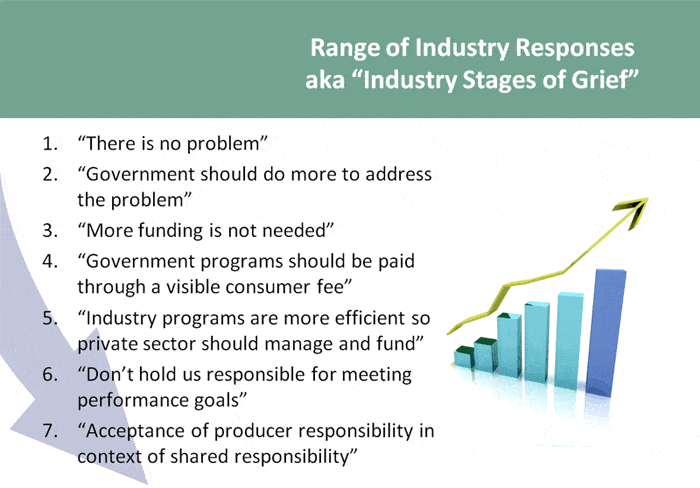
Over the past decade, PSI has knocked on the proverbial door of over 15 industry sectors and offered to work collaboratively to reduce the unintended lifecycle impacts resulting from their products. Companies, like the people who run them, have responded in a variety of ways. These responses usually fit within a trajectory of perspectives that reflects the culture of the industry sector and the individuals who lead them. Whether and how these perspectives change through discourse is also a reflection of the industry, its leadership, and external influence and circumstances. In general, PSI’s experience is that the perspective of most industry sectors proceeds along the following path during the course of a dialogue: (1) there is no problem; (2) government should do more to address the problem; (3) more funding is not needed; (4) government programs should be paid for through a visible consumer fee; (5) industry programs are more efficient so the private sector should take programmatic control; (6) don’t hold us responsible for meeting performance goals.
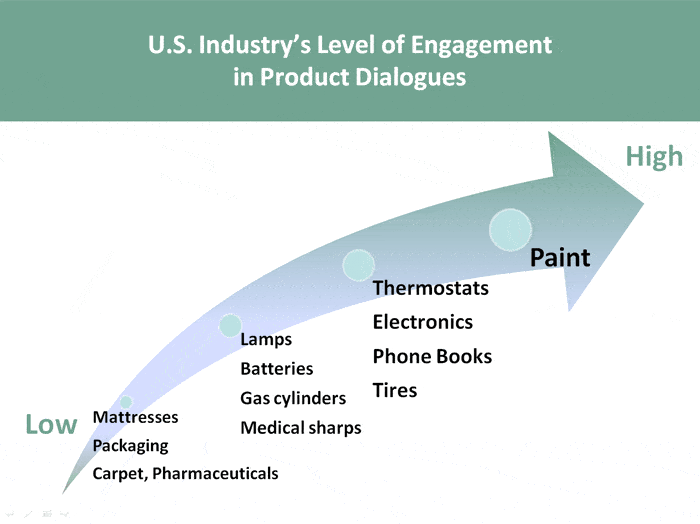
Of the industries we work with, only two manufacturers – paint and rechargeable batteries – have fully engaged government, and both were responding to the threat of legislation. Perhaps the paint industry learned from previous legislative battles on lead paint and volatile organic compounds and saw how it could benefit from the unified national process that PSI offered. Maybe the rechargeable battery industry learned that collaboration with governments was needed to implement its own voluntary producer responsibility program. Whatever the case, the rest of the industries have either refused to engage in a constructive dialogue about the problems caused by their products or they engaged for a period of time, sometimes up to six years, before digging in against further discussion.
The six phases above have been called Industry Stages of Grief by my colleagues in the British Columbia Ministry of the Environment. These phases represent the progression of perspectives that most corporate executives go through when they are confronted with problems caused by their products. No company likes to be told that their products cause pollution and add to the financial strain of governments. None wants to be asked to change its business practices, since change will always mean an investment of resources. The key is whether a company or an industry sector is willing to learn, and also believes it can convince other stakeholders of its viewpoint. I have found that all stakeholders have the potential to change their positions once they engage in dialogue. This change of perspectives happened at every one of PSI’s dialogues, no matter which industry sector we engaged. Government officials learned as much as their industry colleagues, and all positions were influenced as a result.
To be sure, there are companies that are engaging with external stakeholders and have figured out how to make social and environmental sustainability a key component of their business models. For many others, it is difficult to break from the pack.
The Industry Stages of Grief outlined above is a general guide. Manufacturers enter at different places along this trajectory, and proceed at different speeds. All stakeholder viewpoints must evolve to some degree for negotiations to be successful. It takes a commitment of resources for groups of individuals who represent divergent viewpoints to jointly embrace a common idea. There is a dynamic tension that occurs in negotiations. For the dialogue to succeed, the pace of change must meet the expectations of the stakeholders, particularly the governments that now pay a huge cost to manage waste. Progress must be fast enough to keep them from unilaterally legislating. On the other hand, if these regulators proceed too quickly, before strong coalitions can be formed to support the desired changes, they risk not only alienating the industry groups they want to engage but other key stakeholders as well.
Gilles Goddard, an industry representative from Canada, uses the following phrase to capture the delicate dance of negotiations: “You can’t pull a flower to make it grow.” Negotiations take time, perseverance, and the right individuals who want to reach an agreement. Timing is a key element. If government pushes too hard or pulls too fast, it can ruin the chance for success. But if industry moves too slowly, it can also sour the opportunity for an agreement, and result in unilateral government legislation.
Honest dialogue anyone? Is there anybody out there?
That Used to Be Us. The title of Thomas Friedman’s latest book sounds like a deep dark downer. Instead it is a wonderful framing of problems we face as a nation and the steps we must take to get back in the driver’s seat. As with many large macro-scale issues affecting our nation, we can also see them reflected at a micro-scale, in this case in the product stewardship movement. And, not surprisingly, the authors plead for producer responsibility policies in the U.S. to capture lost jobs to China, highlighting the plight of one California-based electronics recycler, Mike Biddle of MBA Polymers.
Written with Michael Mandelbaum, the book’s thesis is “…that China’s educational successes, industrial might, and technological prowess remind us of the ways” we used to be as a nation. Friedman and Mandelbaum focus on four challenges that we must address as a nation – globalization, the revolution in information technology, the nation’s chronic deficits, and our pattern of excessive energy consumption. The book also highlights one common theme that undercuts the malaise that runs across our country’s attempts at problem solving – a disdain for government and a firm belief in the myth of absolute free markets. To me, this is one of the biggest hurdles we need to overcome.
One of my first jobs out of college was with the New Jersey Department of Environmental Protection. I was hired to write permits for companies discharging effluent to groundwater and surface water. I had little educational training, and was not provided training on the job. I arrived at the industrial facilities with a checklist of To Dos, with little knowledge of what I was doing. I was matched with engineers and scientists with years of experience that dwarfed my understanding. And yet I was required to write a certain number of permits each week. When I asked policy questions of my management, I was told to keep writing permits. If I was one of the companies I regulated, I would be tempted to think that all government officials were losers. This is the attitude that grew among businesses in the 1980s and has gained steam over the past 30 years. Ronald Reagan made a career of denigrating government officials, and the Tea Party considers it hallowed ground.
But I didn’t jump on the pile of government bashing. Instead, I quit my job, went back to school, and sought to become a different kind of government official, one that fostered free market competition with sensible rules. There are many of that type of government official out there, and they are now in the majority. But no one wants to notice. Instead, we continue to hear uncompromising anti-regulatory dogma. I yearn for a more healthy balance. Just as jobs and the environment go hand-in-hand, so do regulations and the free market economy. In fact, without this balance, regulations will choke progress and the free market will result in corporate excesses requiring government bail-outs. Again.
That Used to Be Us recounts how Theodore Roosevelt’s experience “…taught him that for business to thrive it required consistent and transparent rules, as well as regulators authorized to prevent abuses and hold businesses accountable.” It mentions that “His [Roosevelt’s] concept of the vital role government had to play to regulate markets, as well as to protect public health and safety, not to mention to safeguard our nation’s wilderness, laid the basis for America’s Progressive era.”
Here are a few more tidbits to ponder from Friedman/Mandelbaum: “Markets are not just wild gardens that can be left untended. They need to be shaped by regulations that promote risk-taking but prevent recklessness on a scale that can harm everyone. The need for regulations arises from an unavoidable feature of any free-market economy, one that economists call ‘externalities.’ These are the costs of free-market activities that are not captured by prices, for which, therefore, nobody pays, and that can injure the society as a whole. To correct this market failure, government has to step in to make sure that something closer to the full costs of the activity do somehow get paid.”
These concepts are not new. In fact, they are basic economic principles. In his November 6 New York Times column, Paul Krugman wrote about the true costs of hydraulic fracking, saying “…special treatment for fracking makes a mockery of free-market principles. Pro-fracking politicians claim to be against subsidies, yet letting an industry impose costs without paying compensation is in effect a huge subsidy.”
Why is it that the government we rely on to correct market failures is so criticized for its attempts to tame the beast? And why is it that those whose products cause external costs on our society believe that voluntary solutions are the only solutions that exist, and that government should back off and let industry police itself, even when the evidence suggests over and over that this is not possible?
The balance between government regulation and the free market economy has gotten horribly out of whack in the U.S. The Product Stewardship Institute was founded on the principle of collaboration with industry. We spent countless hours explaining the concept of externalities, documenting actual costs to government and the lost jobs owing to pure waste of valuable materials. We jointly identified common goals, uncovered barriers to reaching those goals, and explored possible solutions. Data prove that product stewardship systems reduce external costs and turn wasted materials into jobs and economic value. Only a few U.S. industries are willing to accept this truth. Others fight.
The more we have succeeded in passing EPR laws, the more that companies have placed their bets on the corporate wheel of fortune. They have slowed legislation through lobbying, reducing their own corporate costs while imposing continued costs on the environment and government. There is no doubt that corporate change is hard to achieve, especially when those with the power are benefiting unfairly. If this sounds familiar, it is no wonder that Occupy Wall Street has struck a chord with Middle America. While those in tents plead to remedy a range of inequalities, those promoting product stewardship can rest assured that their micro-issue has resonated with the macro-issues facing our nation.
It is time for balance and time for change. That really can be us.
Last month, as the Product Stewardship Institute celebrated its 10th Anniversary at our national forum, a new coalition of manufacturers seeking voluntary programs announced its creation. The Product Management Alliance (PMA) launched a press release stating that it seeks to “…support voluntary market-based extended producer responsibility efforts and voluntary incentives for increased recovery and sustainable product and package design.” PMA is comprised of manufacturers of carpet, electronics, toys, paper, packaging and transportation materials, mattresses, plastics, personal goods, and pharmaceuticals. But while voluntary programs have a definite role in reducing the health and environmental impact from consumer products, they are no substitute for balanced regulation, which is often a better way to foster innovative market-based solutions.
One good place to start is with the facts. Voluntary, market-based approaches will result in high collection rates only when a product has value at the end of its useful life greater than the cost to collect and transport that product to a secondary market. For example, many retailers collect toner cartridges because they can refill and sell them at a profit. No regulations are needed because the value of the used cartridge is greater than the cost to collect, transport, refurbish, and resell the refurbished cartridge. Retailers have the incentive to heavily market the return of those cartridges. In another example, a car battery left on the curbside will magically disappear because some enterprising scrap dealer will always pick it up and bring it to market for the value of the lead. Unfortunately, though, the cost to properly manage many other consumer products – including carpet, mattresses, electronics, toys, and all the other products whose manufacturers have formed the Product Management Alliance – is much greater than the market value of the used product.
After nine years and a signed agreement, the carpet industry’s best efforts to put in place a voluntary collection and recycling system has resulted in the recycling of only 4.5 percent of all the carpet available for recycling in 2010. The rest of that carpet material – more than 95 percent, or nearly 2.9 million tons – was disposed of in landfills and incinerators. Not only was this material wasted, but it causes operational problems at these disposal facilities, resulting in extra costs. The 13-year old voluntary industry thermostat recycling program reached only a 5 percent recycling rate before governments started to regulate. And the voluntary industry recycling program run by the rechargeable battery recycling industry for the past 17 years has posted only a 10-12 percent rate.
Wasted resources result in lost jobs and economic value. This is not a band wagon to hop on and emulate.
Don’t get me wrong. PSI supports voluntary programs under certain circumstances. Voluntary programs work well as a ramp up to regulated programs. They can grease the wheels so that, when a regulated system kicks in, the players know what they are supposed to do. These programs can also allow an industry leader to spark an innovative program. PSI worked with Staples in 2004 to develop the country’s first computer take-back program, which was piloted, then scaled nationally after two years. This voluntary program is available to everyone, and it resulted in innovative programs by others in the office supply sector, such as Office Depot and Office Max, as well as Best Buy. And voluntary programs can operate in areas where no laws, or weak laws, are in place.
But relying on manufacturers to voluntarily collect their products is like trusting that people will stop at intersections with no stop lights or signs…and no threat of enforcement.
Some people will have the sense to do it, but most will not. This is why the environmental movement was born nearly 50 years ago. It was because the market cannot police itself, resulting in environmental externalities in the form of pollution that impacts all of society. Do we really have to explain this concept all over again? Have we regressed this much?
Imagine a professional ballgame with minimal rules, no common goals, and no referee, where each player performs according to his own definition of success, and where there is no penalty for not playing. Like this imaginary game, voluntary product stewardship programs create a competitive advantage for those companies that will not act unless forced to do so. And, in every case, there will be a significant number of those companies. This reticence is unfair to those corporate leaders that know what is needed, have the ability to reach high performance, but get dragged down to the least common denominator.
The buzz among the product stewardship community is that the formation of the PMA is an indication that the product stewardship movement has gained steam, attention, and credibility. There is an interest in finding ways for voluntary industry initiatives to integrate with regulated programs. But there is also a concern that PMA is promoting voluntary programs to block sensible laws that will require them to take greater responsibility, even if the results will be better for the common good. There are other concerns about voluntary programs. Since they rely on the good will of companies, they could be here today but gone tomorrow. And it is often hard to know how effective they are since program operations are often not transparent, and companies selectively report data.
For the past 30 or 40 years, there has been a creeping sense among some in politics that all government officials are inept bureaucrats tying companies in knots, preventing job growth, and wasting investment dollars for little benefit. To be sure, those officials exist. But most officials I know are interested in using their authority to create a level playing field for fair competition that will result in more recycling jobs from materials that previously polluted the environment. They want to set broad performance targets and allow companies the flexibility they need to innovate and reach the targets at minimum cost. That is the type of balanced regulation and progress we need.
Government product stewardship regulations will result in fair and effective systems. Voluntary actions will not.
It is widely known that the route to producer responsibility in the U.S. has been markedly different from the route taken in Europe and, to a degree, Canada. In the U.S., issues were prioritized based largely on toxicity. When the Product Stewardship Institute (PSI) held its first national product stewardship forum in 2000, we asked state and local solid waste management officials across the country what they considered their biggest waste management problems. By far, the number one issue was electronics, followed by mercury products and paint. For this reason, in the U.S., we focused on these products as the top issues.
Europe, however, started with Germany’s packaging law in 1990. Over the past 20 years, more than 30 European countries have adopted extended producer responsibility (EPR) programs for packaging. Four Canadian provinces have now enacted packaging EPR laws. And the U.S. is still building the groundwork for action.
Here is how the landscape is shaping up for EPR for packaging in the U.S. Proponents of EPR include, not surprisingly, state and local government agencies that started the U.S. product stewardship movement. However, all governments are interested, not just those in progressive states. The cost of managing waste has become a big issue for government, and they are ready to act. Governments are interested in saving money, but are also concerned about the loss of control over the collection of recyclables from households. PSI has been convening its state and local government members to figure out the type of EPR system they want as a model in the U.S. Other EPR supporters are, also not surprisingly, environmental groups. And that is where the current support for EPR for packaging and printed materials stands at the moment.
There are some exceptions among industry. Nestle Waters North America (NWNA) has stepped out as a major proponent of EPR, and PSI is working with them, among many others. NWNA wants to show that EPR can result in increased supply of recycled materials on par with the rates achieved by beverage deposit laws. This position is not to be confused with the position of others in the beverage industry that developed the EPR packaging bill in Vermont in 2010 that included EPR only if the state’s 40-year old container deposit law was repealed. That strategic misstep has confused many people into believing that EPR is synonymous with a repeal of the bottle bill, and has created great animosity among stakeholders. But it has gotten people talking.
“If success is measured by the achieved recycling levels, then member states with strong producer responsibility systems have successfully increased overall rates.” 2005 European Commission Study on Packaging Waste and Options to Strengthen Prevention and Re-use of Packaging
Consumer packaged goods (CPG) companies have, for the most part, been uninterested in engaging in a discussion about EPR for packaging in the U.S., even though their counterparts are operating under the exact same systems in Europe and Canada. Sierra Fletcher, our Director of Policy and Programs and I spent four meetings over nine months with representatives from P&G, Kraft, Unilever, Colgate-Palmolive, ConAgra, and other CPG companies in meetings held by the U.S. Environmental Protection Agency. These companies, in general, believe that we can increase recycling significantly solely by optimizing the current system. In my ten years of engaging brand owners in EPR, we know that this is a necessary step in the process because the existing system can always be made more efficient, and that reduces cost. But it is always only a stage in the process of moving toward an understanding that EPR, and perhaps other systems, are also needed. Only two CPG companies – Estee Lauder and SC Johnson – have engaged PSI in a real discussion on EPR. Estee Lauder is a big fan. SC Johnson does not believe it is the right solution.
The rest of the stakeholder groups are in learning mode, and this is who PSI is talking to.
End users of glass, plastic, paper, aluminum, and other metals – so called commodities – have started to warm to the idea of learning about EPR. The Association of Post-Consumer Plastics Recyclers invited me to speak at its annual meeting in June. I found an engaged and interested group of plastics recyclers that were desperate for ways to increase the recycling of plastics. They want more supply of high quality recycled plastics at the best possible price. They are looking at all solutions, and their staff and policy committee smartly have begun to learn about EPR and how it can help them. Have they embraced EPR whole-hog? No. But do they think EPR might be part of the solution for more business and more jobs. Absolutely.
Plastics recyclers are leading the commodity groups in understanding that quantity, quality, and price can possibly be achieved by EPR. But aluminum is not far behind. I just got back from a trip to Chicago where the Aluminum Association had its annual meeting. I spoke to aluminum industry executives about what EPR is and isn’t, and how EPR and the bottle bill can live together or apart but that the decision should be up to the brand owner as to how they will meet aggressive performance goals. Aluminum industry representatives asked all the right questions, and we have begun a healthy discussion.
Representatives of glass and paper commodities are still warming to the idea of even having an in-depth discussion about EPR. But PSI is talking to them as well. A key concern of the paper industry is why they should face the potential transactional costs of a shift to EPR when their material is already recycled at a high rate.
We are also having discussions with waste management companies, which view EPR as a potential threat to their business models. These companies have invested in recycling and waste disposal trucks and facilities, and in a business strategy that will need to be flexible to respond to the changes ahead with EPR.
Other groups are pushing the conversation as well. The newly formed PAC-NEXT, based in Canada but working with retailers, CPG companies, and related businesses that operate across North America, has invited PSI to engage with its corporate members with the goal of helping the packaging industry transition toward a world without packaging waste. PSI is co-chairing a PAC-NEXT project to develop best practices for post-consumer material recovery, including EPR, which will lead toward harmonization of programs in North America. And Future 500 out of San Francisco is selectively engaging stakeholders on EPR in the U.S.
Packaging and printed materials is a product area that is much different from others we have tackled in the U.S. – yet at the same time it shares with other products the fact that our traditional waste management system has relied on the patchwork of local and state governments to clean up after us. A solution will not be achieved overnight, but we are starting to build it. There are many stakeholders with multiple interests that need to be melded into a cohesive agreement that is sustainable. These stakeholders are not at the same place in their interest and willingness to develop a model EPR bill in the U.S. But these discussions are taking place, and coalitions are forming.
But the first thing that needs to happen is that people learn the facts, and that is where PSI is spending its time – educating all stakeholders about EPR so that they understand how EPR will result in less waste, more recycling, more jobs for the recycling industry, and lower costs for government. This is all about how good government and the right regulations CREATE jobs. It is time for this reality to be heard loud and clear in America.
Check out the article in Plastics News reporting on my presentation to the plastics recycling industry. Although there are a few factual errors in the article, it will give you a good sense of what I said, and about how EPR can increase material supply and quality, and lower costs.