
For the 11th year in a row, Massachusetts has failed to pass electronics EPR legislation. It is now 12 years since the Commonwealth became the first state in the country to ban the disposal of lead-bearing cathode ray tubes, sparking the electronics recycling industry in the U.S…and placing the financial burden to manage electronics on Massachusetts cities and towns. It was the classic ban without a plan. Unlike the stellar U.S. women gymnasts who earned Gold in London yesterday, our country fails miserably at passing legislation that will keep gold and other valuable materials out of our country’s landfills and incinerators.
What a waste. What a shame. To watch our great and mighty companies offshore jobs, complain about it being the only choice they have, but do little to create thousands of green jobs that are there for the asking if they would engage with PSI and other stakeholders to develop extended producer responsibility (EPR) laws and other strategies that meet their own interests.
The powerful corporate self interest that has blocked movement on product stewardship and EPR in the U.S. is the same one that unknowingly is weakening itself, just as the U.S. auto industry’s fight against fuel efficiency standards weakened itself, causing the need for a government bail-out.
I just finished yet another book that chronicles ways that U.S. companies and policy makers are failing to take actions that will strengthen our economy, instead resulting in the slow decline of U.S. economic power. Edward Luce’s Time to Start Thinking shows what the product stewardship movement experiences on a smaller scale – a failure to launch. Look no further than the microcosm of the product stewardship field, where many unenlightened companies fight against policies that will save billions of dollars for U.S. taxpayers, reduce waste, and generate thousands of recycling jobs.
These companies operate under the guise of groups like the Product Management Alliance, which evaluates EPR laws by showing that the laws that they weaken actually don’t perform well. How enlightening! The powerful corporate self interest that has blocked movement on product stewardship and EPR in the U.S. is the same one that unknowingly is weakening itself, just as the U.S. auto industry’s fight against fuel efficiency standards weakened itself, causing the need for a government bail-out.
As I wake up this morning to yet another failed attempt to pass an e-waste bill in the all-Democratic Massachusetts Legislature (and with its Democratic Governor), I wonder what this failure is all about…was Dell so bent on passing a bill that ensured that any goals included would already be met before the law went into effect? Or was the House leadership frozen in political gridlock on matters far removed from the bill itself? It is clear that there was no consensus on the bill, but how can stakeholders be so far apart for so long that we cannot figure out a way to act in all of our own self interest?
Close your eyes…and envision a time when we in the U.S. really went for the gold…like those women Olympic gymnastic heroes of today. Rather than burying our gold in the ground and mining raw materials in an endless cycle of waste, we owe it to ourselves to find a way to break out of this malaise together.
Every two weeks, PSI members and partners receive updates on product stewardship news from around the world. A recent NY Times article on battery recycling caught my attention because it illustrated how product sustainability requires a full lifecycle perspective — not only a focus on end of life. The December 8 front-page story described how processing methods used at a Mexican plant for recycling vehicle and industrial batteries from the U.S. are poisoning workers and citizens. The batteries are recovered — mostly voluntarily — at a very high rate in the U.S., without the need for an extended producer responsibility system, because there is great demand for the lead in the batteries. However, those collecting the batteries are skirting U.S. laws by shipping the batteries to poorly run facilities in Mexico. The money saved by companies is at the expense of the health of workers, citizens, and the environment. It is also at the expense of U.S. companies that are abiding by more protective standards in the U.S. There is truly no such thing as a free lunch. We need to level the global playing field so that U.S. companies do not lose business to companies operating abroad under insufficient standards. We should require U.S. companies to certify that they are using material processors that truly protect the environment all throughout the product lifecycle. This is real product sustainability. It is time for U.S. citizens to demand global environmental and social standards of protection for the products they consume.
It is widely known that the route to producer responsibility in the U.S. has been markedly different from the route taken in Europe and, to a degree, Canada. In the U.S., issues were prioritized based largely on toxicity. When the Product Stewardship Institute (PSI) held its first national product stewardship forum in 2000, we asked state and local solid waste management officials across the country what they considered their biggest waste management problems. By far, the number one issue was electronics, followed by mercury products and paint. For this reason, in the U.S., we focused on these products as the top issues.
Europe, however, started with Germany’s packaging law in 1990. Over the past 20 years, more than 30 European countries have adopted extended producer responsibility (EPR) programs for packaging. Four Canadian provinces have now enacted packaging EPR laws. And the U.S. is still building the groundwork for action.
Here is how the landscape is shaping up for EPR for packaging in the U.S. Proponents of EPR include, not surprisingly, state and local government agencies that started the U.S. product stewardship movement. However, all governments are interested, not just those in progressive states. The cost of managing waste has become a big issue for government, and they are ready to act. Governments are interested in saving money, but are also concerned about the loss of control over the collection of recyclables from households. PSI has been convening its state and local government members to figure out the type of EPR system they want as a model in the U.S. Other EPR supporters are, also not surprisingly, environmental groups. And that is where the current support for EPR for packaging and printed materials stands at the moment.
There are some exceptions among industry. Nestle Waters North America (NWNA) has stepped out as a major proponent of EPR, and PSI is working with them, among many others. NWNA wants to show that EPR can result in increased supply of recycled materials on par with the rates achieved by beverage deposit laws. This position is not to be confused with the position of others in the beverage industry that developed the EPR packaging bill in Vermont in 2010 that included EPR only if the state’s 40-year old container deposit law was repealed. That strategic misstep has confused many people into believing that EPR is synonymous with a repeal of the bottle bill, and has created great animosity among stakeholders. But it has gotten people talking.
“If success is measured by the achieved recycling levels, then member states with strong producer responsibility systems have successfully increased overall rates.” 2005 European Commission Study on Packaging Waste and Options to Strengthen Prevention and Re-use of Packaging
Consumer packaged goods (CPG) companies have, for the most part, been uninterested in engaging in a discussion about EPR for packaging in the U.S., even though their counterparts are operating under the exact same systems in Europe and Canada. Sierra Fletcher, our Director of Policy and Programs and I spent four meetings over nine months with representatives from P&G, Kraft, Unilever, Colgate-Palmolive, ConAgra, and other CPG companies in meetings held by the U.S. Environmental Protection Agency. These companies, in general, believe that we can increase recycling significantly solely by optimizing the current system. In my ten years of engaging brand owners in EPR, we know that this is a necessary step in the process because the existing system can always be made more efficient, and that reduces cost. But it is always only a stage in the process of moving toward an understanding that EPR, and perhaps other systems, are also needed. Only two CPG companies – Estee Lauder and SC Johnson – have engaged PSI in a real discussion on EPR. Estee Lauder is a big fan. SC Johnson does not believe it is the right solution.
The rest of the stakeholder groups are in learning mode, and this is who PSI is talking to.
End users of glass, plastic, paper, aluminum, and other metals – so called commodities – have started to warm to the idea of learning about EPR. The Association of Post-Consumer Plastics Recyclers invited me to speak at its annual meeting in June. I found an engaged and interested group of plastics recyclers that were desperate for ways to increase the recycling of plastics. They want more supply of high quality recycled plastics at the best possible price. They are looking at all solutions, and their staff and policy committee smartly have begun to learn about EPR and how it can help them. Have they embraced EPR whole-hog? No. But do they think EPR might be part of the solution for more business and more jobs. Absolutely.
Plastics recyclers are leading the commodity groups in understanding that quantity, quality, and price can possibly be achieved by EPR. But aluminum is not far behind. I just got back from a trip to Chicago where the Aluminum Association had its annual meeting. I spoke to aluminum industry executives about what EPR is and isn’t, and how EPR and the bottle bill can live together or apart but that the decision should be up to the brand owner as to how they will meet aggressive performance goals. Aluminum industry representatives asked all the right questions, and we have begun a healthy discussion.
Representatives of glass and paper commodities are still warming to the idea of even having an in-depth discussion about EPR. But PSI is talking to them as well. A key concern of the paper industry is why they should face the potential transactional costs of a shift to EPR when their material is already recycled at a high rate.
We are also having discussions with waste management companies, which view EPR as a potential threat to their business models. These companies have invested in recycling and waste disposal trucks and facilities, and in a business strategy that will need to be flexible to respond to the changes ahead with EPR.
Other groups are pushing the conversation as well. The newly formed PAC-NEXT, based in Canada but working with retailers, CPG companies, and related businesses that operate across North America, has invited PSI to engage with its corporate members with the goal of helping the packaging industry transition toward a world without packaging waste. PSI is co-chairing a PAC-NEXT project to develop best practices for post-consumer material recovery, including EPR, which will lead toward harmonization of programs in North America. And Future 500 out of San Francisco is selectively engaging stakeholders on EPR in the U.S.
Packaging and printed materials is a product area that is much different from others we have tackled in the U.S. – yet at the same time it shares with other products the fact that our traditional waste management system has relied on the patchwork of local and state governments to clean up after us. A solution will not be achieved overnight, but we are starting to build it. There are many stakeholders with multiple interests that need to be melded into a cohesive agreement that is sustainable. These stakeholders are not at the same place in their interest and willingness to develop a model EPR bill in the U.S. But these discussions are taking place, and coalitions are forming.
But the first thing that needs to happen is that people learn the facts, and that is where PSI is spending its time – educating all stakeholders about EPR so that they understand how EPR will result in less waste, more recycling, more jobs for the recycling industry, and lower costs for government. This is all about how good government and the right regulations CREATE jobs. It is time for this reality to be heard loud and clear in America.
Check out the article in Plastics News reporting on my presentation to the plastics recycling industry. Although there are a few factual errors in the article, it will give you a good sense of what I said, and about how EPR can increase material supply and quality, and lower costs.
While a light bulb may seem like a trivial item, it has incited momentous debate. To energy efficiency advocates, the light bulb symbolizes the opportunity to upgrade an Edison-era technology, save money, and reduce greenhouse gases and other environmental impacts. In the Tea Party’s eyes, the light bulb is a prime example of an overly pervasive government dictating what items we can install in our private homes. To me, many actors – Republicans and Democrats, environmental groups and anti-government cheerleaders – have turned the lights out on the public, muddling and oversimplifying a complex issue.
In 2007, President George W. Bush, signed into law the Energy Independence and Security Act, which requires light bulb manufacturers to improve household bulb efficiency by 30 percent and phase-out 100- and 40-watt bulbs between 2012 to 2014. The law exempts “specialty bulbs” like those for chandeliers, and does not mandate using any particular type of energy-efficient bulb.
Not only was the federal bill signed into law by a staunch Republican, but it also had overwhelming bipartisan support. The House passed the bill 314-100 following its 86-8 passage in the Senate. Lighting manufacturers and retailers also heavily favored passage of the bill. “We support the notion that efficiency is a desirable thing, and this type of standard has been a part of our body politic for a long time,” said Randall Moorhead, vice president of government affairs at Philips, earlier this year.
The Energy Independence and Security Act was also touted as a way to lower our foreign oil dependency. Although many of us have warmed to the glow of incandescent bulbs, the U.S. EPA notes that 90 percent of an incandescent bulb’s required energy is wasted as heat, meaning increased use of scarce and highly polluting natural resources such as oil and coal. The Natural Resources Defense Council also predicted annual savings of $13 billion in energy costs and a yearly reduction of 100 million tons of carbon dioxide emissions.
Before the bill was introduced, technology gurus were at work developing energy-efficient alternatives. According to the U.S. Environmental Protection Agency, one such alternative – compact fluorescent lamps (CFLs) – use 75 percent less energy and last 10 times longer than traditional incandescents. The U.S. Department of Energy asserts that, over its lifetime, a 25-watt CFL actually costs a consumer $105 less than a 100-watt incandescent, factoring in the cost of the bulb and energy usage.
Manufacturers began rolling out CFLs in bundles, large retailers marketed energy-efficient bulbs to the masses with huge discounts, and consumers switched to CFLs and light emitting diodes (LEDs). Unfortunately, supporters of this well-intended light bulb law did not finish their homework. Many consumers are dissatisfied with the performance of the alternative bulbs. And worse, no one mentioned that CFLs contain small amounts of mercury and, therefore, need to be recycled once they burn out. In addition, no one explained that CFLs can break, although not nearly as easily as their well-known cousins, the linear fluorescent lamp known worldwide by anyone who works in an office or does home improvement projects. The fact that breakup cleanup is easy and not particularly hazardous (but needs to be done right) further botched communication with the public.
Does the Tea Party have something to howl about? Yes it does. But they are howling at the wrong moon, missing a golden opportunity to help the public by meaningfully addressing the real issues. To this day, lighting manufacturers are fighting legislation that would require them to create recycling programs for their product. They want taxpayers, not consumers, to cover the cost.
What does this all mean? The adoption of the Energy Independence and Security Act has certainly created chaos. Proper planning for the law’s implementation was bungled by government, manufacturers, retailers, and environmental groups. Was it well intended? Absolutely. Should we roll back the clock? No. The potential for energy savings, pollution reduction, and cost savings for consumers in the long-run are too great to sacrifice for Tea Party enthusiasts who want to shrink government into nonexistence.
What do we do now? One solution is to make sure that manufacturers of these mercury products take responsibility for recycling burned out bulbs. Also, retailers promoting the sale of the bulbs must be part of the solution, collecting bulbs voluntarily and/or alerting consumers that the bulbs must be recycled and directing consumers to convenient drop-off locations. We must also learn from this mistake on a larger scale. Manufacturers of products should account for the product’s full lifecycle impact and factor the ultimate fate of a product’s materials into a plan for recycling or proper disposal.
Government officials, environmental groups, and PSI have all succeeded in Maine, Washington, and Vermont in mandating that fluorescent lamp manufacturers pay for recycling spent mercury lamps. We hoped that this industry would recognize the need for leadership without our persuasion. But all involved parties must now roll up their sleeves and find joint solutions to past mistakes. One thing we don’t need, however, is the drone of anti-government accusations taking the spotlight off more significant issues.
On March 1, the Sustainable Apparel Coalition launched a new voluntary initiative by leading companies such as Wal-Mart, J.C. Penney, Patagonia, and Timberland. According to the New York Times, the coalition seeks to develop “…a comprehensive database of the environmental impacts of every manufacturer, component, and process in apparel production, with the aim of using that information to eventually give every garment a sustainability score.”
This initiative marks a turning point for the apparel industry, and offers promise that consumers will be able to make more informed purchasing decisions. This effort is laudable on its own merits. However, in addition, these companies are opening the window to what they don’t know. And in so doing, it is bound to raise some interesting questions, ones that will likely lead to the need for global environmental and social standards for product manufacture. For years, U.S. companies have had to compete with cheaper labor in China, India, and other countries. But are they competing on labor costs and other criteria at the detriment of environmental and social impacts?
In fact, what do we know about the environmental and social impacts caused by manufacturing operations in developing countries? The answer is not much. We do know that many used electronics are shipped from well-meaning companies, government agencies, and non-profits in the U.S. to developing nations to be recycled. It all sounded so good…until the Basel Action Network informed us that many of these operations polluted rivers and sickened unprotected workers. It is likely that the Sustainable Apparel Coalition will find similar operations in which their members are unsuspecting enablers of poor environmental and social practices. As the New York Times reports, Americans spent nearly $340 billion last year on clothing and shoes, nearly all of which was made in other countries.
The New York Times article begins with an image of blue dye and other chemicals floating downriver from textile mills in China. An inside photo shows a fabric dyeing factory in Mumbai, India, that appears to provide little to no protection of the environment and workers. Our values, as Americans, are embedded in our laws. We would not want those same practices to take place on American soil. Those who uphold our country’s values for our own people should ensure that their actions are not enabling practices that cause harm to others in far-away places. We should not be exporting jobs to other countries if we are not also requiring that products we buy from companies operating in these countries be made using the same environmental and worker safety standards that we require of companies operating here in the U.S.
Companies participating in sustainable business practices know that you either pay now or pay more later…in the form of health care for sick or injured workers, cleanup of pollution, and replacement of poorly made products. The Sustainable Apparel Coalition is off to a good start.
Last week, in the President’s State of the Union address, he challenged the nation to tap into our entrepreneurial spirit so we can better compete against China, India, and other countries that have invested heavily in their own country’s future. He spoke of a role of government that is nuanced – one that can work with the market, where government can guide development through policies that make us more competitive.
Product stewardship seeks limited governance that sets broad parameters for market competition. It seeks a greater role for the private sector, shifting the management and financial burdens from often inefficient government practices to those driven by market forces. Managing products that we call “waste” is nothing but inefficiencies in the market. It is a market failure. And that failure has resulted in billions of dollars of taxpayer costs to subsidize businesses whose products are manufactured and sold without consideration for their social and environmental costs.
How is it possible that telephone directories are still produced and distributed across the United States at the current rate? No one knows for sure how many people still use them, although most people I talk to don’t, except perhaps my over-80 parents and a few die-hards. Over 660,000 tons of directories get plunked onto our doorsteps, pathways, driveways, and vestibules each year. Less than a quarter are recycled. All must be collected and recycled or disposed of by government and paid for by government, with complaints being dealt with by government. That is the same Government that Tea Party leaders want to get out of business and get out of the business of business. It is time to heed their call.
Phone books keep getting delivered at their current rate of excess because the external costs of managing the directories after they are kerplunked is paid for by taxpayers, all $64 million of it. Whether we use one or not, we are all subsidizing telephone companies like AT&T and Verizon, and independent directory publishers like Dex and Yellow Book. Not only are we paying financially for their inefficient ways, but these companies are not covering the true cost of their impacts on our environment. They do not pay for the greenhouse gas impacts that the production of directories causes, or the stress on our water or air as the result of factories producing books no one wants, or emissions from trucks that transport them, deliver them, and pick them up, or pollution from the facilities that recycle them or dispose of them.
I picked on phone books here because they are visible and a clear waste if no one wants them. But this argument can be made on all products produced worldwide. Some companies have taken steps to reduce the lifecycle impacts of their products, and these leaders should be applauded. Others have taken a lead on turning materials from used products into usable commodities.
The United States can be a global leader in competitiveness. We are still the world’s market powerhouse. Product stewardship can maintain this strength through the efficient use of our nation’s resources, whether they are mined from the earth or mined from our households and businesses after use. Product stewardship policies seek good governance, not NO governance. Government should not “get out of the way” and let business run rampant. Haven’t we seen that movie before with the crises from banking, housing, and credit card deregulation? The government’s role in good product stewardship programs is limited to setting parameters for industry, guiding it, enforcing against those who cheat and want a free ride, and encouraging companies that are the true leaders of innovation to succeed.
I wanted to share the endorsed comments I provided for the Product Stewardship Institute at the DEA’s public hearing yesterday. Thank you to the 119 endorsers for helping me to deliver the message that these considerations for the DEA’s rulemaking process are widely supported by groups concerned about the future and improvement of drug take-back programs around the country. The DEA, EPA, FDA, ONDCP, CMS, and USPS were all present. Congressman Jay Inslee from Washington opened the second day.
In two days of comments by both federal agencies and members of the public (including local government, state government, waste companies, reverse distributors, data companies, environmental organizations, law enforcement, pharmacies and pharmacists, drug abuse prevention groups, poison control, academic institutions, the pharmaceutical industry, and on incredibly moving grieving father), a number of themes were repeated by multiple presenters:
- Communities need a range of options for secure disposal of controlled substances and other pharmaceutical drugs. Those mentioned included collection at pharmacy and other community locations, mail-back from the home, and HHW.
- Take-back programs (including all methods described above) should be able to include both controlled and non-controlled substances without sorting them.
- Take-back programs must be convenient and accessible to the public.
- Security to prevent diversion is critical, including tracking of containers, tamper evident seals, locked containers, and other such measures.
- Regulations should not require that individual pills/vials/etc. be counted and logged.
In addition, the question of who should pay for take-back programs was brought up many times in spite of the fact that this important question lies outside of the DEA’s responsibility under this rulemaking. There were many references to needing “public-private partnerships,” support/sponsorship from companies, and/or calling on the pharmaceutical industry to fund take-back programs. The importance of reducing drug waste was also mentioned. We look forward to seeing and commenting on the DEA’s proposed rule-making in the near future.
by Scott Cassel, CEO and Founder of PSI
Protecting vulnerable populations from environmental, health, and safety risks is a critical goal shared by many in the electronics recycling industry. It is a cornerstone of the R2 Practices, one of the new certification standards for the electronics recycling industry.
Some have asked why, then, doesn’t R2 establish outright bans on exports of electronic scrap to developing countries and on the use of prison labor?
The answer has to do with economic opportunity. The stakeholders that developed R2 designed a set of requirements that call for equal environmental, health and safety protections no matter the location or situation. Importantly, the R2 requirements do so in a manner that does not curb the business opportunities of law-abiding, state-of-the-art companies and their workers in developing countries. And, with respect to prison labor, they do so in a manner that does not diminish the vocational training opportunities of people that are incarcerated.
The R2 Practices
During the multi-stakeholder development of The Responsible Recycling “R2” Practices for use in Accredited Certification Programs for Electronics Recyclers, aka the “R2 Practices”, stakeholders addressed critically important issues relating to the environmental, health, safety (EHS), and security performance of electronics recyclers and their downstream vendors. The comprehensive standard contains provisions for best practices in a number of operational areas including: an EHS management system, downstream due diligence, adherence to legal requirements including those covering exports, and reuse and refurbishing activities.
The resulting document—the R2 Practices—serves as the basis for the R2 Certification Program. Electronics recyclers can contract with one of a handful of registrars (certification bodies or CBs) to become certified to R2. This rigorous, two-phase audit process requires the recycler to exhibit conformity to each of the R2 Practices’ many performance and management system requirements.
R2 and Exports of End-of-Life Electronics Equipment to Developing Countries
Developing countries can be home to both atrocious, and “state-of-the-art”, electronics recycling and refurbishing operations. In these countries, as well as internationally, there is a desire to shift electronics recycling and refurbishing away from the former and into the latter types of operations. This accomplishes environmental, health and safety goals while also promoting good jobs in some of the areas of the world most in need of economic opportunity.
To ensure exported electronic scrap ends up at state-of-the-art facilities, three key criteria need to be met. First, shipments of exported electronic scrap must be sent and received in accordance with the laws of the exporting and importing countries. Illegal shipments all too often end up causing serious harm to health and the environment in the worst of recycling and refurbishing operations.
Second, all receiving facilities must be evaluated on a regular basis to ensure that they are employing best technologies and practices. In Asia and other parts of the world, there are a number of state-of-the-art electronics recycling and refurbishing facilities that rival those in the U.S. in terms of technology and materials management.
Third, all equipment must be accurately characterized on the shipping manifest. Too often, e-scrap exports are characterized as “reusable” to avoid the added scrutiny and legal requirements that apply to “waste”. This creates a loophole which can allow scrap to be inappropriately sent to a facility that is not capable of safely handling it.
R2 effectively addresses each of these criteria. It prohibits the shipment of end-of-life electronic equipment containing toxic materials to developing countries unless the shipment is legal under the laws of both the exporting and importing countries. It requires that the receiving facility conforms to key R2 requirements and employs technologies appropriate for the materials it processes. Furthermore, “reusable” electronics equipment containing toxic materials is subject to these same requirements unless it has been tested and its key functions are working properly. Finally, all shipments must be accurately labeled.
Through these requirements, the stakeholders that developed R2 achieve the goal of protecting vulnerable populations while supporting legal, safe, environmentally-sustainable, economic development in developing countries.
R2 and Prison Labor
UNICOR (also known as Federal Prison Industries) maintains operations in a number of manufacturing industries, including: textiles, office furniture, industrial products, commercial fleet asset services (commercial vehicle remanufacturing), electronics manufacturing and electronics recycling. The company was established by Congress “to create a voluntary real-world work program to train federal inmates” – thereby helping them obtain employment upon release from prison. To this end, the UNICOR electronics recycling program has been successful, as electronics recycling firms have experience hiring formerly incarcerated people from the UNICOR program.
A few years ago, some prisoners at UNICOR worked in unsafe settings in electronics recycling facilities. Unfortunately, employees of less sophisticated recycling operations in the private sector have, and may continue to be, exposed to similar dangers. More recently, in December, 2009, The National Institute of Occupational Safety and Health issued a report that found no health problems linked to electronics recycling operations at the four UNICOR facilities it investigated.
Regarding the issue of prison labor, the stakeholder group that drafted the R2 Practices decided not to develop different requirements for different categories of workers. Rather, the R2 Practices set forth extensive requirements covering on-site environmental, health, and safety; and they apply to all workers in a facility, be they employees, consultants, volunteers, or prisoners. As a result, R2 does not prevent prisoners from safely learning new skills that will help them find employment upon their return to society.
The future of R2
R2 offers a practical and equitable approach to addressing the areas of exports and prison labor. And as the industry continues to evolve, so too will the R2 Practices. Similar to the spirit of the standards development process, R2 Solutions is inviting stakeholders from all industry sectors, including NGOs, to shape the future of the standard so it can continue to effectively address the needs and concerns of the industry.
by Scott Cassel, CEO and Founder of PSI
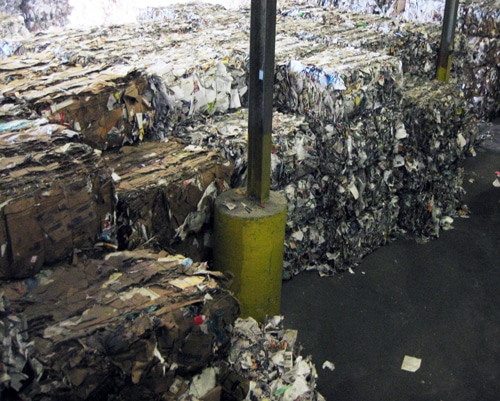
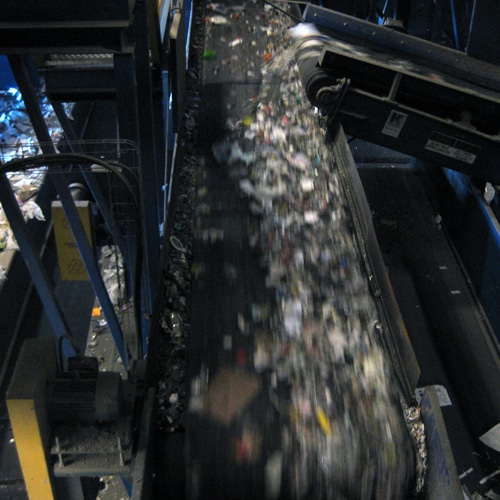
Last week a team from the Product Stewardship Institute took a tour of a materials recovery facility (MRF; pronounced “murph”) operated by Casella Waste Systems in Charlestown, Massachusetts, which recycles material from municipalities in the Boston area. We would like to thank Lisa McMenemy, the Municipal Development Representative at Casella, for being such an informative tour guide and leading us through all the steps of the recycling process. The Charlestown MRF was converted to a single-stream (also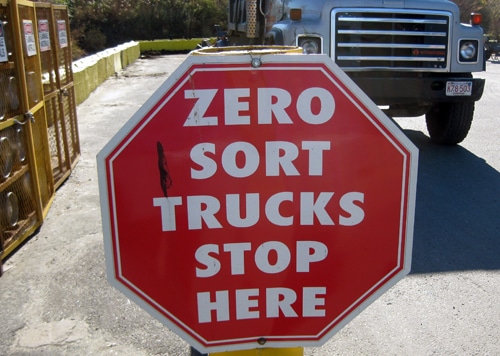
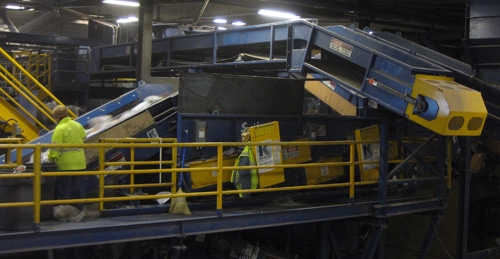
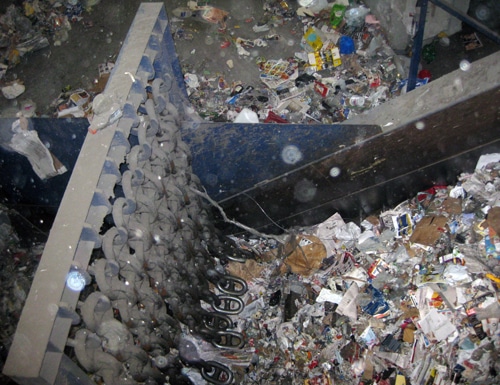
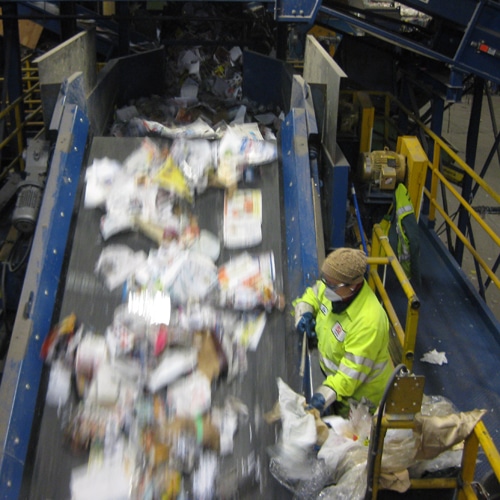
With all the materials spread out along the conveyer belt, the pre-sorting begins. The pre-sort is a labor-intensive step where materials that are not recyclable, or that may damage the equipment, are removed by hand. Plastic bags are by far the biggest contaminant in the recycling process, and are not able to be recycled once they get to the MRF. It is important to remember that even if you have good intentions and wish to recycle your grocery bags, the bags can slip through the pre-sort and end up in bales of other material. If a bale reaches a certain level of contamination, it can be rejected by a mill and must then be reprocessed, which requires additional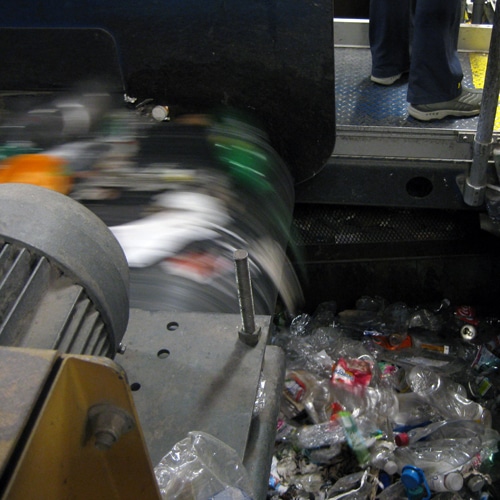
With the pre-sort complete, a series of screens then separates out light paper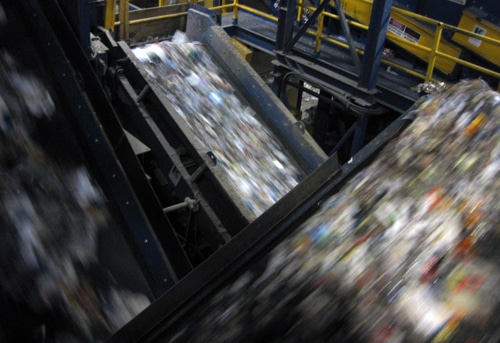


by Sarah Westervelt, the e-Waste Project Coordinator at the Basel Action Network (BAN) and the Recycling Coordinator for the Electronics TakeBack Coalition
For years, there has been little more than pilot programs, pledges and a great deal of concern about what electronics recyclers are actually doing with the e-waste they collect. While federal regulations exempt much of this waste stream, the relatively new electronics recycling industry has been plagued by unscrupulous companies that profit largely by exporting scrap or untested/non-working equipment to countries that cannot legally trade in hazardous waste with the US, as defined in a United Nations treaty called the Basel Convention.

© Basel Action Network 2008.
As of this year there are not one, but two accredited certification programs for electronics recyclers in the US, both of which are recognized by the US EPA – the e-Stewards Certification program and the Responsible Recycling (R2) Certification program. The question is, what are the differences, and which one of them will best serve your needs? Having two programs requires some homework on the part of customers or officials.
To get to the bottom of this question, it is important to compare the standards themselves, as well as the rigor of the verification system (i.e. the certification bodies which certify that recyclers conform to a particular standard, and the accreditation bodies that oversee their work.)
Let’s start with comparing the verification systems. Both R2 and e-Stewards certification programs utilize the ANSI-ASQ National Accreditation Board as their accreditation body. ANAB is one of the top three accreditation bodies in the world, and is the largest, most respected in the United States.
Next, let’s look at the certification bodies (CBs) that are accredited by ANAB to certify to either R2 or the e-Stewards Standard. Each of the programs has three certification bodies that are accredited to certify to their respective standards. An important question is how rigorous and consistent the auditor training is for each program, with the goal of having a high level of confidence that the auditors across all the CBs consistently understand the standard they are auditing to and program requirements. Without an owner for the standard or host organization until this fall, the R2 program has not had a sole auditor training program since its inception, resulting in a variety of auditor trainings for the different CBs. The e-Stewards program requires that all auditors must successfully complete a 3-day training provided by SAI Global, one of the top professional training organizations.
Finally, and central to every certification program, are the standards that define requirements for the companies attaining certification. The R2 Practice document, which was finalized without support from the environmental community, is 13 pages long, with no guidance document, but it comes with an audit checklist. The e-Stewards Standard, created by the Basel Action Network in conjunction with leaders in the recycling and refurbishment industries, and supported by 70 organizations, is 49 pages long. It has a 67 page companion guidance document, but no auditor check list. Based on the shear length of the two standards, it is easy to understand that one spells out much more comprehensive requirements for the recyclers.
There are two basic types of requirements in each of the standards. One set of requirements is for the environmental management system (EMS), which involves a Plan-Do-Check-Act system for identifying, documenting, and reducing the environmental impacts of the business operations. The R2 Practices has one page of general requirements that an R2 recycler’s EMS must meet . The e-Stewards Standard has the 8-page global standard for environmental management systems, called ISO 14001, imbedded in it, so that all certified e-Stewards are also certified to ISO 14001.
Within this framework of an EMS, both standards require some minimum performance requirements, which are the second basic type of requirements in these two standards. Performance requirements are industry-specific restrictions of or prescriptions for certain activities. Along with the EMS requirements, this is where the two standards differ dramatically.
The chart below summaries some of these differences:
| Does the Standard… | R2 Practices | e-Stewards Standard for the Responsible Recycling and Reuse of Electronics |
| …Allow toxic materials in solid waste landfills & incinerators? | Yes. If circumstances beyond the control of the R2 recycler disrupt its normal management of the toxic materials, it may utilize solid waste disposal facilities, to the extent allowed under applicable law. | No, as it was deemed inappropriate for heavy metals and other hazardous materials to be disposed of in solid waste disposal facilities. |
| …Ban the export of toxic materials to developing countries? | No. R2, in principle, calls for only allowing the export of equipment and components containing ‘focus materials’ to countries that legally accept them, but does not ban them from rich to poorer countries. | Yes. Based on the international definitions found in the Basel Convention, toxic materials bound for recycling or disposal are not allowed to go from developed to developing countries, consistent with the Amendment to the Basel Convention, already ratified by 65 countries, including the European Union. |
| …Require accountability for toxics throughout final processing? | Limited. | Yes, with detailed performance requirements for downstream audits, documentation, and restrictions for initial and on-going accountability. |
| …Allow untested or non-working equipment to be exported to developing countries for refurbishment (which can transfer hazardous waste)? | Yes. | No. |
| …Have detailed minimum requirements for occupational health and safety? | Left to the R2 recycler to determine. | Yes, developed with a great deal of input from state occupational health and safety experts. |
| …Allows the shredding of mercury-containing devices? | Yes, “if they are too small to remove safely at reasonable cost, and workers are protected…”, and if the mercury-containing materials are sent to licensed facilities that utilize technology designed to manage it. | No. There are no safe levels of mercury, and currently no shredders that can capture all mercury vapors. Shredding mercury disperses it into the shredded mixed materials, the workplace, and the environment. |
| …Prohibit the use of prisoners to recycle toxic electronic waste? | No. | Yes. |
While having two certification programs requires some due diligence, most people welcome the arrival of new mechanisms for holding an industry accountable for managing a toxic waste stream.
Check out the companion post to this blog piece by John Lingelbach of R2 Solutions.

© Basel Action Network 2008.