

This question is one we continually challenge ourselves to answer so that we stay on the cutting edge of the U.S. product stewardship movement. As we embark on a new decade full of opportunity for EPR, we want to ensure that the research, projects, legislative models and laws that we craft continue to be relevant.
PSI reflects the strength of the individuals and entities who embody the movement. While we have evolved, we stay close to our inner core. We bring together multiple parties with diverse interests to develop comprehensive plans to solve big waste management challenges. We are problem-solvers who base our policy recommendations on sound science, experience, and peer review. We advocate for product stewardship solutions that are shaped by our long list of members and partners. We are systems thinkers who dissect problems and craft solutions from various angles – environmental, economic, technological, political, and communication with the public. We understand the big picture context as well as the individual parts of resource consumption problems. Above all, we have maintained an ethic of credibility and personal responsibility while leading the U.S. product stewardship movement for the past 20 years.

Like all movements, ours would not have taken hold without the energy, skills, and advocacy of thousands of people, including those government officials in the northwest – Oregon and Washington – who were the early pioneers. The success we have jointly achieved has required policy innovators in state and local governments who risked agency rebuke to forge beyond the status quo. It took corporate talent who leveraged their social capital to look beyond pure profit to engage with others. And it took environmental activists who could share an agenda with other players to achieve joint goals.

At PSI’s inaugural conference in December 2000, more than 100 state and local government officials from 20 states came to Boston to learn about a new concept for holding product manufacturers responsible for financing and managing post-consumer products. That meeting sparked a national movement.
Today, 119 EPR laws have been passed in 33 states on 14 products, and 2019 was a banner year for the U.S. product stewardship movement. A record 50 EPR bills were introduced in 16 state legislatures across the country. Of those bills, 12 passed into law, one committed a legislature to introducing a bill in 2020, and four mandated studies that include EPR as the central solution.
2020 promises to be a critical year for the movement. Packaging bills will be introduced or discussed in at least eight states, and EPR bills on pharmaceuticals, paint, carpet, mattresses, artificial turf, and batteries are already being actively debated. And PSI is right in the middle of it all. We now look forward to the future with renewed passion for progress.
On September 8-10, in Portland, Oregon, PSI will celebrate our 20th Anniversary at the national U.S. Product Stewardship Forum. We are already hearing from colleagues who plan to attend from across the U.S., as well as from Germany, France, England, and Chile. We will acknowledge our roots, assess the growing U.S. and global EPR movements, and plan for the next 20 years of growth. We hope to see you there.

For those of us in the environmental movement, it might seem as if we are on a long hike, which keeps going and going and going, from peak to peak, and valley to valley. The landscape looks familiar, the challenges commonplace. There are times to rest, and times to move, times to seek shelter, and times to book it across wide open fields. And then there are times when you sit back and notice that you have come a long way, and that the process was enjoyable, and that the long days of trudging in mud got you to a place of beauty, and that the view is nothing like you could have imagined.
On July 1, I attended an event at a Sherwin Williams paint store in Branford, Connecticut, to mark the start of Connecticut’s paint stewardship program. Before Governor Dannel Malloy placed the first gallon of paint into the collection container, he spoke of the importance of keeping paint out of our storm drains and the Long Island Sound, and praised the industry for their product stewardship efforts. Dan Esty, Commissioner of the Department of Energy and Environmental Protection, talked about the “new world of product stewardship” and how the paint program kick off represents the “next step in Connecticut’s move to building the waste management system of the 21st Century.”
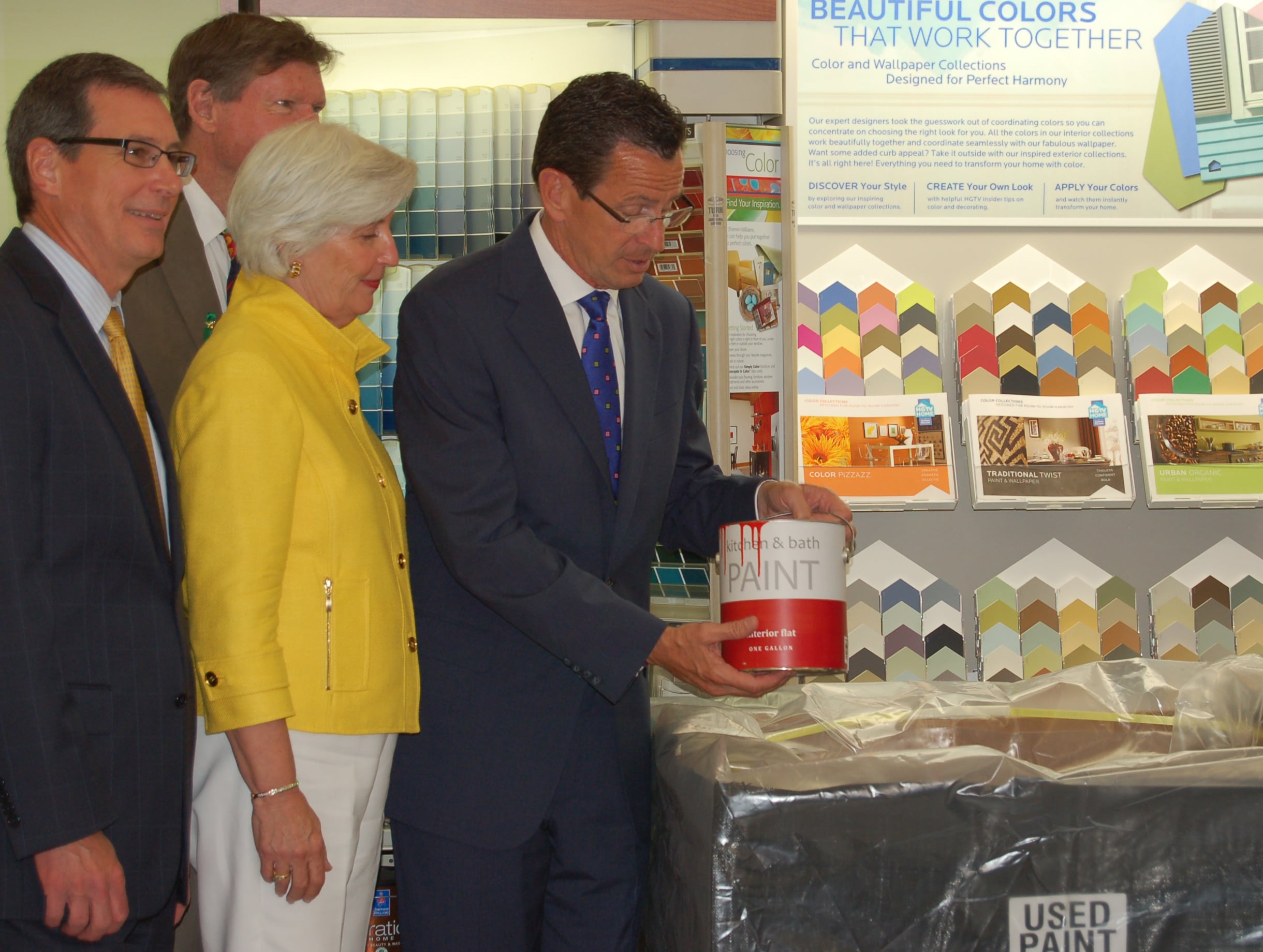
Connecticut Gov. Dannel Malloy places a can of paint in a recycling bin in a symbolic kick-off to the PaintCare Program. (L to R: American Coatings Association President Andy Doyle; Connecticut State Sen. Ed Meyer; Connecticut State Rep. Pat Widlitz; and Gov. Dannel Malloy.)
One after the other, speakers walked to the makeshift podium at the corner of the paint store, amidst the colored strips of lavender and mauve, and praised the new paint program and its ability to save resources, save money, and create jobs.
There was a good feeling, and rolling out right in front of me, like a video documentary, was a paradigm shift of immense proportions, as Important People, from the Governor and his Administration, to key legislators, retailers, and paint manufacturers, praised the collaborative nature of this innovative program.
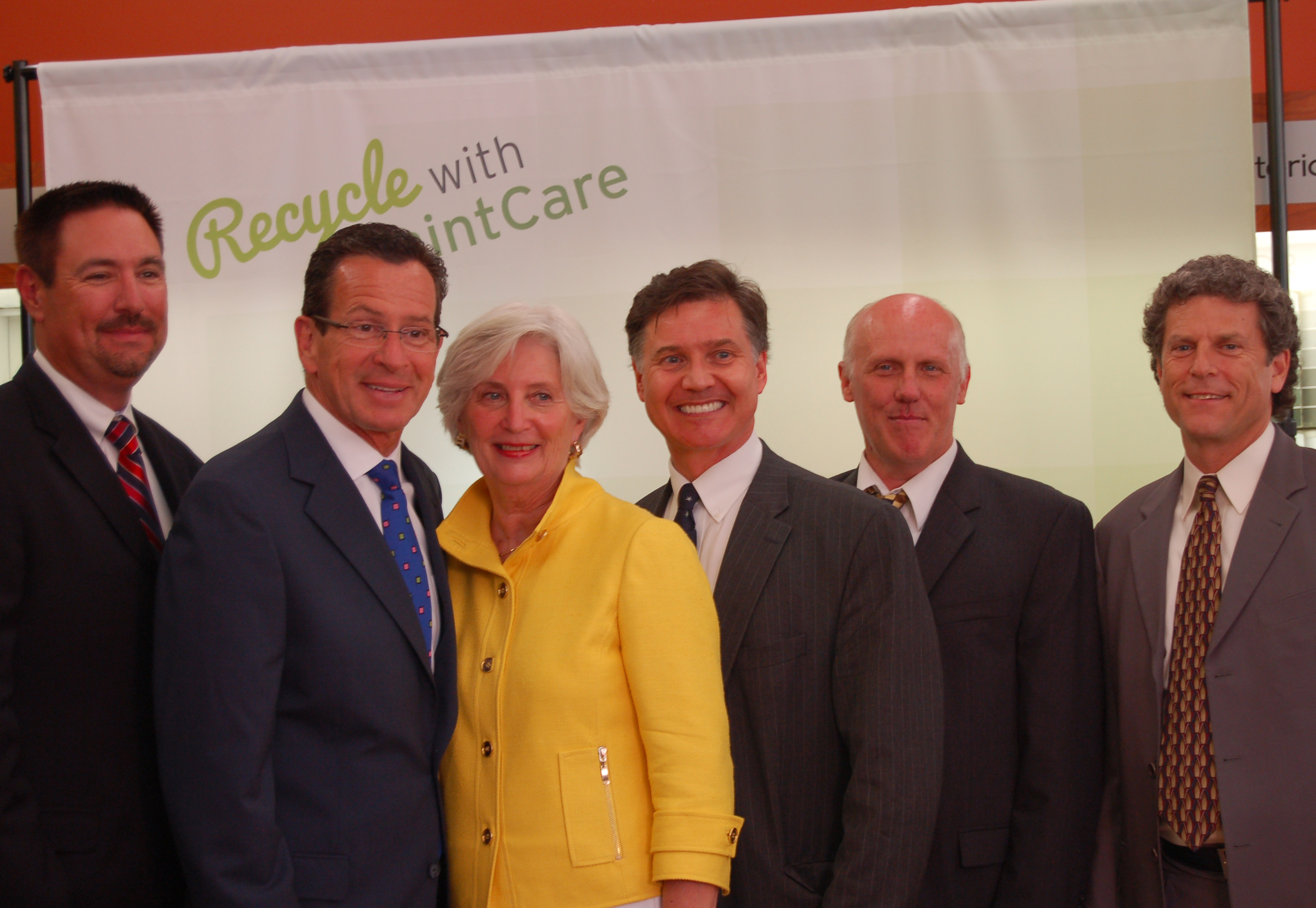
(L to R: Sherwin-Williams District Manager Tom Kelly; Connecticut Gov. Dannel Malloy; Connecticut State Rep. Pat Widlitz; Connecticut Dept. of Energy and Environmental Protection Commissioner Dan Etsy; Connecticut Dept. of Energy and Environmental Protection Environmental Analyst Tom Metzner; Product Stewardship Institute Chief Executive Officer Scott Cassel)
Tom Kelly, Sherwin Williams District Manager, mentioned the calls he already received on the first day of the program from residents seeking a place to bring leftover paint. “They come in just to drop off paint, but then see a clean store, and that we have what they need, and they leave a customer,” he said. Andy Doyle, President of the American Coatings Association, pledged the “support and backing of America’s paint industry” to recycle all the state’s leftover paint. The two chief bill sponsors – Sen. Ed Meyer and Rep. Patricia Widlitz – applauded the Governor and his team, as well as the industry, for their collaborative approach to finding a solution to a significant environmental problem, calling it “something really special.” They talked about the “terrific concept of producer responsibility” in which “paint manufacturers come up with their own plan to recycle.” State Rep. Lonnie Reed said that “…building in recycling and end-of-life elements into all of our products is important, and a sign of things to come.”

(L to R: American Coatings Association President Andy Doyle; Product Stewardship Institute Chief Executive Officer Scott Cassel)
As I stood there listening, it struck me that product stewardship has become commonplace in Connecticut. PSI laid the groundwork for paint product stewardship in Connecticut and across the nation by convening paint manufacturers, retailers, state and local governments, and others in national meetings to hash out the agreements that led to this very moment. But the paint program in Connecticut would not have happened if each of the local stakeholders at that press event did not seize on the opportunity they were presented. The paint industry has now transformed itself from an industry that once saw consumers as the reason for leftover paint to one that has taken a leadership role to make sure leftover paint is recycled.
As our nation debates immigration reform, marriage equality, and voting rights, we can all sense shifts in public opinion that represent sea changes of immense proportion. This year marks a watershed moment in the product stewardship movement. To date, eight producer responsibility laws have passed this past year on four products in eight states: pharmaceuticals (Alameda County, CA; King County, WA); paint (Maine, Minnesota, and Vermont); mattresses (Connecticut and Rhode Island); and thermostats (New York). No, the entire country has not embraced producer responsibility; that will take decades. But we now have Governors and Commissioners speaking about an industry’s responsibility to manage its own waste, and an industry speaking glowingly about its partnership with regulatory agencies that allow it to assume its rightful responsibility.
This is the paradigm shift that many of us predicted in 2000 when the Product Stewardship Institute was created on that cold December day in Boston when over 100 government officials assembled to talk about a little known concept called product stewardship.
The times have changed. Sometimes it is nice to sit back and enjoy the show, and revel in the enjoyment that your hard work has provided to others. For many of us, now is that time.
Last weekend I had the joy and good fortune to watch my daughter graduate from college. Few of my previous life experiences have matched that prideful day.
At Wesleyan University, on commencement day, a commitment to social justice dripped from each graduate’s gown. A stream of red and black marched by the round-topped star-gazing observatory as African drummers pounded soulful renderings under a tent. Professors and other dignitaries mingled around lawn chairs, and flags whipped in the cold wind.
Receiving an honorary degree was former Wesleyan graduate, Majora Carter, whose efforts to economically revitalize poor urban areas are profoundly “Wes.” So was her speech. Her message: Get ready to be uncomfortable. That’s right! Anyone who wants to shake up the status quo will have enemies, even brutal opposition. You will know who your friends aren’t, she said.
As someone who wears product stewardship lenses inside his gl
Over the past 13 years, this space has yielded dividends. In the past two weeks, three new producer responsibility laws have passed – Connecticut’s first-in-the-nation mattress law, and paint laws in Minnesota and Vermont (the 5th and 6th states to pass paint stewardship legislation so far). These laws do not pass solely because of PSI. In many ways, they would never pass if it was all up to us, or up to any one stakeholder. It takes a strong coalition that gets built over time. Starting and maintaining those coalitions is what PSI does – and it often starts in a very uncomfortable place, where we need to convince all stakeholders that the heavy lifting needed to change the status quo is worth the effort.
Thanks to all of our partners for great success these past two weeks, and we hope for many more victories that result in resource savings, job creation, and taxpayer savings. I am starting to like this feeling of being a little less uncomfortable.