
by Amy S. Cannon, Executive Director of Beyond Benign
What is green chemistry? Why and how does it relate to you? Green chemistry is the design of products and processes that reduce or eliminate the use and generation of hazardous substances. Sounds simple, doesn’t it? It is perhaps a bit more difficult than it sounds. However, just because something is difficult doesn’t mean it is not worth doing. Green chemistry focuses on the invention and design stage of a product’s life-cycle. The idea is that if we can infuse chemists with the knowledge of toxicity and mechanisms of environmental harm, then chemists will be able to use that knowledge to create safe, non-toxic products in a non-hazardous manner.
A question you might ask is, “So you mean chemists haven’t always deliberately tried to make safe products?” Well, the answer to this is, “No, we haven’t.” Why do chemists and scientists not design products and processes to be safe from the beginning? To put the answer simply – we just are not taught how to do it. It is not in our vocabulary or in our knowledge base.
If you study chemistry at any level, you will most likely never take a course that has anything to do with the environment. You will not take a course on toxicology, the very science with the knowledge of understanding the hazards associated with chemicals. You will not take a course on environmental fate and transport to understand the ecological cycles in which we function. Traditionally, this knowledge has been left for the environmental scientists to learn about and deal with the waste and hazards that chemists create in the design and manufacture of products. Green chemistry seeks to change this by teaching chemists to understand environmental science and toxicology. The chemists and design scientists can have the greatest impact on pollution prevention, reducing waste and hazards.
To help explain this, let’s think about how products are made.
There are many stages to a product’s life-cycle. In order to create safe, sustainable products there are a number of people that need to be involved. Chemicals policy makers focus on the implementation of the best suitable alternatives that are currently available. The policy makers are essential in ensuring that the products that are on the shelf are as safe as possible. Green chemists focus on the demand side of the product life-cycle. The very moment a chemist begins to plan how they will create and develop a new product or redesign an existing product, they are making decisions that will have impact down stream. If we can teach chemists to design products and processes in a sustainable, non-toxic manner, then the roles of the engineer and the chemicals policy maker become much easier.
For too long, environmental issues of hazards and toxicology have been absent from the education of scientists. It is time to bring this knowledge back into the chemist’s curriculum so that a chemist is able to create safe, non-toxic products and processes each time they sit down to do so. Can you imagine a future where all products are designed to be safe at conception? This would make our purchasing much more simplified and we would no longer have to scour the literature to determine which skin-care product is the least hazardous or which cleaners will be safe to use within our homes.
As green chemists, we are working towards making this future happen. Industries are climbing on board as they find out about the economic benefits of green chemistry. Governments are beginning to implement legislation that is supportive of green chemistry efforts, recognizing that economic development and sustainability are not mutually exclusive. Developing nations are recognizing the benefit of green chemistry and working with local, bio-based resources. And, perhaps most importantly, students are signing up in droves for classes and programs where they can learn how to do chemistry in a way that does not have to harm the earth or human health. It is, after all, the next generation that will lead the path toward building a sustainable world with safe, non-toxic, effective products. And, it is for them and their future that we need to support these efforts. Together we can make the world a safer place.
For more information about Green Chemistry see: http://www.beyondbenign.org/ or http://www.warnerbabcock.com/.
by Rodney North of Equal Exchange
For those interested in product stewardship the focus historically has been upon physical/material matters – such as:
Is a product toxic in its production, use, or disposal?
Can it be recycled? If so how?
How much water or energy is used in its life-cycle?
Etc.
We do this both out of a concern for the environment itself but equally because of the direct and indirect effects upon people. And if improving human welfare is sometimes/often/or always your motivation for product stewardship then we modestly suggest a wider perspective on the many ways the stuff people buy impacts people’s lives.
For this reason Equal Exchange might have unusual insights to share with the product stewardship community. For 24 years we have worked hard to make select industries that produce goods that most Americans buy every month, and maybe even daily – like the coffee, tea and banana trades – work better for more people. We’re focused most of all on the millions of small-scale farmers around the world who grow these crops. In fact the industries beyond these everyday items have shaped the course of history for dozens of nations. For example, where do you think the phrase “a banana republic” came from? Suffice to say that the systems that keep our grocery stores stocked with bountiful amounts of very affordable tropical products works better for food companies, retailers and consumers than they do for farmers or farm workers.
Specifically, as a business Equal Exchange has been uniquely concerned with how the buying and selling of products affect people, especially those who are the most disadvantaged within a given supply chain. So even when the physical aspects of a product pose no threat we have seen over and over how the commercial aspects of a supply chain can have powerful negative or positive effects upon communities both abroad and here at in the U.S. It is for these reasons that back in 1986 we helped introduce to US grocery stores the Fair Trade model for imported foods.
In the U.S. and other developed economies we have taken many steps to soften the edges of the marketplace so that it is not as callous, dangerous and exploitative as Charles Dickens’ “dark satanic mills” or Upton Sinclair’s “jungle”. There is still more to be done – for example for migrant farm workers and meat-packing employees – but especially for those in less affluent nations, where the marketplace remains largely ungoverned and where the vast majority work at the mercy of amoral and impersonal market forces.
I know that’s strong language but there is no other way to describe it. Plus it helps explain why there is a need for companies like Equal Exchange and why governments, at all levels, should think about products more broadly and consider not only physical and environmental attributes, but also the social character of how goods are produced and traded.
With that said, Equal Exchange is also very concerned about the environmental impacts associated with our products and for good reason. After one’s home and maybe even more than one’s car the food we buy (annually over $6,000 per year per person) may represent the largest environmental impact we have. For example, agricultural is a bigger contributor to climate change than are all forms of transportation combined. A whole host of other environmental issues also pivot on farming, including soil erosion, dead zones in the Gulf and Chesapeake Bay, and loss of wildlife habitat. So if you care about how products affect the environment, then you have to think about food, which means thinking about farming. At Equal Exchange we do and that is why over 95% of what we import is organically grown.
This is where our work, and that of tens of thousands of organic farmers around the world, overlaps most closely with the traditional concerns around product stewardship. Let’s put it in what might be more familiar language.
Imagine you have two ways to produce a widget:
Process A involves chemicals ranging from mild to very toxic, including many that are have long been banned in the U.S. due to their extreme environmental side-effects when used as directed. The chemicals are often used by people with no safety instruction or equipment (masks, gloves, aprons, washing stations, etc). There is little-to-no regulatory oversight of the use of these chemicals. Direct and indirect harmful exposure to workers, their families, and other in their communities is common, resulting in frequent illness, and even birth-defects and death. Rivers and public water sources become contaminated. These chemicals are typically combined with complementary production techniques that together accelerate climate change, soil erosion in mountainous regions, lower soil fertility and the loss of both animal and plant biodiversity.
And Process B for producing the widget avoids all of the problems above, while also sequestering carbon and increasing climate change resilience, restoring soil fertility, minimizing erosion, restoring biodiversity, and encouraging a stewardship mentality to the productive resources involved. Process B often produces higher quality “widgets” and is also sufficiently productive and efficient to be competitively priced on the market.
This over-simplified story of 2 “widgets” essentially captures some of the production choices we face in how much of our food is produced in the global South, and we hope the product stewardship community will consider this, as well the human/commercial side of those supply chains, in the years to come.
by Eric Lombardi, Executive Director of Eco-Cycle, Inc.
It’s a sad and little known fact that the U.S.A. recycling rate has been stalled out at about a 33% “discard recovery” rate (recycling and composting) since around 1997. We did experience a rocket-ride recycling decade that started in 1987, the year of the Mobro Garbage Barge out of New York City. For those ten years the recycling explosion was steered by passionate risk-takers who had a real desire to conserve natural resources by recovering them from our landfills and incinerators. But that all ended in 1997 when the municipal/industrial complex took over most mission-driven recycling efforts. Without the freedom that comes with passionate advocacy, recycling rates plateaued. It was at that time when a handful of us decided to keep the fires burning and created the Zero Waste revolution, launching a new national organization named the GrassRoots Recycling Network.
The next ten years, 1997-2007, was an interesting time that proved Ghandi was right when he proclaimed about social change, “First they ignore you, then they laugh at you, then they fight you, then you win.” We were initially sidelined as radicals, then jokingly put-down as idealistic, then the “big trash” companies and industry publications raised their fists at us, but now I think we’re moving toward victory. How can we know? I like to point to the Newsweek 2008 Earth Day issue where they named Zero Waste the #1 “Fix For The Planet,” and how in 2010 the largest trash hauler association in the world, the National Solid Waste Management Association (NSWMA) said, “It was time to basically tell the world that we do support zero waste … We see it as a tremendous business opportunity.”
Recently San Francisco announced that their landfill diversion rate was a whopping 77%! And it’s important to note their claim that if they had full participation by the public, they would be closer to 90%. So it’s clear that we know how to do this job of recovering resources, and that our challenge now is more in the economic and political realms.
In S.F., one of the keys to their success is that their private sector hauler, Recology, is what the Italians would call “an inside company” and not vulnerable to the gnashing teeth of the single-bottom-line marketplace since they are written into the City Charter and can’t be denied their contract. To most free-market Americans, this sort of cozy relationship might sound like a bad thing. But in fact this sort of “social business” is exactly the formula needed to transform our waste management system into a resource management system. Why? Because resource conservation is a social issue first and a market issue second and will remain that way until the economists of the world can figure out how to correctly price out the bloody resource wars in Africa for minerals, Indonesia for timber and worldwide for oil… not to mention the spoiling of our water, soils and atmosphere. Bringing an end to our wasting society is a triple-bottom-line activity, and that’s political.
So if it’s time to stop arguing and get on with it, how do we go forward? That question has been arising everywhere I go, and so Eco-Cycle has created a simple plan to get launched. We call it “The 10-Year Bridge Strategy for Building a Zero Waste Community.” It is a simplified roadmap written for policymakers such as elected officials and City Managers so that they can envision the community-scale changes needed to move away from landfills and incinerators.
Eco-Cycle is the largest Zero Waste social enterprise in the USA and has an international reputation as a pioneer and innovator in resource conservation. Eric Lombardi is recognized as an authority on the social and technical aspects of creating community-based “Zero Waste” resource recovery programs. Eric is participating in PSI’s 10th Series of Networking Conference Calls and will be the primary speaker for the first call of the series: Product Stewardship and the Drive Towards Zero Waste.
by Scott Cassel, CEO and Founder of PSI
I had always yearned to travel to the Mississippi Delta. My young eyes were drawn to the words of Mark Twain and William Faulkner and, even back then, my harmonica resonated with the gravelly blues from the cotton field plantations, jailhouses, and trains a blowin’. This summer I went to check it out.
On the train called the City of New Orleans, chugging out of Memphis, Tennessee, I pondered my two-day immersion into civil rights history at the national museum located in the Lorraine Motel, where Rev. Martin Luther King, Jr. was felled in a pool of blood on the balcony outside Room 306. The messenger died. But the movement did not. Movements ride on the backs of the people, and the civil rights movement was an amalgamation of heroic acts…legal arguments by giants like Thurgood Marshall that changed school desegregation laws…the stubbornness of Ida Wells and Rosa Parks refusing to give up their rights on a bus…James Meredith outlasting the opposition to become the first African American to attend the University of Mississippi…and the unswerving principled leadership of ministers Fred Shuttlesworth and Ralph Abernathy. But it was also about hundreds of thousands of people, black and white, who marched and protested, defied police clubs and fire hoses, and were attacked by large police dogs. They were willing to go to jail, lose their jobs, and fight for change. They were children, teens, college kids, adults, and the elderly.
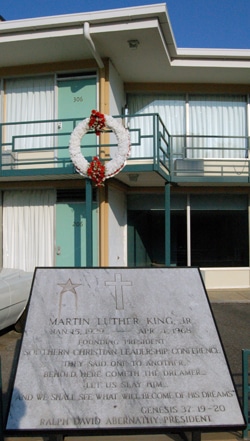
National Civil Rights Museum – Memphis, Tennessee
But the civil rights movement teaches us that laws do not guarantee change. One hundred years after emancipation from slavery, the civil rights movement was needed to make changes that were intended in the eyes of Lincoln. African Americans had the right to vote at least as early as 1870. However, white intimidation and resistance to allowing black voters to register resulted in few black voters for the next hundred years. School desegregation rulings did not guarantee that an equal amount of money was spent on white and black kids, or that the learning experience was equivalent. Much changed with the law, but it took the Civil Rights Movement to ensure that results were attained.
How does this relate to environmental issues? The product stewardship movement is only about 20 years old, and only 10 years old in the U.S. Over 46 states, nearly 200 local governments, and scores of national associations and other groups have endorsed Principles of Product Stewardship that call for a fundamental change in who is responsible for mitigating a product’s lifecycle environmental impacts, from materials extraction through recycling or disposal. Instead of taxpayer-funded government programs paying to collect consumer products when they are no longer needed, Product Stewardship Principles require producers to internalize the costs of collecting the products into their cost of doing business. Over the past four years, over 60 product stewardship laws have been passed in 32 U.S. states on 7 product categories.
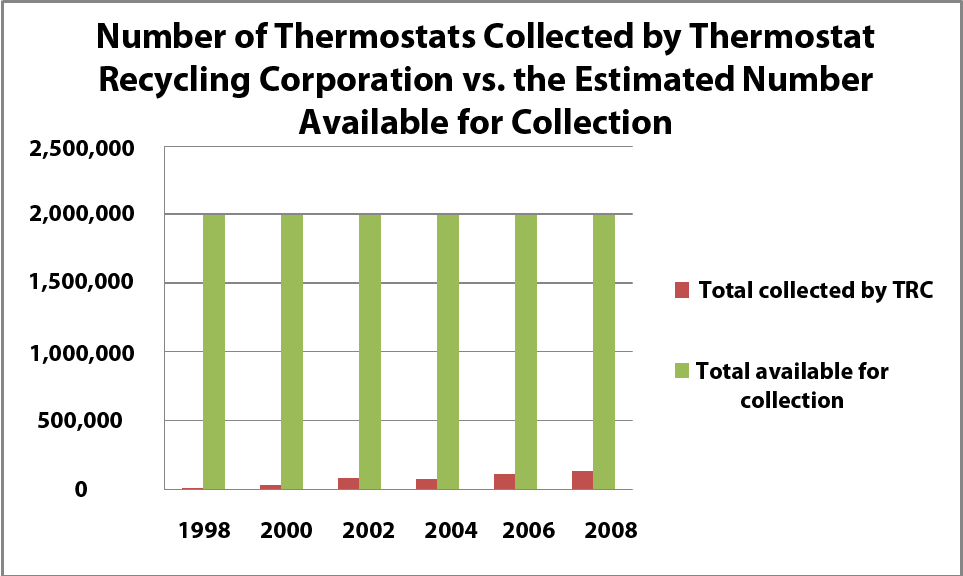
Number of Thermostats Collected by Thermostat Recycling Corporation vs. the Estimated Number Available for Collection
But, as we learn from the civil rights movement, product stewardship laws do not guarantee results. They only guarantee a foothold. There are still forces that want change to happen slowly or not at all. Although many manufacturers support product stewardship and accept their responsibility, others oppose legislation and strangle the implementation of laws once they are passed. For example, the Thermostat Recycling Corporation (TRC) members, which finally phased out the manufacture of thermostats that contain mercury after years of resistance, now resists being held accountable for collecting mercury thermostats that are replaced with newer models. In the past decade, while their voluntary program diverted just 5 percent of thermostats nationally in the U.S., millions of thermostats containing mercury were disposed of in landfills and incinerators, emitting mercury into the environment. Mercury, a toxin that can affect the nervous system, has made its way into many fish caught in U.S. waters. Nearly every state issues a health advisory to limit or avoid eating certain fish owing to the mercury content. Unfortunately, TRC and the National Electrical Manufacturers Association (NEMA) has fought against the public interest to safely recycle their mercury products. TRC’s voluntary program did not result in the significant removal of mercury from the environment, and the nine state laws passed to correct that deficiency will only be successful if thermostat manufacturers are held accountable for eliminating the mercury hazard.

Why We Can’t Wait
To be sure, the civil rights movement dealt with similar, but more abhorrent and entrenched, opposition. For that movement to succeed, it relied on the perseverance of its leaders, marchers, sign-holders, counter-dwellers, bus riders, and others in the ranks. There was urgency in their actions. There was conviction in their goals. They knew that they were right to demand their rights. Dr. King summed it up in his 1963 book, Why We Can’t Wait, when he explained how the situation for African Americans in the U.S. became intolerable. He knew the pace of change that was needed to keep up with the will of the people, and he sensed how it was at odds with those supporting a more moderate position. They needed action, and it could not wait.
To truly succeed, the product stewardship movement needs greater urgency. We need governments ready to legislate and businesses willing to be good partners. We need outrage at companies that refuse to take responsibility for the environmental impacts of their products. Without these changes, we will continue to fail to incorporate the full cost of producing and using a product into its cost — including the full cost of oil spill cleanups. We will continue to have pharmaceuticals change the gender of fish as they are flushed into waterways, medical syringes puncturing workers, phone books piled unwillingly in our doorways, and packaging choking our landfills and incinerators.
Currently, the government is held responsible for figuring out how to pay for the safe management of products when they are no longer wanted. There is no incentive for manufacturers to stop excessive waste. Product stewardship policies seek to change that. By holding manufacturers responsible for their products all through the lifecycle, there is a direct financial incentive for them to reduce waste and make products that have value at the end of life.
Martin Luther King gave his famous Mountaintop Speech on August 28, 1963, in front of the Lincoln Memorial, where he envisioned a better world. If you are a person of color, you should make the pilgrimage to the National Civil Rights Museum at the Lorraine Motel. If you are anyone else, you should make the pilgrimage to the Lorraine Motel. And if you are an environmental advocate, you should go for the added reason that you need to understand what it will take for our young product stewardship movement to truly succeed.
by Scott Cassel, CEO and Founder
For my summer vacation, I went to check out the worst environmental disaster in the history of the United States. That’s right, straight down to the Gulf to see for myself the havoc reeked on birds dripping in oil, dolphins belly up for miles, and beaches lapping waves of petrodollars on deserted shores. Well, except for the deserted shores, I didn’t find many overt signs of man-made mayhem. Instead, what I found was much more subtle. At ground zero in Grand Isle, Louisiana, I was in the eye of prevailing counter-forces in modern day America, where Big Oil has a stranglehold on Big Fishing, and both are sitting heavy on those employed by each industry, blaming government for intervening while pleading with government to preserve their way of life.
Complicated? You bet. Hypocritical? Sure. Human? All too.
The BP oil spill has shown the world the worst of what can happen when producers seek short-cuts to maximize profits, when government abdicates its regulatory role, and when residents are so reliant on a limited number of industries to make a living that they put their health behind job security.
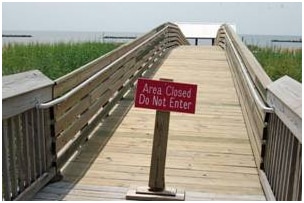
One of the many closed beaches along the coast of Louisiana
That is the struggle in the Gulf right now. Tourism is way down. There is a moratorium on offshore oil drilling until the federal government says it is safe. And commercial fishing has been closed in a large swath of the Gulf waters. BP is paying out claims for lost income at a snail’s pace, while pressuring the federal government to declare the area safe for fishing and oil drilling. And the people living in the Gulf just want to go back to doing what they do best – fishing and drilling for oil, or supporting those two industries. After Hurricane Katrina, this oil spill is no big deal. They have been through it all. No oil spill is going to stop their lives after a hurricane killed thousands of people, wiped out entire towns, and drenched 80 percent of New Orleans. Americans are tough, and those living in Louisiana and Mississippi are some of the toughest, proudest, and most resilient Americans I have met.
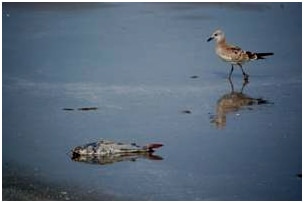
Evidence of the impact the spill had on marine life
But this spill is creepy. Yes, we all saw pictures of oil-drenched birds, and I did see one pelican soaked in oil, several dead fish, and tar balls the size of quarters all along the beach, even after the beach was declared safe for swimming. But visible signs of the oil spill have been largely contained. Following the uncontrolled gushing of the well, the impacts have been masterfully managed. But it is what we don’t see that is of significant concern. And because we don’t see it, there is a rush by BP to say that it does not exist. And these hurricane-ravaged people want to believe it.
But not all. I read about local commercial fishermen who criticized the government for moving too quickly to open up areas for fishing because they fear that the remaining oil and chemical dispersant make the fish unsafe to eat. A native who owned a kayak business showed me an odd substance he had never seen before that washed up on shore, and he guessed it was dispersant. I read an op-ed from a Louisiana State University entomologist warning about the dearth of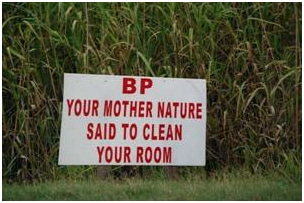
These cautious locals and other experts are the counter-weight to the rush to getting back to business-as-usual. They are concerned about the long-term impacts of oil and the dispersant on bird nesting areas, fish reproduction, and human health. And so am I.
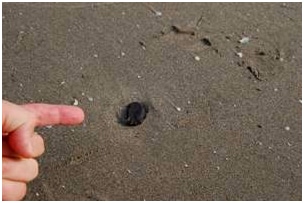
Just one of the many tar balls appearing on shorelines along the Gulf Coast
While many in the Gulf understandably just want their lives back, others know that the fight against Big Oil has just begun. The pressure to reopen the Gulf to lucrative offshore drilling is intense. The drive to reopen fishing grounds has picked up to a gale-wind force. BP will do everything in its power to cut its losses and pay out businesses for lost income in exchange for a commitment not to sue in the future. They want to turn the page and their PR machine is in overdrive. But this oil spill is not only about an acute impact. It is about long-term repercussions in a complex ecosystem.
To understand what this spill means to BP, consider that the day after several segments of beach in Grand Isle were declared safe for swimming, I saw mature palm trees being transplanted into their rightful place in the sand, welcoming residents back. A half mile down the beach, a heavy duty construction operation was still scooping sand, sifting it through special equipment to remove hydrocarbons, and replacing it back on the beach.
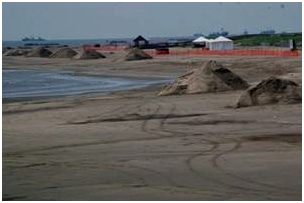
Closed beach
To understand what this oil spill means for America, throw a giant rock in a pond. The area of the initial splash gets back to normal fairly quick. But the concentric rings of impact spread outward in an ever wider path as it spreads across the pond, lapping onto shore. The BP oil spill was a giant boulder dropped in the Gulf, and it will be a decade or two before the repercussions of its wake fully come to rest. BP should commit to funding scientific studies by independent researchers with a guarantee that results will be shared with scientists and the public for at least the next 10 to 20 years. They should put money into an escrow account, so that if impacts are later detected, they have the resources to clean it up or pay out further claims. They should pay current claims and keep open the possibility of further payments as long-term studies are conducted and impacts understood.
This oil spill is about producer responsibility, and I cannot think of a more quintessential producer than BP. It is time to resist the force of a reckless company and teach BP the meaning of social responsibility.
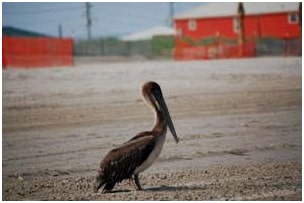
Lone pelican covered in oil awaiting rescue