
Brendan Adamczyk, Associate for Policy and Programs
One year ago, PSI’s Sydney Harris noticed a troubling trend around the country: states and municipalities were rolling back regulations on single-use plastics due to fears of surface transmission of COVID-19. Wanting to understand the magnitude of this trend, Sydney launched PSI’s COVID-19 Impacts on U.S. Plastics Policy Tracker, chronicling delayed legislation, lifted bag bans and fees, and bans on reusable bags on city, county, and state levels. She also included impacts on bottle deposits, other single-use plastics (such as polystyrene takeout containers), and relevant major news coverage. I joined PSI’s team in June and have worked over the past nine months to keep the tracker up to date.
In the year since, we have learned from health experts across the globe that reusables are just as safe as single-use plastics. The plastics industry promoted the idea that plastics reduce exposure to COVID-19 as early as mid-March 2020, requesting that the U.S. Health and Human Services Department speak out in support of single-use plastics. This is one example in a long history of plastics producers misleading the public about the benefits of plastics and their role in the plastic pollution crisis– a crisis that has only deepened as a result of COVID-19, with consumption of single-use plastics rising by up to 300% while plastic pollution in the oceans continues to climb.
Ongoing Impacts of COVID-19
The impacts of COVID-19 on single-use plastics regulations have been severe and spread out across the country, as one can see by looking at the map below. In 2020, nine of the ten states with bottle deposit programs (all states except Hawaii) temporarily suspended collections. Interruptions lasted for months, with the last state (California) resuming collection at the end of August. Beyond these programs, 72 waste-reduction policies were delayed, lifted, or suspended because of the pandemic. On top of this, 16 new policies were enacted that restricted the use of reusable bags and containers. Overall, these 88 policy impacts spanned 23 states and the District of Columbia and are comprised of:
• 21 delayed plastic bag bans or fees;
• 26 lifted plastic bag bans;
• 15 lifted plastic bag fees;
• 16 new policies that barred customers from using reusable bags or takeout containers; and
• 10 suspended or lifted policies banning plastic straws or polystyrene cups and takeout containers.

As of today (April 1, 2021), 25 of the 88 policies, or 28 percent, remain affected, all of which are bans or fees on plastic bags that continue to be either delayed in implementation or are still suspended. In addition, eight jurisdictions withdrew previously planned bag or polystyrene ban legislation, most notably Colorado, Maryland, and New Hampshire, all of which pulled bag bans. In part due to the now-debunked myth that reusable bags transmit COVID-19, Ohio and Pennsylvania passed statewide preemption laws that prevent municipalities from banning plastic bags through the middle of 2021. The state of Pennsylvania is currently being sued by a group of municipalities, led by Philadelphia, who want to maintain their ability to ban bags at the local level. The graphs below illustrate how these policies were spread across cities, counties, and states and how many of them continue to be impacted one year after the start of the pandemic.
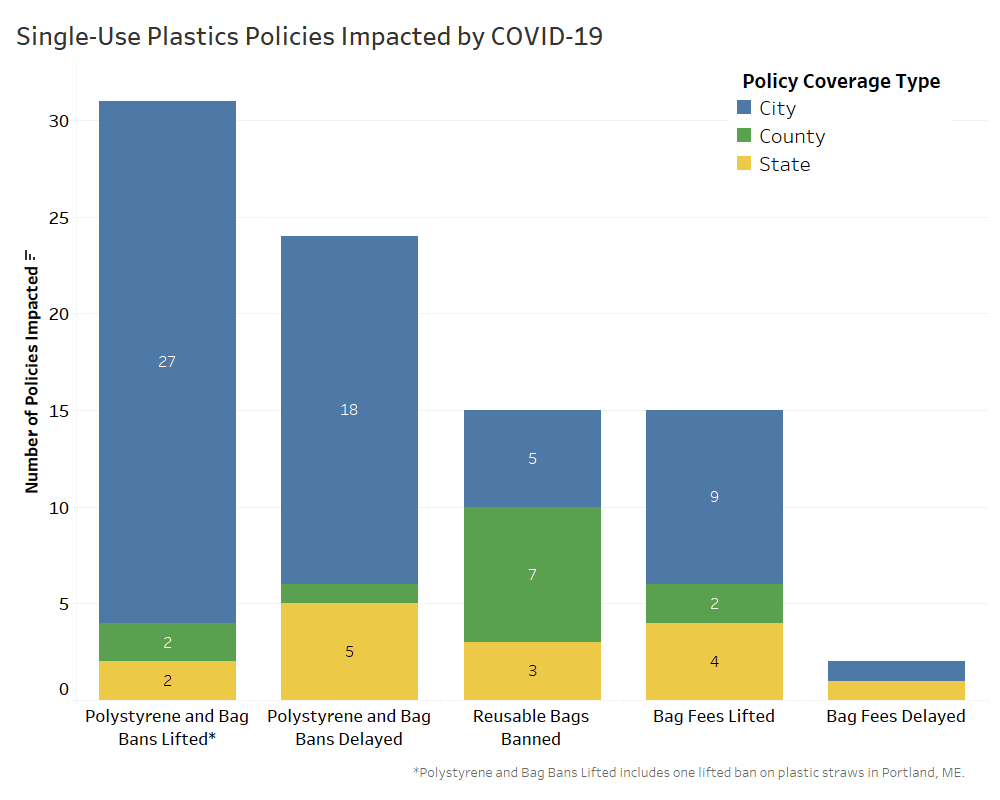
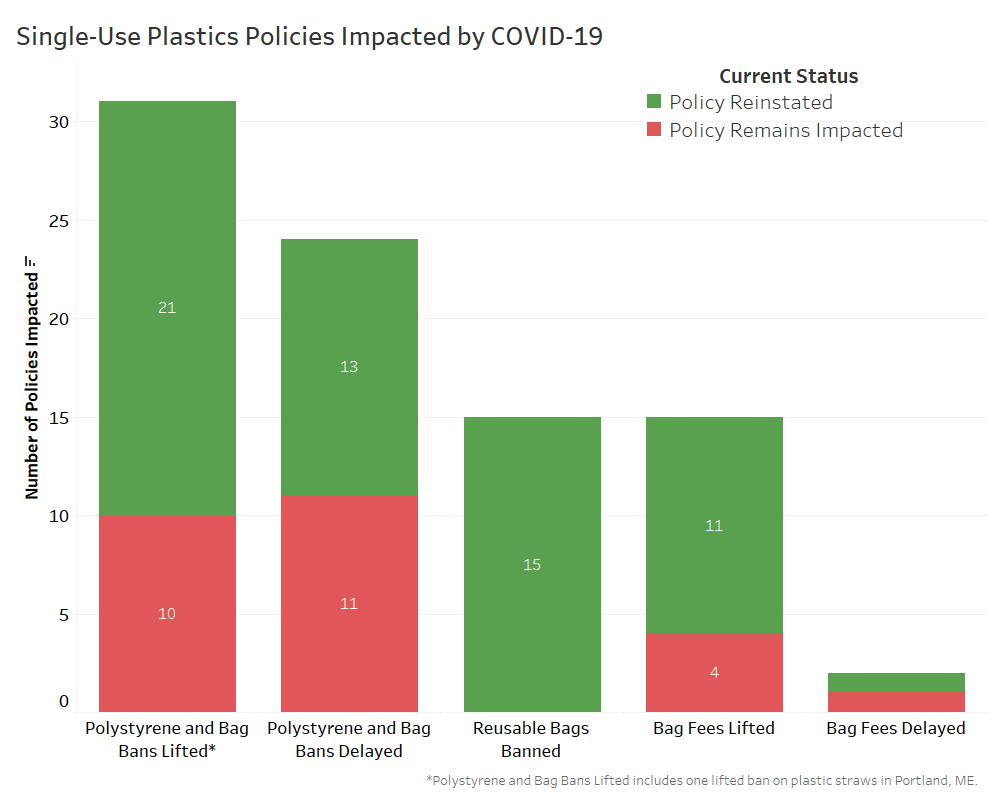
Even amidst the pandemic, however, it has not all been bad news for plastics regulation. During the past year, six jurisdictions passed bans on plastic bags, including New Jersey’s robust ban on both plastic and paper bags. Additionally, eight previously-passed bans on plastic bags or polystyrene containers took effect despite the pandemic, including bag bans in three states – Delaware, Vermont, and Virginia – as well as a ban on expanded polystyrene in Maryland.
Looking to the Future
In the wake of COVID-19, which also had major impacts on the U.S. recycling system in the beginning of the pandemic and will pose ongoing challenges in the future, it is clear that change is sorely needed. PSI advocates for Extended Producer Responsibility (EPR) legislation that holds producers accountable for their products and packaging by shifting the financial and management burden of recycling from taxpayers and local governments to consumer brands. Globally, EPR for packaging has helped solid waste programs stay resilient in the face of COVID-19, with a study conducted by Éco-Entreprises Québec finding that curbside recycling experienced fewer pandemic-related disruptions in Canadian provinces with EPR than those without. This is true despite Canadian programs facing the same challenges as the U.S. did, including a 30% increase in residential trash volume and employee shortages throughout the pandemic.
In the United States, momentum for EPR legislation for packaging and paper products has greatly increased. At least 13 bills across 10 different states have been introduced or are expected to be introduced in the 2021 legislative session, as well as two bills on the federal level: the CLEAN Future Act, an overarching climate bill that includes EPR elements, and the Break Free from Plastic Pollution Act, a waste reduction bill centered around a packaging EPR model, which was informed directly by PSI’s model and would overhaul the U.S. waste management system.
For now, while some policies and recycling programs remain affected, PSI will be no longer be updating our COVID Impacts Tracker as most of the country has returned their single-use plastic policies to pre-pandemic status. Instead, we are focusing our energy on the EPR bills above. The lessons we have learned over the past year are important. But it is now time to look forward, knowing we have the policy tools to drive genuine change in the U.S. waste management system. EPR for packaging and paper products will stabilize and improve our recycling programs and push our country away from single-use plastics towards a circular economy built on closed-loop recycling. EPR legislation is a policy whose time has come.
by Scott Cassel, CEO and Founder of PSI
The COVID-19 pandemic significantly slowed legislative activity in many states across many product categories, yet packaging bills have been particularly active in the past few months. California AB 1080 and SB 54, which did not pass, would have established a fee on single-use plastics and consumer packaging and required the state agency to evaluate options – including EPR — for potential inclusion in regulations. Another California bill, AB 793, which was signed into law by Governor Gavin Newsom in September mandates that plastic and glass beverage bottles contain minimum thresholds of post-consumer content.

In Colorado, the passage of SB20-055 prompted the State’s Department of Public Health and Environment to launch a legislative and literature review of EPR as a potential solution to the problems posed by packaging. New Jersey and Maryland have also recently taken action to address packaging waste: the New Jersey legislature passed a bill to ban single-use plastic and paper bags and Maryland’s foam food container ban, introduced by Delegate Brooke Lierman, takes effect this fall after initial delays due to COVID-19. At the federal level, Senator Tom Udall (D- NM), co-sponsor of the Break Free From Plastic Pollution Act, which included EPR contributions from PSI, recently introduced the Plastic Pellet Free Waters Act which would prohibit the discharge and pollution of pre-production plastic pellets into the environment.
PSI anticipates the 2021 legislative session will be a busy one for EPR, with bills planned for a range of product areas including paint, carpet, mattresses, and HHW, as well as packaging. In PSI’s online Legislative Library, you can keep tabs on the movement of legislation across U.S. jurisdictions that would establish new EPR programs, amend existing EPR laws, or are related to EPR. Through this Member- and Partner-only resource, maintained by the PSI team on an ongoing basis, you can check a bill’s status, download the most recent bill version, and search for laws and bills by year, jurisdiction, product, or bill type.
PSI is actively advising on bill development and is currently holding government strategy calls for Full Members on multiple products. For more information or to join the calls, contact Brendan Adamczyk.
by Olivia den Dulk, PSI Associate, Sydney Harris, PSI Senior Associate, and Scott Cassel, CEO and Founder
Recycling used to be a reliable source of revenue for many US municipalities when China imported 70 percent of the plastics we put in our recycling bins. China and other countries, like Malaysia, paid for post-consumer recyclables that included high levels of contamination, which allowed Americans to generate waste and recycling without giving much thought to where it ended up. But while this system was easy and cheap, it was also unfair to export our environmental problems to vulnerable communities, contaminating their air, land, and water with our trash. In China, for instance, much of the imported contaminated material was difficult to recycle, ending up in landfills or polluting agricultural land and waterways. Due to the sheer volume of incoming waste and recyclables, illegal (unpermitted) waste was not easily tracked and a large amount arrived, exposing children to toxics. China enacted its National Sword Policy in 2018 to restrict imports of most plastics and other post-consumer materials, leaving U.S. municipalities reeling.
For two years, PSI has been tracking news reports from over 170 US cities and counties affected by China’s import ban. Initially the U.S. and other Western countries looked to other countries as a destination for recyclables, but soon their facilities, too, were overwhelmed with our waste. In Malaysia, the high degree of contamination of the recyclables shipped led to burning the waste, which released toxics into communities. Malaysia, Vietnam, Thailand, and India have all subsequently restricted post-consumer plastics imports.
Widespread Negative Impacts on U.S. Recycling Programs
The impacts on U.S. recycling programs and municipal budgets have been dramatic. One report found that the “China Ban” resulted in a 50 percent decrease in overall revenue for municipalities that sold recyclables due to the sudden lack of viable markets. Another found that the end market value of recyclable materials fell from more than $90 per ton at the beginning of 2017 to around $24 per ton at the end of 2019, as buyers for post-consumer materials grew increasingly scarce.
As post-consumer export restrictions took hold, municipal budgets tightened, taxpayers and ratepayers saw increased fees, and many programs eliminated certain items from collection lists that no longer had viable markets. Over 60 local recycling programs closed entirely.
PSI found that, on average, municipal recycling costs increased by about $900,000 per year, according to the local news reports that we have tracked. This figure varied widely with the size of the municipality, the region, and the program itself. For example, smaller communities like Parkside, PA and Kilgore, TX saw increases of $13,000 per year and $20,000 per year, respectively. By contrast, larger municipalities experienced bigger impacts. Boston, MA saw a $4.8 million increase in recycling costs in 2019. In Philadelphia, costs rose from $5 per ton of collected material to $106 per ton. Many U.S. programs that used to earn a revenue from selling recycling saw that revenue dramatically decrease or disappear, or had to pay processors to take the recyclable materials for the first time, drastically increasing their net recycling costs. Phoenix, AZ and San Diego, CA saw revenues drop $5.6 million per year and $3.4 million per year, respectively.
In states where individual residents (ratepayers) fund recycling programs directly, residents paid on average $1.96 more per month, with increases as high as $5 per month in communities in Massachusetts and Illinois.
PSI’s research also found that the impacts of the China Ban on municipal recycling have been exacerbated by the financial effects of the coronavirus pandemic. Under the pressure of rising recycling costs coupled with the financial strain of the pandemic, several communities report that they are seriously considering closing their recycling programs permanently.
Municipalities in every region are still struggling to find affordable ways to recycle, accepting fewer materials, and raising residents’ rates even though China’s Ban was enacted over two years ago. Where local programs have closed, residents are often left with no choice but to dispose of recyclables in their household trash. In some instances, collected recyclables have ultimately been disposed due to a lack of viable end markets, often to the dismay of residents. But while these negative impacts are concerning, we should not go back to the inequitable global export model we used to rely on. Clearly, something must change.
Creating a More Equitable System
By implementing Extended Producer Responsibility (EPR) for packaging and paper products in the United States, we will shift the financial and managerial burden of recycling away from overburdened municipalities and taxpayers to the companies that produce, sell, and profit from consumer products, and stop burdening poorer countries that did not produce the waste in the first place. Without a healthy domestic economy for recycling, we incur lost economic value, lost jobs, and an enormous cost to human and environmental health. We all stand to benefit in this more equitable system – from enhanced quality and supply of recycled content for packaging and other products, from U.S. jobs in the recycling and manufacturing sectors, and from healthier communities.
As we look ahead to the 2021 legislative session, PSI is working with our members and partners in many states and at the federal level to develop and support effective EPR for packaging bills. Our work is based on our model, a set of recommendations and policy options developed through close collaboration with our members. PSI’s EPR model has been incorporated into the federal Break Free from Plastic Pollution Act, recently introduced by U.S. Senator Tom Udall and U.S. Representative Alan Lowenthal to reduce packaging waste. The model has also influenced the development of EPR legislation for packaging in numerous states, including New York, Vermont, Massachusetts, Maine, Connecticut, Maryland, Washington, Oregon, and California.
We urge you to support emerging bills that use EPR to address the recycling crisis, to consider this approach for your own state, and to engage your company in this process.
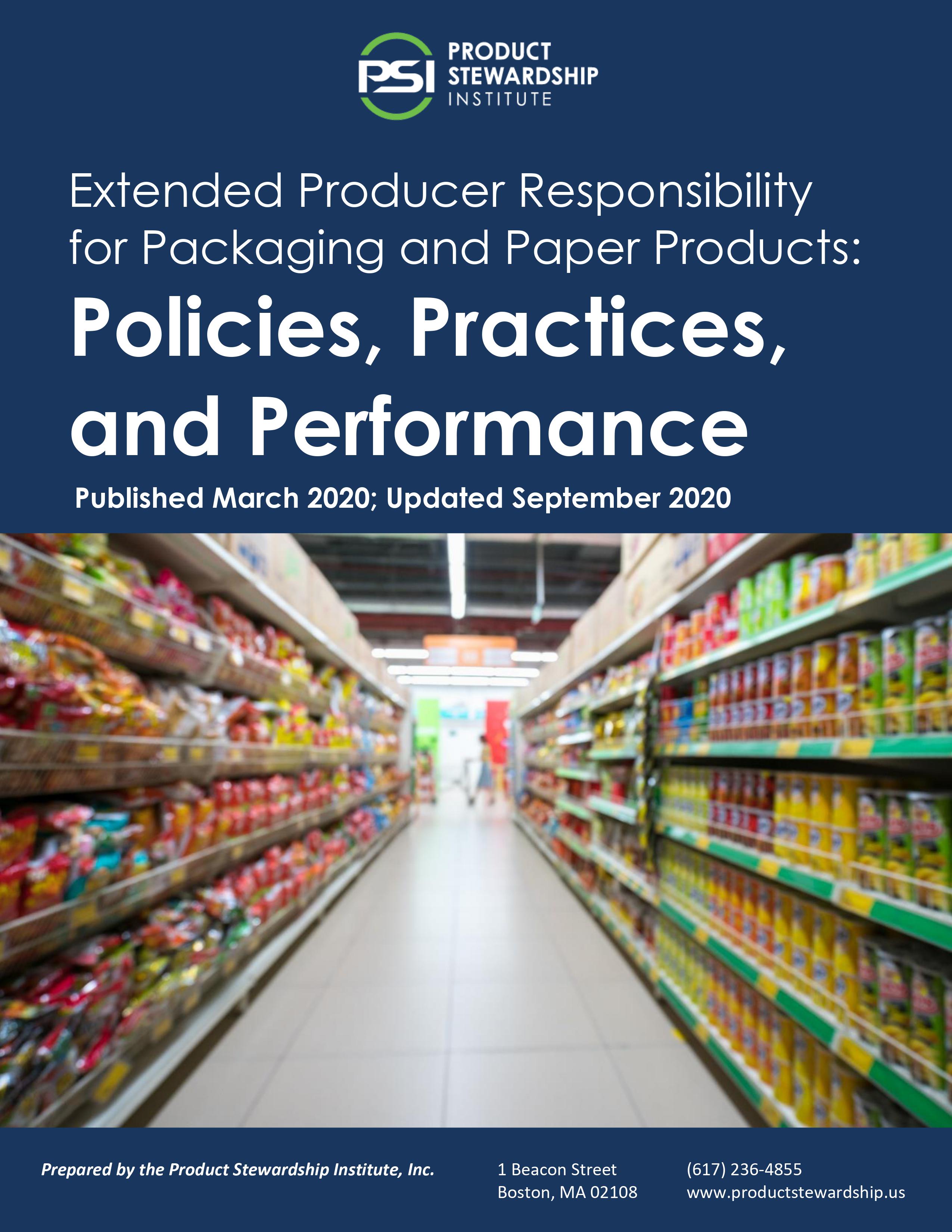
For more information, we have plenty of resources to help. We recently updated and re-released our EPR for Packaging and Paper Products (PPP) report. This report provides guidance on the fundamentals of EPR for PPP and how it can effectively increase packaging recycling and recovery, reduce contamination, and develop markets for difficult-to-recycle materials. It includes the most up-to-date information about four successful Canadian programs, and an in-depth case study of program in British Columbia, the first full producer responsibility program for packaging in North America.
PSI is also working with the Flexible Packaging Association to mediate a set of shared principles of EPR for PPP in the United States, which is the first time industry and government have come together to work substantively on EPR policy for packaging.
The 2018 China Ban was a hard awakening for U.S. municipal recycling programs, and for two years local governments have struggled with the repercussions. Exporting our waste to developing countries is no longer a solution. It is time to put in place modern, equitable recycling systems that are better for both our planet and the financial and physical health of communities both here and abroad.
By Brendan Adamczyk and Olivia Den Dulk, PSI Associates
In June, PSI examined the initial impacts of COVID-19 on US recycling programs as municipalities suspended services and re-evaluated their budgets. Cities with recycling programs were struggling with the initial impacts of the pandemic. In Miami, FL residents were instructed to mix trash and recycling and in Los Angeles, CA recycling materials were diverted to the landfill. This summer, we continued monitoring the effects of the pandemic on recycling programs and found that while many recycling pick-up and drop-off services have reopened, other impacts continue to present serious challenges for recycling programs. Cities of various sizes across the country have continued to face two key difficulties: First, recycling programs contended with employee shortages as staff tested positive for the novel coronavirus, quarantined because of possible exposure, or stayed home due to the risk that the virus presented. Second, residents disposed of more trash and recycling while spending more time at home.
Philadelphia, PA and Baltimore, MD both exemplified this two-fold problem this summer. Philadelphia residents disposed of 30% more trash during the pandemic and sanitation crews struggled to keep up, especially as some employees tested positive and had to take time off from work. Residents complained of unsightly trash left on the curb for days, and in August some crews had to resort to mixing trash and recycling. Baltimore experienced a 20% increase in trash, and several employees either contracted the virus or quit because of the virus risk. The city was overwhelmed by these compounding problems and announced that recycling pick-up would be suspended for at least a month beginning on August 31.
While several municipalities have reopened their recycling services, PSI expects that COVID-19 will continue to cause employee shortages and increased volumes for months to come as cities face new outbreaks and manage them by implementing lockdowns and restrictions. Budgetary impacts on recycling programs have also persisted since the outbreak of the pandemic. Some cities proposed terminating their curbside recycling programs altogether. Others switched to bi-weekly services. Some municipalities stopped accepting materials, such as cardboard and some plastics. It is clear, and concerning, that these changes will have a lasting impact on programs across the country, particularly as local governments are still grappling with with the budgetary impacts of the 2018 China Sword Policy.
Plastics Policies Rolled Back

Beyond recycling programs, COVID-19 has also had a major impact on plastic pollution policy across the United States. Since March of this year, PSI has been monitoring these changes on the city, county, and state levels in our COVID-19 Impacts on U.S. Plastics Policy tracker, chronicling delayed legislation, lifted bag bans and fees, and bans on reusable bags, as well as impacts on bottle deposits, other single-use plastics (such as polystyrene takeout containers), and relevant major news coverage.
What we have found is troubling: at least 79 policies rolling back restrictions on single-use plastic bags and takeout containers or banning reusable bags were imposed between March and August 2020, spanning 22 states and the District of Columbia. As of September 1, 45 of these policies, or 57%, remain in effect, with more than a dozen guaranteed to extend through the beginning of 2021 – just one of the many policy impacts of COVID-19. The graphics below indicate the impact on plastic bags, the biggest category impacted by recent changes:


It’s clear from this data that a wide swatch of municipalities rescinded or delayed bans on plastic products, with some even banning reusable bags outright, all based on claims that plastic helped reduce exposure to COVID-19. This idea was promoted by the plastics industry in mid-March, when they urged the U.S. Health and Human Services Department to speak out against bans and in support of single-use plastics. However, research soon revealed turning to plastics was not the solution, as a June 2020 statement signed by more than 125 health experts from 18 countries urged retailers, governments, and consumers alike that reusables were just as safe as single-use-plastics. This is the most recent example in a long pattern of the plastic industry placing the burden of systemic problems on individuals and deflecting focus from plastic pollution instead of taking responsibility for their role in the plastic pollution crisis.
What EPR Can Do
While the problem is clear, what is the solution? PSI advocates for Extended Producer Responsibility (EPR) legislation for packaging and paper products that holds producers accountable for their products by shifting the financial and management burden of recycling from taxpayers and local governments to the packaging producers themselves. Around the world, EPR for packaging has helped solid waste programs weather the economic uncertainties of the China National Sword as well as the COVID-19 crisis. For example, a study conducted by Eco-Entreprises Quebec found that in the areas in Canada where EPR has been implemented, curbside recycling experienced fewer disruptions than in provinces without EPR. Furthermore, recycling services in provinces with EPR were far more resilient to the effects of COVID-19 than programs in the United States, despite Canadian programs facing the same challenges as the U.S., including a 30% increase in residential trash volume and employee shortages.
In the United States, at least 10 states will be considering EPR for plastic and packaging products in the upcoming 2021 legislative session, while the Break Free from Plastic Pollution Act, introduced in February 2020 by Sen. Tom Udall (D-NM) and Rep. Alan Lowenthal (D-CA), would implement EPR for packaging and paper products on a national scale, along with a nationwide container deposit requirement, bans on certain single-use plastic products, a carryout bag fee, and standardized labeling for recycling and disposal.
As the nation continues to work through this crisis, we need to aim higher than the status quo – now is the time to adopt EPR legislation for packaging and paper products in the U.S. so that we can stabilize and improve our recycling programs and build their resiliency in the face of any challenges that may lie ahead.
By Sydney Harris, Senior Policy Associate, Product Stewardship Institute
As states responded to the novel coronavirus (COVID-19) pandemic, municipal recycling programs across the U.S. felt the impacts. Eco-Entreprises Quebec, the PRO for packaging and paper products in Quebec, provided funding for PSI to track the impacts of the virus on U.S. recycling programs. PSI found that, although many states deemed recycling an essential public service or a critical piece of manufacturing for high-demand items such as toilet paper and shipping boxes, dozens of local programs were put on pause due to staffing shortages and health concerns. Furthermore, commercial and bottle deposit materials decreased dramatically, while residentially generated trash and recycling volumes sharply increased, with notable impacts to the recycling supply chain

Though “Essential,” Recycling Suspended in Many Communities
Beginning in March, at least 40 states issued stay-at-home orders that closed all non-essential businesses and directed residents to stay inside for several weeks or more. At least 10 of these states specifically named recycling on lists of essential services, while most others allowed recycling to continue as either public works services or critical manufacturing. Unfortunately, dozens of curbside and drop-off recycling programs were still suspended; many remain on hold as of early June. Residents were frequently instructed to comingle recyclables with trash for curbside collection, while some programs offered the option to store materials at home until services resumed. The largest municipal programs impacted by the pandemic were Miami, FL, where residents were instructed to comingle materials with trash; Los Angeles, CA, where at least half of curbside materials collected were diverted to landfill; and Philadelphia, PA, where curbside collection was suspended for a week and then scaled back to bi-weekly to accommodate staffing shortages. In some jurisdictions, curbside recycling materials were diverted to waste-to-energy plants.
Safety the Priority, but PPE in Short Supply

Consensus emerged within the medical community that handling waste and recyclables does not pose a significant transmission risk to workers, provided employee safety is prioritized with adequate social distancing and personal protective equipment (PPE) such as masks, gloves and sometimes gowns or face shields. The Solid Waste Association of North America (SWANA), the National Waste & Recycling Association (NWRA), ISRI, and the Northeast Resource Recovery Association (NRRA) all issued guidance on best practices for worker safety.
In late March, NWRA wrote to the Director of the Federal Emergency Management Agency (FEMA) requesting that waste and recycling workers receive priority access to PPE, but waste and recycling collectors across the country still experienced PPE shortages. Some programs turned to creative solutions to procure PPE for employees, such as the Chittenden Solid Waste District (CSWD) in Vermont, which purchased washable cloth masks for all staff online. In Swanzey, NH, residents worked together to create cloth masks for sanitation workers.
Residential Volumes Up, Commercial Volumes Down
Haulers experienced significant increases in residential trash and recycling volumes in nearly every state – sometimes up 40% from average amounts. Many operators cited an increase in spring cleaning as a contributing factor, in addition to people simply generating more of their waste at home. With reduced staffing and increased generation, municipal programs struggled to keep up. At the same time, haulers saw an unprecedented decline in commercially generated waste as businesses closed their doors.
Bottle Bill Programs Almost Universally Interrupted

Nine out of the ten U.S. states with bottle deposit bills temporarily suspended their programs to some degree. Most announced periods of non-enforcement, which, combined with a general decrease in people spending time outside, effectively shuttered the programs. Even where programs remained open, grocery stores and drop-off facilities often stopped accepting containers for redemption, and many residents simply began storing bottles and cans at home.
The Result: Major Supply Chain Impacts
Lack of commercial and bottle deposit materials, coupled with the steep increase in residential volumes, caused major shifts in the recycling supply chain. Because commercial materials and deposit containers are typically less contaminated than residential materials, they comprise the primary feedstock for packaging remanufacturing in the U.S. For example, roughly 40% of recycled aluminum and 60% of cullet used to manufacture cans, bottles, and jars in the U.S. comes from deposit programs.
Meanwhile, residential materials tend to be shipped to end markets for durable goods, such as automotive manufacturing. During the height of state shut-downs, demand all but ended for durable goods manufacturing while packaging demand spiked with the increase in packaged food, beverage, and cleaning supply sales. To remain operational, packaging manufacturers began accepting curbside-collected materials as feedstock. For example, CarbonLite, a major bottle-to-bottle recycler that normally relies exclusively on PET recovered through the bottle deposit system for its California facility, reported obtaining 60% of its feedstock from residential curbside sources.

The China Sword and the Pandemic Together Create Financial Woes
Long-term financial impacts of the coronavirus on U.S. recycling programs are uncertain. Municipalities were already facing increased recycling costs due to the lingering impacts of the China Sword policy. Now, these cost increases are exacerbated by potential rate adjustments due to spiking residential volumes and a continued decline in end markets for recycled materials, especially plastics. In a hopeful turn, however, municipal programs began to reopen around the country in late April, and have continued to reopen ever since.
Photos by Karolina Grabowska, Pexels.com

Sydney Harris, PSI
COVID-19 has impacted the recycling industry and product stewardship community in many ways. While some entities are innovating to ensure environmental protection, others are abusing the situation to push single-use plastics.
PSI’s efforts to track the impacts on plastics use has gained the attention of Vice News, and we are also tracking impacts and new best practices for other products, such as electronics, HHW, and more. Share your experience — take our survey to help us better understand the impact of COVID-19 on U.S. product stewardship programs.
While trash and recycling collection are considered essential services during the Coronavirus (COVID-19) pandemic, product take-backs often aren’t included under that umbrella. Unfortunately, interrupted take-back programs mean higher risks for public health and the environment, as people store or even improperly dispose of hazardous materials. Suspending take-back programs also means revenue and job losses in the case of paint, mattresses, carpets, electronics, and other materials that provide valuable feedstock to recyclers.
PSI wants to get people back to work while protecting worker and public health, by sharing collection and processing best practices, so we’re asking you to respond to a quick survey to help us identify program impacts from COVID-19, major trends, and best practices. As nationwide restrictions are relaxed over time, states will open up at different times and will need guidelines for safely getting back to work.
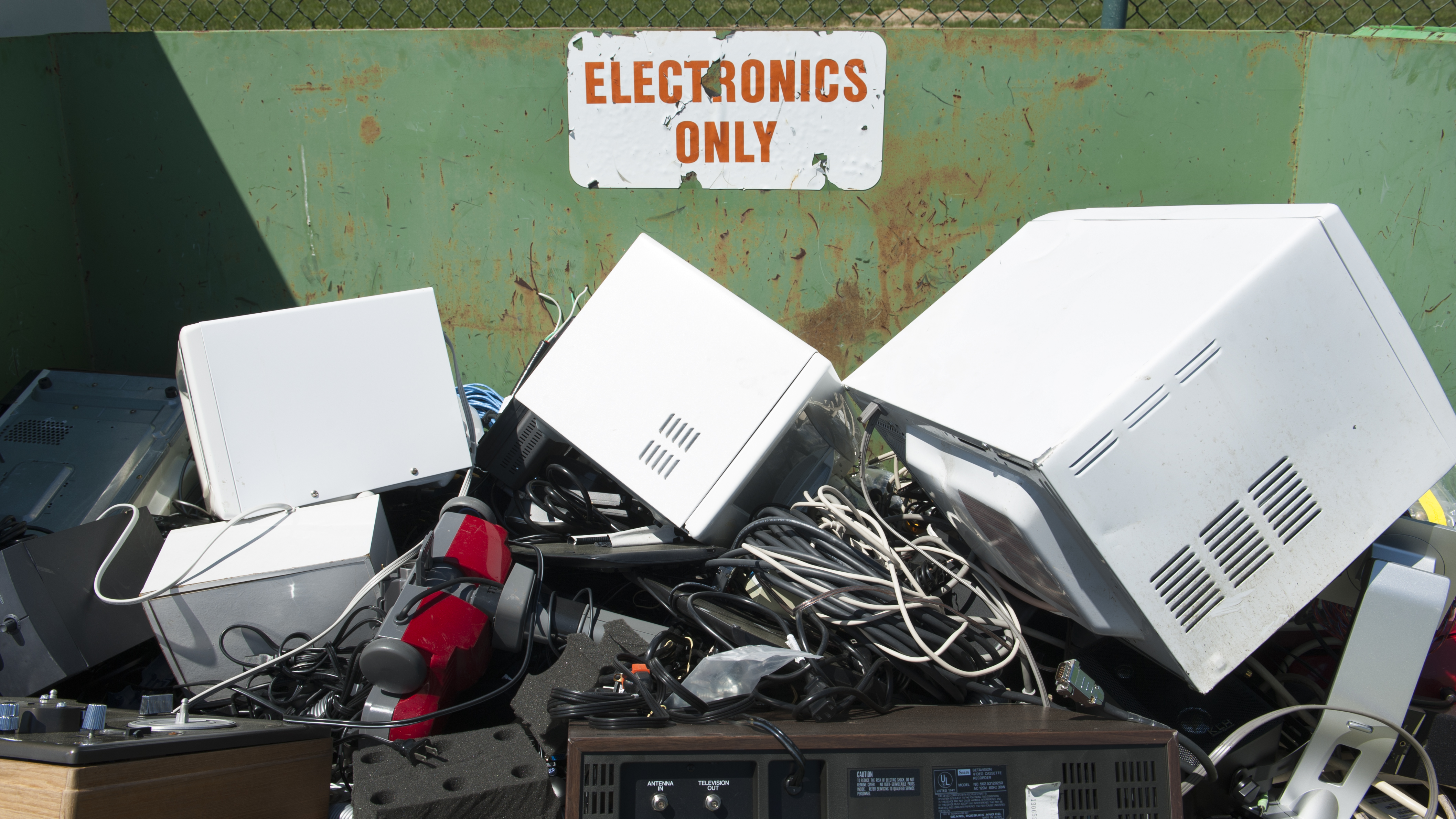 PSI has already learned, for example, that electronics recyclers are experiencing a significant reduction in incoming volumes of material (reported to be as low as 30% of normal levels). Many recyclers are being forced to lay off staff given low material supply from residences, retail stores that serve as collection sites, and nonprofits like Goodwill. Recyclers are adjusting their business practices to include social distancing, staggering shifts, and the use of personal protection equipment. Some are also making the collection process contactless and letting incoming material sit for 24 hours before processing.
The Mattress Recycling Council, which says that it has “activated plans to continue operations and limit service disruptions while also keeping health best practices,” has posted COVID-related guidelines for transporters, collectors, recyclers, and retailers. Members of the International Paint Recycling Association, which PSI helped create, have adopted similar practices to protect their workers while still producing recycled paint. Chittenden County, VT is working on new procedures to re-open its household hazardous waste (HHW) facility, including using a scheduling app to ensure residents can safely drop off materials. As restrictions begin to lift, more communities (like Kane County, IL) are developing “return to service” guidelines to restart collections. PaintCare is advising consumers who are planning to drop off paint for recycling to contact drop-off sites in advance and asking them to follow CDC guidelines to protect themselves and others, and is rescheduling drop-off events planned through June.

With social distancing and other safety measures in place for the foreseeable future, new practices that safely continue take-back programs are vital. PSI will also be working with state product stewardship councils across the country to learn how states are handling impacts of the virus. If you have questions or information to share, please contact Rachel Perlman, PSI Senior Associate.
As the novel coronavirus continues to spread throughout the U.S., state and local governments are working tirelessly to respond and adapt. The primary concern for all of us in this trying time is the health and safety of our communities, especially the essential workers in health care, sanitation, retail, transportation and public safety who are putting themselves at risk to help stop the spread of COVID-19.
Unfortunately, state and local governments are facing increasing pressure to reverse, delay or otherwise roll back environmentally beneficial waste-reduction policies, such as fees or bans on plastic bags, in the name of public health.
The plastics industry in particular has argued that plastic bags are the most sanitary option for transporting food home from restaurants and grocery stores, and it has urged governments to act swiftly to lift restrictions on plastic bags and other single-use plastics. The industry has specifically called out reusable bags as unsanitary, although there is no scientific evidence to support the claim that properly sanitized reusable bags contribute to the transmission of COVID-19.
To date, neither the Centers for Disease Control and Prevention (CDC) nor the World Health Organization has issued guidance advising against the use of reusable bags.
PSI has created a digital tracker to record the changes taking place across the United States. Thus far, Connecticut has lifted statewide fees on plastic bags while Massachusetts and New Hampshire have banned reusable bags in grocery stores, pharmacies, and – in the case of New Hampshire – all retail stores.
Massachusetts has also banned local jurisdictions from charging fees on single-use plastic, paper and compostable bags. Maine has delayed its recently enacted single-use plastic bag ban and 5-cent fee on paper bags until 2021. Several local jurisdictions across the country are placing bag bans and other single-use plastics policies on hold, as well. On a corporate level, many major chains, including Starbucks and Dunkin’, have restricted customers from bringing in reusable items, such as coffee mugs.
Repercussions of sidelining reuse
While the protection of our communities and essential workers is paramount in the short term, we must also acknowledge that increased use and disposal of single-use items has long-term implications for the environment and human health at each step of the consumer-products value chain, from production through waste management.
In the case of plastics, for instance, oil and natural gas extraction and refinement for plastics production causes chronic and sometimes fatal respiratory conditions, cancers, neurotoxicity, reproductive and developmental damage, and immune suppression in many thousands of people each year.
The everyday use of plastic products has been linked to cancer, endocrine disruption and other health problems for consumers. At their end-of-life, hundreds of thousands of tons of plastic products from the U.S. and other wealthier nations are shipped abroad to developing countries, where low-wage waste-pickers must sort through our rubbish to extract recyclable items. Much of this waste is openly burned, leading to further chronic health concerns. The conversion of petrochemicals into plastic products also has a tremendous carbon footprint.
While many suspensions on reusable items cite the quick disposal of single-use products as a boon to worker and consumer health, the resulting increase in waste adds to the challenges facing our already-strained collection system. The waste industry has braced for increased residential volumes since the start of the outbreak in the U.S. At the same time, the industry is dealing with a reduced workforce. As of April 9, at least 350 sanitation workers in New York City had tested positive for COVID-19.
Protecting communities from harmful chemicals and pollution has always been at the heart of local and state waste reduction policies such as bans or fees on plastic bags. While most of the rollbacks to these policies across the U.S. are temporary, it will be critical to ensure they do not lead to long-term policy reversals. The need for sustainable, sanitary reuse infrastructure to facilitate long-term waste reduction has become clear amid this crisis.
The role of EPR
Over the long term, product stewardship and extended producer responsibility (EPR) laws will help address many of the challenges with plastics and other single-use products in the U.S. by creating incentives for reuse, recycling and the production of materials with fewer environmental impacts, and by supporting infrastructure development for proper collection and recycling.
PSI’s recently released report, EPR for Packaging & Paper Products: Policies, Practices, & Performance, outlines problems faced by U.S. recycling programs and how EPR programs in four Canadian provinces have increased packaging recovery and recycling, reduced contamination and developed domestic markets for difficult-to-recycle materials.
As we look ahead to a post-COVID-19 future, PSI is hopeful that innovative product stewardship policies will provide avenues for reducing the production and consumption of single-use materials, increasing domestic reuse and recycling opportunities, and safeguarding public health and safety.
PSI will continue to track policy changes and advise members on responding to concerns about existing policies. If you have any updates on plastics or single-use policy changes stemming from the COVD-19 crisis, please add them to the tracker or contact Sydney Harris.
Sydney Harris is senior associate for policy and programs and Scott Cassel is CEO and founder of the Product Stewardship Institute (PSI).
This question is one we continually challenge ourselves to answer so that we stay on the cutting edge of the U.S. product stewardship movement. As we embark on a new decade full of opportunity for EPR, we want to ensure that the research, projects, legislative models and laws that we craft continue to be relevant.
PSI reflects the strength of the individuals and entities who embody the movement. While we have evolved, we stay close to our inner core. We bring together multiple parties with diverse interests to develop comprehensive plans to solve big waste management challenges. We are problem-solvers who base our policy recommendations on sound science, experience, and peer review. We advocate for product stewardship solutions that are shaped by our long list of members and partners. We are systems thinkers who dissect problems and craft solutions from various angles – environmental, economic, technological, political, and communication with the public. We understand the big picture context as well as the individual parts of resource consumption problems. Above all, we have maintained an ethic of credibility and personal responsibility while leading the U.S. product stewardship movement for the past 20 years.

Like all movements, ours would not have taken hold without the energy, skills, and advocacy of thousands of people, including those government officials in the northwest – Oregon and Washington – who were the early pioneers. The success we have jointly achieved has required policy innovators in state and local governments who risked agency rebuke to forge beyond the status quo. It took corporate talent who leveraged their social capital to look beyond pure profit to engage with others. And it took environmental activists who could share an agenda with other players to achieve joint goals.

At PSI’s inaugural conference in December 2000, more than 100 state and local government officials from 20 states came to Boston to learn about a new concept for holding product manufacturers responsible for financing and managing post-consumer products. That meeting sparked a national movement.
Today, 119 EPR laws have been passed in 33 states on 14 products, and 2019 was a banner year for the U.S. product stewardship movement. A record 50 EPR bills were introduced in 16 state legislatures across the country. Of those bills, 12 passed into law, one committed a legislature to introducing a bill in 2020, and four mandated studies that include EPR as the central solution.
2020 promises to be a critical year for the movement. Packaging bills will be introduced or discussed in at least eight states, and EPR bills on pharmaceuticals, paint, carpet, mattresses, artificial turf, and batteries are already being actively debated. And PSI is right in the middle of it all. We now look forward to the future with renewed passion for progress.
On September 8-10, in Portland, Oregon, PSI will celebrate our 20th Anniversary at the national U.S. Product Stewardship Forum. We are already hearing from colleagues who plan to attend from across the U.S., as well as from Germany, France, England, and Chile. We will acknowledge our roots, assess the growing U.S. and global EPR movements, and plan for the next 20 years of growth. We hope to see you there.

by Dave Galvin,
President Emeritus, Product Stewardship Institute
First President, North American Hazardous Materials Management Association
Formerly with King County Local Hazardous Waste Program, WA
One of my grounding work philosophies was to innovate locally while coordinating nationally and even internationally (“think global, act local” we were told in the 1970s) for all of my 40 years working for Seattle Metro and King County. We can learn from each other, but we have to be willing to innovate locally with a grounded view as to what is going on nationally and internationally, and how we can both learn from others and influence others. I spent my career following those principals: work locally to do the best job we could while coordinating nationally to learn from others and to influence others to keep us all moving in the right direction. This yin-yang approach is, I believe, key to innovation and positive change at the local government level.
It was critically important for me to have a group such as PSI in order to learn from others around the country and beyond as well as to influence national policy direction. Local governments can’t do these big policy lifts alone, they need coordinated help from others around the country and even beyond, such as the European Union. Yet local governments have the flexibility to enact innovative polities that are more difficult to enact up the food chain.
PSI serves as the unique organization made up of state and local governments that helps us at the local and state levels to do the best we can with progressive policy issues related to product stewardship while coordinating nationally and internationally for the best results. It is actually a conservative approach: let local governments and states innovate, then learn from these models to develop national policy.
PSI is a model for positive policy development related to solid waste management, recycling and product stewardship initiatives. We need to invest in PSI in order to keep the momentum for positive change: to maximize recycling, and to shift the paradigm so that producers of waste are expected to pay for and run take-back systems for the wastes their products produce, from packaging to the end-of-life products themselves. We need to keep pushing for these universal, global, ecological concepts as we deal with day-to-day politics.
I have enjoyed my 3+ decades of association with Scott Cassel and PSI, including serving as PSI board President for more than ten years. PSI is the KEY organization that can integrate what we have learned over the past 40+ years, assess the current climate nationally and internationally, and lead progressive policy initiatives within receptive states and nationally as politics allow.
Please support and participate in PSI’s programs. If we wish to fully address climate change, we need to address how we deal with wastes. The sooner we can achieve a one-to-one take back system such as advocated by McDonough and Braungart’s classic tome from 2002, “Cradle to Cradle,” the better. We need to do better than today’s reality. We need to reach for the sky, for what will actually result in a sustainable future.
The Product Stewardship Institute has served as a compass for the past 20 years regarding a sustainable model for product design and waste management. Let’s continue to push for this ideal in order to generate enough initiative locally and with states to influence the national and world view. Product manufacturers need to take full responsibility for the life cycle of their outputs, including taking back and re-manufacturing end-of-life products they sell. The sooner we can move to this conservative paradigm, the better!
Thanks for your support of PSI and its initiatives. The more we can advocate for full product stewardship, the more our environment will benefit locally as well as across this fragile globe.
by Scott Cassel and Kristin Aldred Cheek
 Last fall’s textiles summit was a watershed moment in efforts to address textile waste in the U.S. Organized by the Product Stewardship Institute (PSI), New York Product Stewardship Council (NYPSC), New York State Association for Reduction, Reuse and Recycling (NYSAR3), and New York State Pollution Prevention Institute (NYSP2I), the event brought together more than 200 textile designers, brand owners, used clothing collectors, recyclers, and government officials for the first time. The focus: improving the sustainability of the textile industry throughout the supply chain, including reducing the amount of textiles disposed and keeping millions of dollars in valuable materials circulating in our economy.
One point of general agreement at the summit was the need to move away from a “fast fashion” mentality and, in its place, build a repair-reuse-recycle mindset among businesses and consumers. Unfortunately, nearly one year later, leadership from brand owners and manufacturers remains largely absent.
Upstream, there are voluntary initiatives to reduce the environmental impacts of the textiles industry. Researchers are developing new methods to separate and extract fibers from used textiles, which would enable companies to recover the most valuable material and turn it into new products. Downstream, there are often-cited projects by companies like Patagonia and Eileen Fisher to repair, reuse, and recycle clothing.
Such efforts are examples of the varied possibilities for a more sustainable approach, but they shouldn’t distract us from the reality that the textiles industry as a whole is the second largest polluting industry in the world after oil and gas. While we wait for fiber recovery technology to be refined and brought to scale, or for voluntary efforts to grow to a meaningful level, the amount of textiles disposed continues to climb. A record 13 million tons of textiles went to landfills or combustion facilities in 2015 alone.
The technology to reuse, recycle, and repurpose many textiles already exists. Countless organizations and businesses already understand the value of recovering what’s currently being wasted and are clamoring for more material.
What’s missing is the properly funded infrastructure for collection and processing.
By requiring all textile manufacturers to finance and manage the post-consumer textiles they sell into the market, Extended Producer Responsibility (EPR) policies can achieve the efficient reuse and recycling of a high percentage of scrap textiles. EPR policies create an organized structure for cooperation and communication that is based on financial incentives and social responsibility. These systems create a level playing field among producers so that all players compete equally. At the same time, EPR lifts much of the burden from taxpayers who are currently funding disposal, regardless of their personal textile purchase and disposal habits.
There is a huge opportunity here for brand owners. Over the long haul, economies across the globe are heading toward more transparency, more substantive corporate responsibility, and more circularity. Companies that take responsibility for the lifecycle of their products will have the fewest risks and the greatest likelihood of increasing their market share. Moreover, companies that seize a leadership role today and engage in the process of developing an EPR system will be setting the bar for themselves and their competitors and defining product stewardship in the textiles industry for years to come.
To develop effective policy, there needs to be a facilitator that can develop a consensus on the extent of the problem, the goals sought by those with an interest in the outcome, the barriers to achieving those goals, and the solutions to overcoming those barriers. There is a roadmap for success. Over the past two decades, PSI has facilitated the development of many effective EPR policy models, and today our members are interested in the development of a policy model for textiles.