

As an organization, PSI has hit its stride. As we approach our 15th year, we are moving from adolescence and the Constant Present to implementing our fourth long-range plan for the future. We have a solid new board of directors that includes a balance of geography (East, West, Midwest, South), politics (red, blue, and purple), and skill sets – all 100 percent committed to advancing product stewardship programs across the U.S.
We have an equally committed staff of 9 dynamic individuals, supported by over a dozen interns and consultants, who juggle multiple projects, fundraise, promote our accomplishments, and assist in passing and implementing product stewardship laws and programs on about 20 product categories!
PSI’s membership and partnership programs have steadily increased from 150 in fiscal year 2009 to over 400 today, representing an active, vibrant, and expansive product stewardship professional network of individuals from agencies, businesses, organizations, universities, and non-U.S. governments. PSI’s finances have also improved slowly but steadily over the past 14 years, and this past year was the first time we broke through the million dollar revenue mark. Our funding strategy has always been to diversify, and we have been successful in maintaining a balanced portfolio of memberships, partnerships, private and public consulting, foundation funding, and other revenue.
The EPR movement in the U.S. has also matured. There are now 82 EPR laws on 11 product categories, with at least one law in 33 states. Over the past six months, there have been many EPR “firsts”:
- Vermont passed the nation’s first primary battery law.
- Colorado passed its first product stewardship law (the eighth paint law in the nation).
- Two major household battery industries representing single-use and rechargeable markets jointly developed draft legislation, preparing for the introduction of bills in several states in 2015.
- There has been acknowledgment by carpet manufacturers that they have a responsibility nationally to fund the recycling of their post-consumer scrap carpet.
- And, as our colleague Matt Prindiville of Upsteam pointed out on our recent Annual Membership/Partnership Conference Call, the consumer packaged goods companies have also acknowledged their responsibility to recycle their packaging.
Moreover, several additional EPR laws have a chance of passing by the end of the year.
PSI has had a hand in all of these developments, at times to a significant degree, and has been instrumental in fueling the movement. And by PSI, I mean the large coordinated network that makes us who we are today (believe it or not, we’re not just a bunch of capable staff in a hip office in Boston’s South End 🙂 !). We, collectively with all of you, are able to experience this social change because we have built a strong coalition among government officials, businesspeople, environmental activists, academics, and the general public.
This change is inevitable. It makes sense. Manufacturers make stuff, so they should be responsible for managing that stuff. But we all benefit from that stuff, so we have roles too. Defining those roles and providing a vision for the End Game is what PSI does well. We know how to involve others, and we know that all stakeholders have important interests, unique technical information, and experience.
We have all done a good job at starting new EPR programs. We need to do a better job at recognizing that new programs will always need corrective action. Product stewardship programs are new in the U.S. and globally. We need to learn from our experiences and apply what we’ve learned to make our programs better.
Last, my trip to Japan in June to present a summary of the EPR programs in the U.S. to 130 global EPR experts at the Organization of Economic Cooperation and Development (OECD) was eye-opening, and a great privilege. I came away with an understanding that all of us—those in developed as well as developing nations—hold the pieces to a giant waste management puzzle. But we are not always connected. For example, while some in the U.S. want to ban the export of scrap electronics, government officials in India, China, and Malaysia want to build capacity through education and training to move the informal recycling sectors in their countries to healthy formal sectors – keeping desperately needed jobs. These are two pieces to the puzzle – our e-scrap and their recyclers – that so far have not been adequately connected.
I hope that you all get a chance to kick back a bit this summer, recharge, and reconnect to the people and things you love. Rest assured that, somewhere in our vast EPR network, there is the hum of activity, advancement, and accomplishment. This engine of product stewardship will never rest. But you should.
For those of us in the environmental movement, it might seem as if we are on a long hike, which keeps going and going and going, from peak to peak, and valley to valley. The landscape looks familiar, the challenges commonplace. There are times to rest, and times to move, times to seek shelter, and times to book it across wide open fields. And then there are times when you sit back and notice that you have come a long way, and that the process was enjoyable, and that the long days of trudging in mud got you to a place of beauty, and that the view is nothing like you could have imagined.
On July 1, I attended an event at a Sherwin Williams paint store in Branford, Connecticut, to mark the start of Connecticut’s paint stewardship program. Before Governor Dannel Malloy placed the first gallon of paint into the collection container, he spoke of the importance of keeping paint out of our storm drains and the Long Island Sound, and praised the industry for their product stewardship efforts. Dan Esty, Commissioner of the Department of Energy and Environmental Protection, talked about the “new world of product stewardship” and how the paint program kick off represents the “next step in Connecticut’s move to building the waste management system of the 21st Century.”
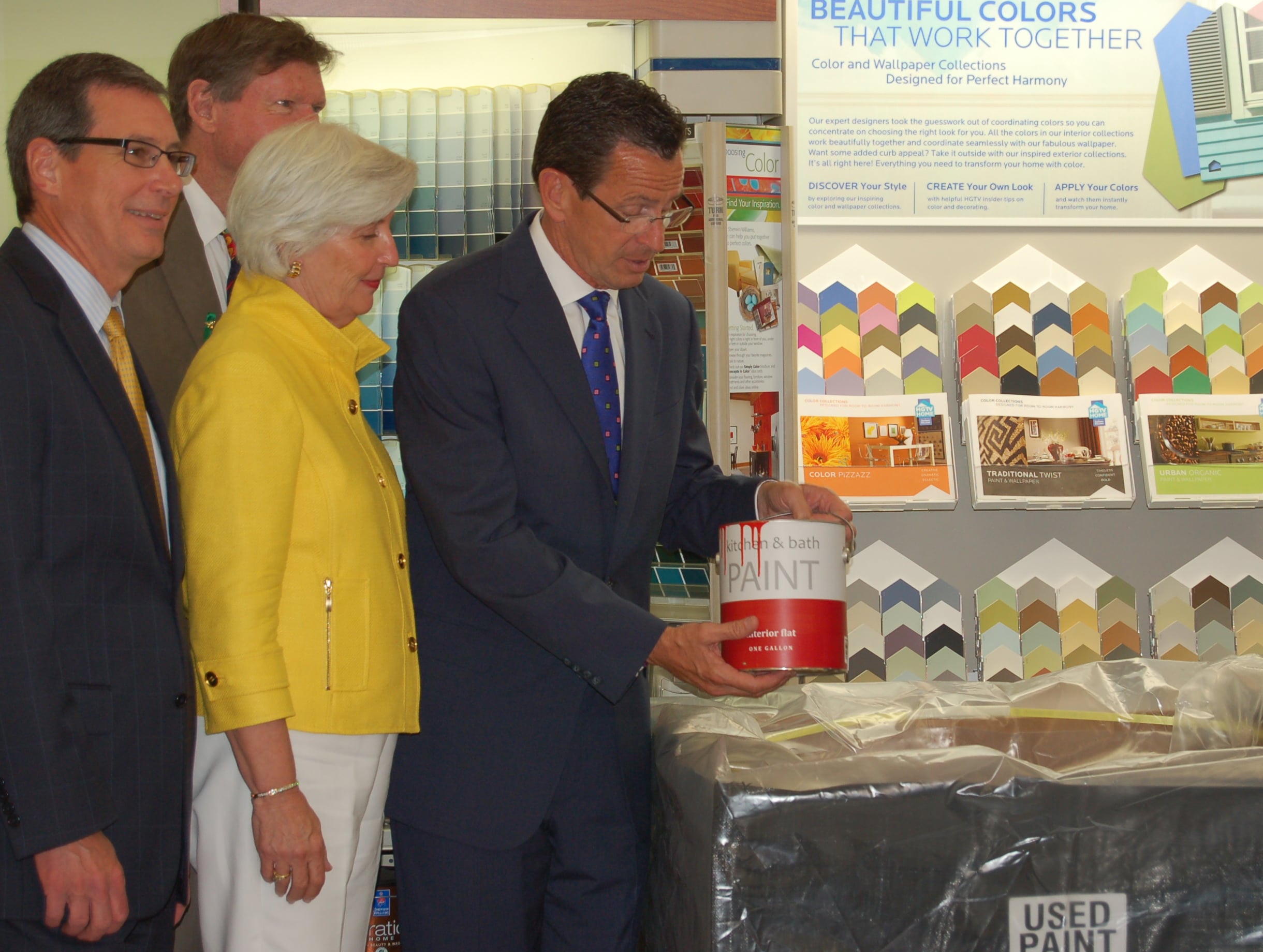
Connecticut Gov. Dannel Malloy places a can of paint in a recycling bin in a symbolic kick-off to the PaintCare Program. (L to R: American Coatings Association President Andy Doyle; Connecticut State Sen. Ed Meyer; Connecticut State Rep. Pat Widlitz; and Gov. Dannel Malloy.)
One after the other, speakers walked to the makeshift podium at the corner of the paint store, amidst the colored strips of lavender and mauve, and praised the new paint program and its ability to save resources, save money, and create jobs.
There was a good feeling, and rolling out right in front of me, like a video documentary, was a paradigm shift of immense proportions, as Important People, from the Governor and his Administration, to key legislators, retailers, and paint manufacturers, praised the collaborative nature of this innovative program.
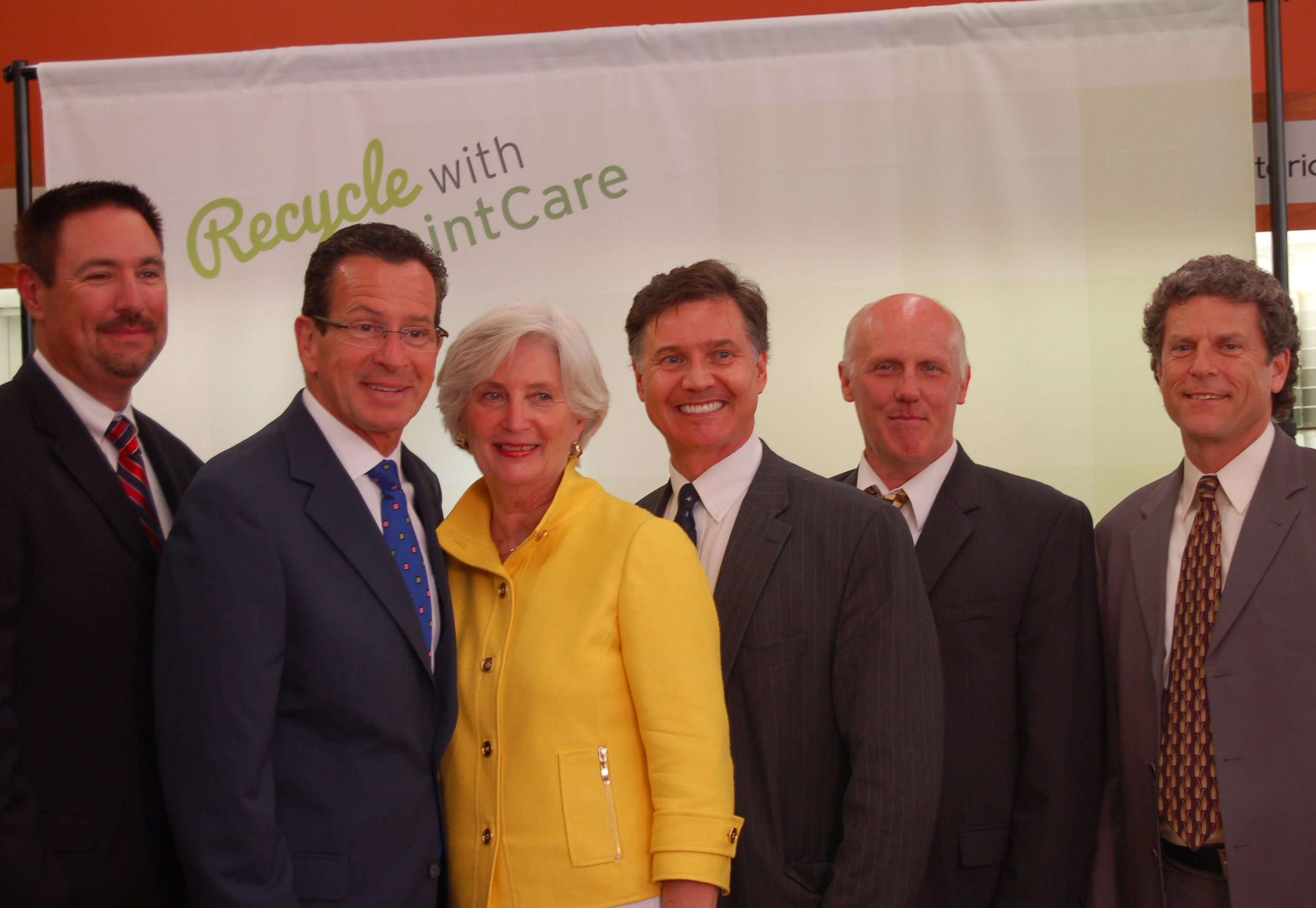
(L to R: Sherwin-Williams District Manager Tom Kelly; Connecticut Gov. Dannel Malloy; Connecticut State Rep. Pat Widlitz; Connecticut Dept. of Energy and Environmental Protection Commissioner Dan Etsy; Connecticut Dept. of Energy and Environmental Protection Environmental Analyst Tom Metzner; Product Stewardship Institute Chief Executive Officer Scott Cassel)
Tom Kelly, Sherwin Williams District Manager, mentioned the calls he already received on the first day of the program from residents seeking a place to bring leftover paint. “They come in just to drop off paint, but then see a clean store, and that we have what they need, and they leave a customer,” he said. Andy Doyle, President of the American Coatings Association, pledged the “support and backing of America’s paint industry” to recycle all the state’s leftover paint. The two chief bill sponsors – Sen. Ed Meyer and Rep. Patricia Widlitz – applauded the Governor and his team, as well as the industry, for their collaborative approach to finding a solution to a significant environmental problem, calling it “something really special.” They talked about the “terrific concept of producer responsibility” in which “paint manufacturers come up with their own plan to recycle.” State Rep. Lonnie Reed said that “…building in recycling and end-of-life elements into all of our products is important, and a sign of things to come.”

(L to R: American Coatings Association President Andy Doyle; Product Stewardship Institute Chief Executive Officer Scott Cassel)
As I stood there listening, it struck me that product stewardship has become commonplace in Connecticut. PSI laid the groundwork for paint product stewardship in Connecticut and across the nation by convening paint manufacturers, retailers, state and local governments, and others in national meetings to hash out the agreements that led to this very moment. But the paint program in Connecticut would not have happened if each of the local stakeholders at that press event did not seize on the opportunity they were presented. The paint industry has now transformed itself from an industry that once saw consumers as the reason for leftover paint to one that has taken a leadership role to make sure leftover paint is recycled.
As our nation debates immigration reform, marriage equality, and voting rights, we can all sense shifts in public opinion that represent sea changes of immense proportion. This year marks a watershed moment in the product stewardship movement. To date, eight producer responsibility laws have passed this past year on four products in eight states: pharmaceuticals (Alameda County, CA; King County, WA); paint (Maine, Minnesota, and Vermont); mattresses (Connecticut and Rhode Island); and thermostats (New York). No, the entire country has not embraced producer responsibility; that will take decades. But we now have Governors and Commissioners speaking about an industry’s responsibility to manage its own waste, and an industry speaking glowingly about its partnership with regulatory agencies that allow it to assume its rightful responsibility.
This is the paradigm shift that many of us predicted in 2000 when the Product Stewardship Institute was created on that cold December day in Boston when over 100 government officials assembled to talk about a little known concept called product stewardship.
The times have changed. Sometimes it is nice to sit back and enjoy the show, and revel in the enjoyment that your hard work has provided to others. For many of us, now is that time.
Last weekend I had the joy and good fortune to watch my daughter graduate from college. Few of my previous life experiences have matched that prideful day.
At Wesleyan University, on commencement day, a commitment to social justice dripped from each graduate’s gown. A stream of red and black marched by the round-topped star-gazing observatory as African drummers pounded soulful renderings under a tent. Professors and other dignitaries mingled around lawn chairs, and flags whipped in the cold wind.
Receiving an honorary degree was former Wesleyan graduate, Majora Carter, whose efforts to economically revitalize poor urban areas are profoundly “Wes.” So was her speech. Her message: Get ready to be uncomfortable. That’s right! Anyone who wants to shake up the status quo will have enemies, even brutal opposition. You will know who your friends aren’t, she said.
As someone who wears product stewardship lenses inside his gl
Over the past 13 years, this space has yielded dividends. In the past two weeks, three new producer responsibility laws have passed – Connecticut’s first-in-the-nation mattress law, and paint laws in Minnesota and Vermont (the 5th and 6th states to pass paint stewardship legislation so far). These laws do not pass solely because of PSI. In many ways, they would never pass if it was all up to us, or up to any one stakeholder. It takes a strong coalition that gets built over time. Starting and maintaining those coalitions is what PSI does – and it often starts in a very uncomfortable place, where we need to convince all stakeholders that the heavy lifting needed to change the status quo is worth the effort.
Thanks to all of our partners for great success these past two weeks, and we hope for many more victories that result in resource savings, job creation, and taxpayer savings. I am starting to like this feeling of being a little less uncomfortable.