
Yesterday, in Boston’s historic Faneuil Hall, I listened to a stirring rendition of the Star Spangled Banner by a high school student whose golden voice inspired angels to dance among the majestic white columns that lined The Great Hall.
I was invited to Faneuil Hall to accept an Environmental Merit Award that the U.S. Environmental Protection Agency bestowed on the Product Stewardship Institute. I was honored to accept that award on behalf of PSI’s staff, members, and partners. And I was proud of our partner, the Northeast Recycling Council, which received an impressive Lifetime Achievement Award.
At the ceremony, I was inspired to hear of the achievements of individuals and organizations in the region, and it gave me time to reflect on what PSI does best, and the challenges we face. What those of us in the product stewardship movement are trying to do — change corporate behavior –is not easy. At stake is the Role of Government, whether that role is to assist industry in developing voluntary projects and agreements, or to develop legislation. PSI seeks to facilitate a healthy balance between regulation and free market enterprise.
Two of our most notable successes have been in partnership with the U.S. EPA.
One of those initiatives was a voluntary program, while the other resulted in model legislation. In 2004, under an EPA grant, PSI partnered with Staples to develop the first retail computer take-back program in the country. Chris Beling of EPA Region I was a diehard advocate for that project and contributed to its success. That voluntary pilot project ultimately led Staples to develop a nation-wide ewaste collection program. Other retailers selling computers and electronics have since followed with their own recycling programs.
The other notable initiative began in 2002, when EPA funded PSI to hold its first dialogue meeting with paint manufacturers, retailers, painting contractors, and government agencies. That first meeting turned into a national agreement, model legislation, and three state laws that require paint manufacturers to set up and fund a system to recycle leftover paint. The paint industry is the main engine behind the passage of these laws. The program will eventually save governments over half a billion dollars each year in paint management costs, create paint recycling jobs, and save valuable natural resources. Prior to the national agreement, PSI facilitated and managed eight voluntary projects funded jointly with nearly $2 million from government agencies and the paint industry. Barry Elman of EPA headquarters played a pivotal role in all phases of the project.
PSI is proud of its achievements to pass EPR legislation, but we also know that voluntary initiatives, as well as other government policies, have a role to play. Waste management requires solutions that are comprehensive and effective.
Thank you to the US EPA for acknowledging the Product Stewardship Institute’s achievements.
The Product Stewardship Institute was founded in 2000 to establish cooperative agreements with stakeholders to reduce the lifecycle health and environmental impacts from consumer products. Most advocates at the time pointed their fingers only at producers, suggesting that the responsibility was solely theirs. Instead, PSI said the responsibility was shared among all stakeholders, but that producers had primary responsibility for financing and managing the system. This nuanced framing of the product stewardship movement as having a lead actor with a strong supporting cast helped the movement take hold in the U.S.
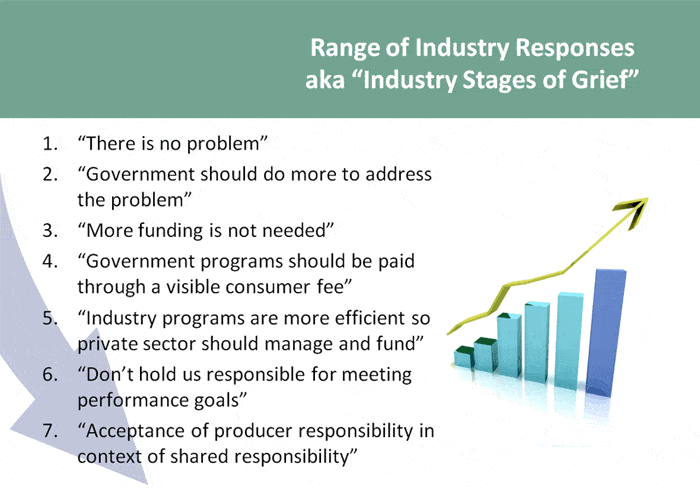
Over the past decade, PSI has knocked on the proverbial door of over 15 industry sectors and offered to work collaboratively to reduce the unintended lifecycle impacts resulting from their products. Companies, like the people who run them, have responded in a variety of ways. These responses usually fit within a trajectory of perspectives that reflects the culture of the industry sector and the individuals who lead them. Whether and how these perspectives change through discourse is also a reflection of the industry, its leadership, and external influence and circumstances. In general, PSI’s experience is that the perspective of most industry sectors proceeds along the following path during the course of a dialogue: (1) there is no problem; (2) government should do more to address the problem; (3) more funding is not needed; (4) government programs should be paid for through a visible consumer fee; (5) industry programs are more efficient so the private sector should take programmatic control; (6) don’t hold us responsible for meeting performance goals.
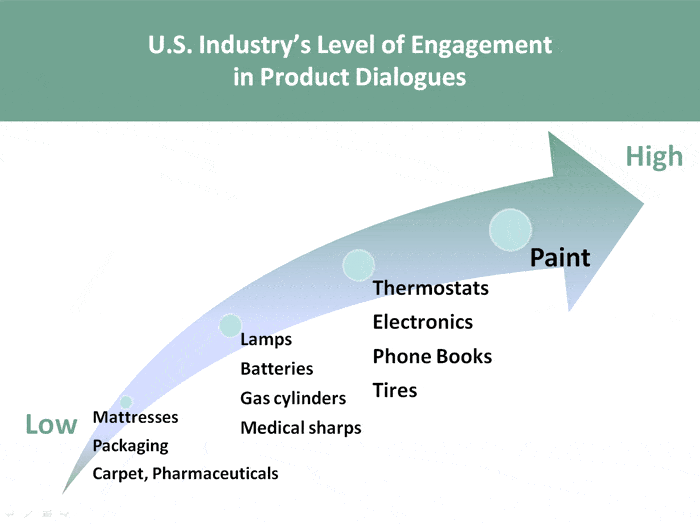
Of the industries we work with, only two manufacturers – paint and rechargeable batteries – have fully engaged government, and both were responding to the threat of legislation. Perhaps the paint industry learned from previous legislative battles on lead paint and volatile organic compounds and saw how it could benefit from the unified national process that PSI offered. Maybe the rechargeable battery industry learned that collaboration with governments was needed to implement its own voluntary producer responsibility program. Whatever the case, the rest of the industries have either refused to engage in a constructive dialogue about the problems caused by their products or they engaged for a period of time, sometimes up to six years, before digging in against further discussion.
The six phases above have been called Industry Stages of Grief by my colleagues in the British Columbia Ministry of the Environment. These phases represent the progression of perspectives that most corporate executives go through when they are confronted with problems caused by their products. No company likes to be told that their products cause pollution and add to the financial strain of governments. None wants to be asked to change its business practices, since change will always mean an investment of resources. The key is whether a company or an industry sector is willing to learn, and also believes it can convince other stakeholders of its viewpoint. I have found that all stakeholders have the potential to change their positions once they engage in dialogue. This change of perspectives happened at every one of PSI’s dialogues, no matter which industry sector we engaged. Government officials learned as much as their industry colleagues, and all positions were influenced as a result.
To be sure, there are companies that are engaging with external stakeholders and have figured out how to make social and environmental sustainability a key component of their business models. For many others, it is difficult to break from the pack.
The Industry Stages of Grief outlined above is a general guide. Manufacturers enter at different places along this trajectory, and proceed at different speeds. All stakeholder viewpoints must evolve to some degree for negotiations to be successful. It takes a commitment of resources for groups of individuals who represent divergent viewpoints to jointly embrace a common idea. There is a dynamic tension that occurs in negotiations. For the dialogue to succeed, the pace of change must meet the expectations of the stakeholders, particularly the governments that now pay a huge cost to manage waste. Progress must be fast enough to keep them from unilaterally legislating. On the other hand, if these regulators proceed too quickly, before strong coalitions can be formed to support the desired changes, they risk not only alienating the industry groups they want to engage but other key stakeholders as well.
Gilles Goddard, an industry representative from Canada, uses the following phrase to capture the delicate dance of negotiations: “You can’t pull a flower to make it grow.” Negotiations take time, perseverance, and the right individuals who want to reach an agreement. Timing is a key element. If government pushes too hard or pulls too fast, it can ruin the chance for success. But if industry moves too slowly, it can also sour the opportunity for an agreement, and result in unilateral government legislation.
Honest dialogue anyone? Is there anybody out there?
It is widely known that the route to producer responsibility in the U.S. has been markedly different from the route taken in Europe and, to a degree, Canada. In the U.S., issues were prioritized based largely on toxicity. When the Product Stewardship Institute (PSI) held its first national product stewardship forum in 2000, we asked state and local solid waste management officials across the country what they considered their biggest waste management problems. By far, the number one issue was electronics, followed by mercury products and paint. For this reason, in the U.S., we focused on these products as the top issues.
Europe, however, started with Germany’s packaging law in 1990. Over the past 20 years, more than 30 European countries have adopted extended producer responsibility (EPR) programs for packaging. Four Canadian provinces have now enacted packaging EPR laws. And the U.S. is still building the groundwork for action.
Here is how the landscape is shaping up for EPR for packaging in the U.S. Proponents of EPR include, not surprisingly, state and local government agencies that started the U.S. product stewardship movement. However, all governments are interested, not just those in progressive states. The cost of managing waste has become a big issue for government, and they are ready to act. Governments are interested in saving money, but are also concerned about the loss of control over the collection of recyclables from households. PSI has been convening its state and local government members to figure out the type of EPR system they want as a model in the U.S. Other EPR supporters are, also not surprisingly, environmental groups. And that is where the current support for EPR for packaging and printed materials stands at the moment.
There are some exceptions among industry. Nestle Waters North America (NWNA) has stepped out as a major proponent of EPR, and PSI is working with them, among many others. NWNA wants to show that EPR can result in increased supply of recycled materials on par with the rates achieved by beverage deposit laws. This position is not to be confused with the position of others in the beverage industry that developed the EPR packaging bill in Vermont in 2010 that included EPR only if the state’s 40-year old container deposit law was repealed. That strategic misstep has confused many people into believing that EPR is synonymous with a repeal of the bottle bill, and has created great animosity among stakeholders. But it has gotten people talking.
“If success is measured by the achieved recycling levels, then member states with strong producer responsibility systems have successfully increased overall rates.” 2005 European Commission Study on Packaging Waste and Options to Strengthen Prevention and Re-use of Packaging
Consumer packaged goods (CPG) companies have, for the most part, been uninterested in engaging in a discussion about EPR for packaging in the U.S., even though their counterparts are operating under the exact same systems in Europe and Canada. Sierra Fletcher, our Director of Policy and Programs and I spent four meetings over nine months with representatives from P&G, Kraft, Unilever, Colgate-Palmolive, ConAgra, and other CPG companies in meetings held by the U.S. Environmental Protection Agency. These companies, in general, believe that we can increase recycling significantly solely by optimizing the current system. In my ten years of engaging brand owners in EPR, we know that this is a necessary step in the process because the existing system can always be made more efficient, and that reduces cost. But it is always only a stage in the process of moving toward an understanding that EPR, and perhaps other systems, are also needed. Only two CPG companies – Estee Lauder and SC Johnson – have engaged PSI in a real discussion on EPR. Estee Lauder is a big fan. SC Johnson does not believe it is the right solution.
The rest of the stakeholder groups are in learning mode, and this is who PSI is talking to.
End users of glass, plastic, paper, aluminum, and other metals – so called commodities – have started to warm to the idea of learning about EPR. The Association of Post-Consumer Plastics Recyclers invited me to speak at its annual meeting in June. I found an engaged and interested group of plastics recyclers that were desperate for ways to increase the recycling of plastics. They want more supply of high quality recycled plastics at the best possible price. They are looking at all solutions, and their staff and policy committee smartly have begun to learn about EPR and how it can help them. Have they embraced EPR whole-hog? No. But do they think EPR might be part of the solution for more business and more jobs. Absolutely.
Plastics recyclers are leading the commodity groups in understanding that quantity, quality, and price can possibly be achieved by EPR. But aluminum is not far behind. I just got back from a trip to Chicago where the Aluminum Association had its annual meeting. I spoke to aluminum industry executives about what EPR is and isn’t, and how EPR and the bottle bill can live together or apart but that the decision should be up to the brand owner as to how they will meet aggressive performance goals. Aluminum industry representatives asked all the right questions, and we have begun a healthy discussion.
Representatives of glass and paper commodities are still warming to the idea of even having an in-depth discussion about EPR. But PSI is talking to them as well. A key concern of the paper industry is why they should face the potential transactional costs of a shift to EPR when their material is already recycled at a high rate.
We are also having discussions with waste management companies, which view EPR as a potential threat to their business models. These companies have invested in recycling and waste disposal trucks and facilities, and in a business strategy that will need to be flexible to respond to the changes ahead with EPR.
Other groups are pushing the conversation as well. The newly formed PAC-NEXT, based in Canada but working with retailers, CPG companies, and related businesses that operate across North America, has invited PSI to engage with its corporate members with the goal of helping the packaging industry transition toward a world without packaging waste. PSI is co-chairing a PAC-NEXT project to develop best practices for post-consumer material recovery, including EPR, which will lead toward harmonization of programs in North America. And Future 500 out of San Francisco is selectively engaging stakeholders on EPR in the U.S.
Packaging and printed materials is a product area that is much different from others we have tackled in the U.S. – yet at the same time it shares with other products the fact that our traditional waste management system has relied on the patchwork of local and state governments to clean up after us. A solution will not be achieved overnight, but we are starting to build it. There are many stakeholders with multiple interests that need to be melded into a cohesive agreement that is sustainable. These stakeholders are not at the same place in their interest and willingness to develop a model EPR bill in the U.S. But these discussions are taking place, and coalitions are forming.
But the first thing that needs to happen is that people learn the facts, and that is where PSI is spending its time – educating all stakeholders about EPR so that they understand how EPR will result in less waste, more recycling, more jobs for the recycling industry, and lower costs for government. This is all about how good government and the right regulations CREATE jobs. It is time for this reality to be heard loud and clear in America.
Check out the article in Plastics News reporting on my presentation to the plastics recycling industry. Although there are a few factual errors in the article, it will give you a good sense of what I said, and about how EPR can increase material supply and quality, and lower costs.
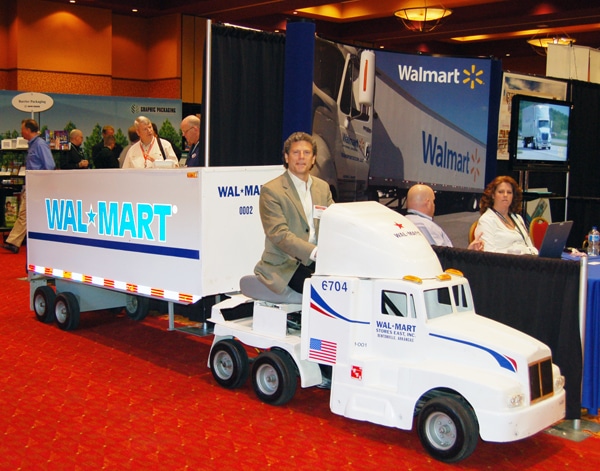
Over the past few years, Wal-Mart has successfully shed its image of fueling America’s thirst for low-cost consumption to become a leader in the emerging field of sustainability. Recently, I had the opportunity to speak about product stewardship at Wal-Mart’s 6th Annual Sustainability Expo in Bentonville, Arkansas. My message was that companies have a unique responsibility to be stewards of their products across the entire lifecycle, and that government can be a good partner. While that message was embraced by many company leaders, I also ran into a tsunami of market-based mania that fears change and uncertain outcomes.
Bentonville is a mix between Rockwell-like farmland with horses and cattle roaming in fenced-in plains…and company row houses. The Expo was located at a hotel that became a Mecca for hundreds of Wal-Mart suppliers, each touting sustainability claims that were verified by PSI partner, EPI, which after six years of Expos, still found the need to correct the claims for two-thirds of the vendors prior to the show. Every commodity association was there – paper, aluminum, plastic, glass, metals. Every consumer packaged goods company was represented, like Colgate-Palmolive, Kraft, Unilever, and P&G. Companies were selling eco-packaging, defined in innumerable ways. And the Product Stewardship Institute was there, with our spiffy table-top display.
Coupled with the vendor booths were three morning presentations, one after the other, two at a time. The rest of the day was free to view the exhibits and mingle. I presented at one of the sessions (twice) and sat in on several of the others. Wal-Mart puts a tremendous amount of effort into defining sustainability for itself and its suppliers. Wal-Mart’s Scorecard compares suppliers on a range of sustainability criteria so that buyers can make decisions based on environmental factors as well as the usual price, quality, and other variables, although I did not hear anything about social criteria (child labor, worker issues, etc.) being measured. The presenters went into painstaking detail about how suppliers are to fill out their Scorecard. The room was packed, and people were paying close attention. I asked several suppliers what motivated them to make changes towards sustainability. “Because Wal-Mart’s asking us to do it,” was the reply.
Perhaps then it should be no surprise that some companies did not take kindly to being told they have a corporate responsibility in the form of product stewardship, and that there was a strong role for government. This is a crowd that runs on voluntary programs, that is motivated by the market, and wants to keep government about the size of a pinhead. They are motivated by cost savings from sustainability, and have not thought much about the environmental impacts of their products when consumers no longer want them. I took the challenge, and told them about market failures, and about the four tons of mercury going into the environment each year from the disposal of thermostats despite a decade-old voluntary industry program. I made the usual case for jobs, economic value, environmental protection, and taxpayer savings. I described how PSI developed paint legislation jointly with the American Coatings Association, and how this has resulted in the expansion of the recycled paint manufacturing sector, just as legislation on electronics spurred huge growth in the electronics recycling sector years ago.
There was much positive response to what I discussed. However, I also learned that many companies are threatened by product stewardship. One senior executive of a pharmaceutical giant knew all about the Product Stewardship Institute (PSI), including our national dialogue on medical sharps two years ago. His company is a major manufacturer of insulin and uses medical sharps as a means of delivering its medications to patients. He said he did not participate in our sharps dialogue because his company was not prepared to state its position. He complained that the dialogue was not developing solutions for real patients and that we didn’t know what patients wanted (even though we had patient advocate groups, sharps manufacturers, and other pharmaceutical companies at the table). During PSI’s two-year dialogue on medical sharps, we sketched out a statewide pilot project for the collection of sharps through various methods so we could evaluate the costs and complexities of such a model system. Unfortunately, the time and expense of developing the background information, reaching solutions, and designing a pilot came up short because the few key pharmaceutical companies (like this guy’s company) that needed to make a commitment refused to participate. Now, two years later, after billions more medical sharps have been disposed of in the trash, and after more worker injuries and added medical costs, I was told that this major company is working on an industry voluntary solution. He indicated he didn’t want any help.
Later, I saw a colleague from the American Chemistry Council and we talked about local government plastic bag bans and taxes, and how the Illinois legislation that requires producers to pay for recycling programs might be an interesting model, one that ACC and local governments in Illinois support. I then talked with one of ACC’s members and a founding member of AMERIPEN, the new lobbying group for consumer packaged goods companies. This person had attended my session, objected to EPR for packaging, objected to my slide on the benefits of EPR, and saw plastic bag bans as EPR which, by the way, she objects to.
All in all, I came away very impressed with Wal-Mart’s ability to motivate companies with the shear force of market optimism, its ability to stay on message with so many dedicated senior staff, and the results they have achieved. I also came away knowing that many companies and individuals shut down their communication because of fear about changes that product stewardship might bring. These people stop progress for themselves, their companies, and the social good. They are indicative of companies that will find themselves at the back of the pack in making the changes they need to stay competitive. They are risky investments.
I do not expect full agreement with the product stewardship message. But if a problem exists, such as waste, environmental externalities, pollution, lost jobs, and unnecessary costs, we need to put our heads together to come up with the answers. Company representatives that want government to wait until their company has an iron-clad position will only harden opposition to a joint solution.
As always, the Product Stewardship Institute is ready for discussion. We are ready to change our understanding of issues…because that is what happens when people talk to one another. But when problems persist, or if companies bury their heads, don’t expect PSI to stand by idly waiting for companies to finally decide they are ready. Where is the corporate responsibility in that? Where is the individual responsibility and personal commitment needed to take care of problems that products cause? If you work for a company and you don’t act now, try explaining that to your grandchildren.
by Rodney North of Equal Exchange
For those interested in product stewardship the focus historically has been upon physical/material matters – such as:
Is a product toxic in its production, use, or disposal?
Can it be recycled? If so how?
How much water or energy is used in its life-cycle?
Etc.
We do this both out of a concern for the environment itself but equally because of the direct and indirect effects upon people. And if improving human welfare is sometimes/often/or always your motivation for product stewardship then we modestly suggest a wider perspective on the many ways the stuff people buy impacts people’s lives.
For this reason Equal Exchange might have unusual insights to share with the product stewardship community. For 24 years we have worked hard to make select industries that produce goods that most Americans buy every month, and maybe even daily – like the coffee, tea and banana trades – work better for more people. We’re focused most of all on the millions of small-scale farmers around the world who grow these crops. In fact the industries beyond these everyday items have shaped the course of history for dozens of nations. For example, where do you think the phrase “a banana republic” came from? Suffice to say that the systems that keep our grocery stores stocked with bountiful amounts of very affordable tropical products works better for food companies, retailers and consumers than they do for farmers or farm workers.
Specifically, as a business Equal Exchange has been uniquely concerned with how the buying and selling of products affect people, especially those who are the most disadvantaged within a given supply chain. So even when the physical aspects of a product pose no threat we have seen over and over how the commercial aspects of a supply chain can have powerful negative or positive effects upon communities both abroad and here at in the U.S. It is for these reasons that back in 1986 we helped introduce to US grocery stores the Fair Trade model for imported foods.
In the U.S. and other developed economies we have taken many steps to soften the edges of the marketplace so that it is not as callous, dangerous and exploitative as Charles Dickens’ “dark satanic mills” or Upton Sinclair’s “jungle”. There is still more to be done – for example for migrant farm workers and meat-packing employees – but especially for those in less affluent nations, where the marketplace remains largely ungoverned and where the vast majority work at the mercy of amoral and impersonal market forces.
I know that’s strong language but there is no other way to describe it. Plus it helps explain why there is a need for companies like Equal Exchange and why governments, at all levels, should think about products more broadly and consider not only physical and environmental attributes, but also the social character of how goods are produced and traded.
With that said, Equal Exchange is also very concerned about the environmental impacts associated with our products and for good reason. After one’s home and maybe even more than one’s car the food we buy (annually over $6,000 per year per person) may represent the largest environmental impact we have. For example, agricultural is a bigger contributor to climate change than are all forms of transportation combined. A whole host of other environmental issues also pivot on farming, including soil erosion, dead zones in the Gulf and Chesapeake Bay, and loss of wildlife habitat. So if you care about how products affect the environment, then you have to think about food, which means thinking about farming. At Equal Exchange we do and that is why over 95% of what we import is organically grown.
This is where our work, and that of tens of thousands of organic farmers around the world, overlaps most closely with the traditional concerns around product stewardship. Let’s put it in what might be more familiar language.
Imagine you have two ways to produce a widget:
Process A involves chemicals ranging from mild to very toxic, including many that are have long been banned in the U.S. due to their extreme environmental side-effects when used as directed. The chemicals are often used by people with no safety instruction or equipment (masks, gloves, aprons, washing stations, etc). There is little-to-no regulatory oversight of the use of these chemicals. Direct and indirect harmful exposure to workers, their families, and other in their communities is common, resulting in frequent illness, and even birth-defects and death. Rivers and public water sources become contaminated. These chemicals are typically combined with complementary production techniques that together accelerate climate change, soil erosion in mountainous regions, lower soil fertility and the loss of both animal and plant biodiversity.
And Process B for producing the widget avoids all of the problems above, while also sequestering carbon and increasing climate change resilience, restoring soil fertility, minimizing erosion, restoring biodiversity, and encouraging a stewardship mentality to the productive resources involved. Process B often produces higher quality “widgets” and is also sufficiently productive and efficient to be competitively priced on the market.
This over-simplified story of 2 “widgets” essentially captures some of the production choices we face in how much of our food is produced in the global South, and we hope the product stewardship community will consider this, as well the human/commercial side of those supply chains, in the years to come.