
While a light bulb may seem like a trivial item, it has incited momentous debate. To energy efficiency advocates, the light bulb symbolizes the opportunity to upgrade an Edison-era technology, save money, and reduce greenhouse gases and other environmental impacts. In the Tea Party’s eyes, the light bulb is a prime example of an overly pervasive government dictating what items we can install in our private homes. To me, many actors – Republicans and Democrats, environmental groups and anti-government cheerleaders – have turned the lights out on the public, muddling and oversimplifying a complex issue.
In 2007, President George W. Bush, signed into law the Energy Independence and Security Act, which requires light bulb manufacturers to improve household bulb efficiency by 30 percent and phase-out 100- and 40-watt bulbs between 2012 to 2014. The law exempts “specialty bulbs” like those for chandeliers, and does not mandate using any particular type of energy-efficient bulb.
Not only was the federal bill signed into law by a staunch Republican, but it also had overwhelming bipartisan support. The House passed the bill 314-100 following its 86-8 passage in the Senate. Lighting manufacturers and retailers also heavily favored passage of the bill. “We support the notion that efficiency is a desirable thing, and this type of standard has been a part of our body politic for a long time,” said Randall Moorhead, vice president of government affairs at Philips, earlier this year.
The Energy Independence and Security Act was also touted as a way to lower our foreign oil dependency. Although many of us have warmed to the glow of incandescent bulbs, the U.S. EPA notes that 90 percent of an incandescent bulb’s required energy is wasted as heat, meaning increased use of scarce and highly polluting natural resources such as oil and coal. The Natural Resources Defense Council also predicted annual savings of $13 billion in energy costs and a yearly reduction of 100 million tons of carbon dioxide emissions.
Before the bill was introduced, technology gurus were at work developing energy-efficient alternatives. According to the U.S. Environmental Protection Agency, one such alternative – compact fluorescent lamps (CFLs) – use 75 percent less energy and last 10 times longer than traditional incandescents. The U.S. Department of Energy asserts that, over its lifetime, a 25-watt CFL actually costs a consumer $105 less than a 100-watt incandescent, factoring in the cost of the bulb and energy usage.
Manufacturers began rolling out CFLs in bundles, large retailers marketed energy-efficient bulbs to the masses with huge discounts, and consumers switched to CFLs and light emitting diodes (LEDs). Unfortunately, supporters of this well-intended light bulb law did not finish their homework. Many consumers are dissatisfied with the performance of the alternative bulbs. And worse, no one mentioned that CFLs contain small amounts of mercury and, therefore, need to be recycled once they burn out. In addition, no one explained that CFLs can break, although not nearly as easily as their well-known cousins, the linear fluorescent lamp known worldwide by anyone who works in an office or does home improvement projects. The fact that breakup cleanup is easy and not particularly hazardous (but needs to be done right) further botched communication with the public.
Does the Tea Party have something to howl about? Yes it does. But they are howling at the wrong moon, missing a golden opportunity to help the public by meaningfully addressing the real issues. To this day, lighting manufacturers are fighting legislation that would require them to create recycling programs for their product. They want taxpayers, not consumers, to cover the cost.
What does this all mean? The adoption of the Energy Independence and Security Act has certainly created chaos. Proper planning for the law’s implementation was bungled by government, manufacturers, retailers, and environmental groups. Was it well intended? Absolutely. Should we roll back the clock? No. The potential for energy savings, pollution reduction, and cost savings for consumers in the long-run are too great to sacrifice for Tea Party enthusiasts who want to shrink government into nonexistence.
What do we do now? One solution is to make sure that manufacturers of these mercury products take responsibility for recycling burned out bulbs. Also, retailers promoting the sale of the bulbs must be part of the solution, collecting bulbs voluntarily and/or alerting consumers that the bulbs must be recycled and directing consumers to convenient drop-off locations. We must also learn from this mistake on a larger scale. Manufacturers of products should account for the product’s full lifecycle impact and factor the ultimate fate of a product’s materials into a plan for recycling or proper disposal.
Government officials, environmental groups, and PSI have all succeeded in Maine, Washington, and Vermont in mandating that fluorescent lamp manufacturers pay for recycling spent mercury lamps. We hoped that this industry would recognize the need for leadership without our persuasion. But all involved parties must now roll up their sleeves and find joint solutions to past mistakes. One thing we don’t need, however, is the drone of anti-government accusations taking the spotlight off more significant issues.
Last month I was fortunate to have been asked to present at the Northeast Resource Recovery Association’s 30th anniversary conference. One of my assigned topics was “Product Stewardship in 30 years.” Initially, this task seemed daunting…until I realized that I could say almost anything since no one knows exactly what will and won’t happen 30 years from now.
As I combed through my litany of what-could-bes, I considered the notion that 10 years of U.S. product stewardship might have finally positioned us to reach far upstream to reduce product impacts, and set us on the path to true sustainability. I even went so far as to say that the current conservative Congressional winds might just open the door to the removal of subsidies underpinning product un-sustainability.
During the question-and-answer period, one of our friendly participants asked me if my cause for optimism was justified. After all, many conservative politicians don’t give a hoot about environmental protection if it means that industry and consumers must pay for added social and environmental protections. Yet members on both sides of the political firestorm are increasingly focused on eliminating subsidies (tax breaks) due to a panic-inducing budget deficit.
First on the chopping block are ethanol subsidies.
Some thirty years ago, when a confluence of circumstances pushed the concept of alternative fuels to the forefront of Congressional consciousness, those growing corn for use in ethanol production received handsome federal subsidies. No thoughtful lifecycle assessment determined if this industry was sustainable. And there was no widespread public debate on the various potential alternative fuel opportunities. But in the heartland there was a focused political interest feeding off homegrown corn that couldn’t be eaten. Age-old ag subsidies, totaling $30 billion over the next decade, are now under attack as anti-subsidy proponents point to biofuel mandates that preempt the need for ethanol subsidies.
The political equation is fraught with fretting, yet the slash-and-burn, subsidy-removing, equalizer sword that conservatives wield at the peril of losing the Iowa primary could effectively level the playing field for sustainable energy as well as sustainable products. And many appear eager to use it.
I am fully supportive of the strong backlash against subsidies. The Product Stewardship Institute’s main objective is to level the playing field for products. Focusing on a product’s end-of-life management is a huge task. But let’s face it, that movement started over 20 years ago in Europe and Canada, and spread to the U.S. 10 years ago. That movement is in full swing. The movement begging for attention relates to the unequal playing field created by subsidies, which causes truly “green” products to be at a competitive disadvantage to those products that only claim to be green, or products that cut consumer price tags but raise societal costs.
This is the next phase of the product stewardship movement.
One of PSI’s goals is to encourage consumers to choose products based on their environmental and social attributes. That is a huge endeavor, considering those attributes often fall behind in product effectiveness, price, and availability. We are still unable to thoroughly and accurately compare the environmental and social attributes of different products. PSI’s green washing webinar highlighted the plethora of environmental claims, certification companies, and public confusion over which products are truly environmentally preferable.
But if we look behind this external curtain, we begin to understand that the product manufacturing system must be challenged. Mining subsidies (150 years old) give millions of dollars each year to companies that extract raw materials from the earth at a time when we are desperately trying to promote the use of recycled materials. Additionally the lack of company requirements for clean-up operations has left 500,000 abandoned mines, polluted 40 percent of western watersheds, and racked up a bill estimated between $32 and $72 billion (not including currently operating mines). We know similar subsidies occur in other sectors like the timber and virgin paper production industry, which allows special tax rates costing taxpayers $440 million a year. Another recent PSI webinar, on mining subsidies, captured these excesses.
If we look closely, there are subsidies everywhere, particularly if that term encompasses society’s subsidization of companies that do not internalize the true costs of their products. And that is the heart of product stewardship. Our movement, across the entire product lifecycle, seeks to require companies to assume the full costs of making products. I do not want to subsidize corn growers for making ethanol, thermostat manufacturers for making sure their mercury thermostats get collected, mining companies for extracting gold to be used in electronics, or any company for costs that society must bear because of that company’s business decisions.
That is a long way of saying that, yes, I am optimistic that now is the time to sound the subsidy issue alarm, and to level the playing field for those businesses truly seeking environmental and social equity. I have no illusions that those rallying for subsidies will stop, or that others will join the effort. But the time is ripe to bring these issues into greater focus and educate ourselves and the public about what we really mean by product sustainability.
I like being comfortable. Every Saturday, I rest. I make myself as comfortable as I can be. On the other days of the week, I make others uncomfortable. Not on purpose. But I suppose it’s the nature of our business…the EPR business. I think of ways to change how waste is managed in our country. And that can make people nervous and downright uncomfortable. The truth is that I am tired of disposing of my own garbage and watching other people’s garbage get tossed out. There are people starving around the world and using scraps to build their houses, and we in the U.S. are still throwing out tons of usable materials. This is a situation no one should be comfortable with. So I want to agitate. I want to change it. Many of you do too. But without holding someone responsible, who is also capable of creating lasting positive change, it will not happen. And that is where EPR comes in.
For years, government was given the responsibility to take care of its citizens. And it embraced that responsibility. Employees cleaned the streets from horse excrement, paved roads, and met the needs of citizens. Along the way, they also started to carry the burden of companies, which made more and more products that were shipped to the store or to the door, and that was the end of their corporate responsibility…unless someone got hurt directly from negligence on their part in the way the product was made or operated.
But now we know that products harm not only directly but indirectly. There are impacts all along a product’s lifecycle. Mining causes worker injuries, pollution, and blighted landscapes. Manufacture, transportation, use, recycling, and disposal all cause impacts. And the entity that can best change those impacts is the manufacturer that makes those products. Unfortunately, they are all too comfortable with how things are right now. After all, it’s tough in business. To survive is not easy. The successful companies have been able to maneuver through a host of obstacles. And who wants to have to engage in yet another challenge, which is what EPR represents? EPR is just one more obstacle to business survival, and one best avoided.
Those of us in the EPR business have gotten accustomed to making people feel uncomfortable. The first presentation I gave to paint industry representatives on paint recycling, well before PSI was created, was met with disdain. After my dinner-time presentation, a guy from California Paints stood up and literally mixed a bunch of liquids together into a can. He wanted to demonstrate how paint recycling was destined for contamination…how it could never be done right, how toxics would inevitably get mixed with good paint and create a hazardous waste of uncontrollable proportions. He sure showed me…15 years later, the recycled paint manufacturing industry is as strong as ever, and poised for exponential growth.
EPR advocates have learned to expect opposition. We are used to the push back. It is our job to make others uncomfortable and to rethink what they have always been doing for years. When my 21-year old daughter does this to me, I thank her for making me think…really think…about what I am doing and why.
It is time for manufacturers to really think about what they are doing and how EPR can help increase the supply of recycled materials, create jobs, and reduce pollution at reasonable cost. It is our responsibility as advocates to show how EPR can result in those benefits. But ultimately it will take those who are comfortable to become uncomfortable before those benefits are realized.
There is the old saying…no pain, no gain. You exercise and you feel better. It is time to start training for the EPR changes that are round the bend.
Businesses and governments have finally begun to get the message about product stewardship. Now it’s time to take full advantage of the most powerful weapon in our arsenal – the public.
Okay, enough with the military imagery. Even though advancing product stewardship can seem like a war sometime, it deserves a better analogy than that. How about this: It’s time to finish this fantastic green building we’re constructing. We’ve laid the foundation, and built the walls, thanks to a growing number of progressive businesses and governments. Now we need to put the roof on that sucker, by making public awareness of product stewardship a real priority.
A lot of what I do in my job these days is public outreach in the Seattle metro area, using mainstream and social media to try to answer questions and help the public understand the complications of recycling and global warming. I also do a lot of presentations to groups. When I talk to people about product stewardship, you’d be surprised how often their eyes light up – even when they’ve never heard of the concept before – and they say something like, “I LOVE that idea.”
With public support, more product stewardship legislation will get passed, and better laws will get crafted because legislators will know their constituents support them. When the public becomes fully engaged, they’ll tell us what they want from product stewardship. We need to listen to them, because that will make the whole movement better and more sustainable.
How do we bring the public in to the product stewardship tent? The first and hardest thing is to make a little time in our schedules for public outreach. Take an hour or two a week to write an article for a community newspaper (or, if it’s great, go ahead and submit it to the New York Times), or pitch a local radio interview, or talk to a senior group (seniors are interested, and they vote). If you have someone in your office who is fluent in Spanish, ask them to work with you on an article about product stewardship for the local Spanish-language newspaper. If you have a successful product stewardship law in your state, have your agency do press releases or media events to show how successful it’s been.
I know – Public outreach and dealing with the media is messy, and makes our bosses nervous, because we don’t have as much control of the message as we would like. But it can also be fun, if you can find someone in your organization who actually likes to do it. That’s key – don’t try to force someone, including yourself, to do public outreach if you really hate it. The messenger needs to be passionate about product stewardship, and be a people person, and want to share that message with folks.
We really don’t have a choice anymore. If we want product stewardship to survive and grow, the public needs to jump on board. There we go – a nice train analogy. I love it. Let’s get everyone on the train and blow that damn whistle for product stewardship!
“There is no such thing as a free lunch.” That’s what my environmental science professor told me many years ago. He was referring to the 2nd Law of Thermodynamics which, according to Wikipedia, “…means that the universe as a whole is ultimately a closed system—there is no magic source of matter, energy, light, or indeed lunch—that does not draw resources from something else, and will not eventually be exhausted.”
Ever since being introduced to this phrase, I have found myself repeating it when I want to make a point about not getting something for nothing. Advertisements that promote free vacations and free stuff always come with a hitch…like grabbing your email address for endless promotions, or fine print on forms that sign you up for costs when an initial free promotion runs out. You know the deal.
So why do some people want a free lunch when it comes to the environment?
These people don’t want their taxes to go up, and they don’t want to pay more for a product at the store, yet they want a clean environment. Why is that?
Here is my understanding. Most people really do want a clean environment. And they want to leave clean air, clean water, healthy land, and lots of other stuff to their kids and grand kids. Unfortunately, no one told them about the true costs for these benefits and, even if they knew those costs, they would need to be convinced that the money they paid was used efficiently and effectively. But here’s the kicker – none of us really knows the true costs of the products we are consuming at a record pace. That beautiful silver cup in your cupboard came from mined materials that have their own impacts on worker safety and health and the environment. That hand-crafted wooden crib for the new baby came from lumber that was certified by some organization whose stamp of approval states that the trees from which it came were harvested with great care. And the jeans you just bought are made from cotton grown somewhere under conditions that required a lot of resources, then dyed with who knows what type of chemicals that were treated in some way that was hopefully protective of the environment and worker safety, and did not use child labor.
Wow! Is it no wonder that we bury our heads in the sand and move on with our lives… making a living, fixing dinner, creating a home, and staying out of debt. And when it comes to paying for the stuff we use, we all want it for the cheapest price.
Remember the credit card bubble, the real estate bubble, and the housing bubble? We are now in the environmental bubble. The real truth is that most of us really don’t have a clue about the environmental and social impacts caused by the products we buy. But we are about to find out, and then we will have burst yet another unsustainable bubble.
Let me pose a hypothetical question. What if you knew that Product A had a negative impact on the water that you and I dearly value, while Product B did not? And what if Product B cost only a few cents more than Product A? Like most people, you would probably choose Product B.
Now what if Product B was more than a little bit more expensive than Product A? Would you choose it anyway? Fewer people would. They will look harder at the trade-off, and wonder whether the negative impact from Product A was really that much worse than Product B. And how would they really know? Who really knows how either Product A or Product B was made? Even if we had some idea, we are all not scientists who can stop in our tracks and calculate the impacts of every purchasing decision we make. And what if Product A performed a lot better than Product B, or you didn’t want to risk the switch and find out? What would you do then?
It’s no wonder that we don’t want to wrap our brains around the full cost of producing the goods we consume. We’d go nuts!
But we have to start somewhere.
Many companies have begun expensive and time-consuming lifecycle assessments to better understand the environmental impacts of their products all along their lifecycle, from mining, to manufacture, to use, and finally disposal. These tools have advanced our understanding of product impacts. But progress has been slow, and these assessments are often best when comparing one variable against another. Taking this information to the public so they can make purchasing decisions is still years away.
What can we do right now?
Pass product stewardship laws of course!
Product stewardship systems hold manufacturers responsible for reducing the impacts of their products. These systems provide a financial incentive for companies to design products so that they use fewer and less toxic materials and choose materials that have a market value and can be processed and re-sold after use. Product stewardship acknowledges that there are no free lunches. There is a cost to the environment when we make and use products, and there is a cost to minimize those impacts.
If we want clean water and air, green jobs, and lower costs to government, the consumer will pay more than what they pay now for many products. While toner cartridges and lead acid car batteries have a value at “end-of-life” that exceeds the cost of collection and processing, carpet, paint, compact fluorescent lamps, most electronics, and many other products don’t. The product stewardship movement has begun to reverse these external costs on the environment.
We all know that the consumer will pay at the end of the day…because there is no such thing as a free lunch…and manufacturers cannot be expected to eat the extra cost. But what if the manufacturer of Product A and the manufacturer of Product B were both required to set up systems to ensure that their products were collected and properly managed when consumers no longer wanted them? And what if these two companies truly included all the lifecycle costs of making and using their products? Only then will you have the real choice between products, since the societal cost of making that product will be included in the price you pay. But how much will you be willing to pay, and for what level of environmental and social benefit? How will you know that the impacts of making that product were truly incorporated in what you paid? And what value do you place on those benefits as compared to your neighbor? This is the bulls-eye for the debate on product stewardship.
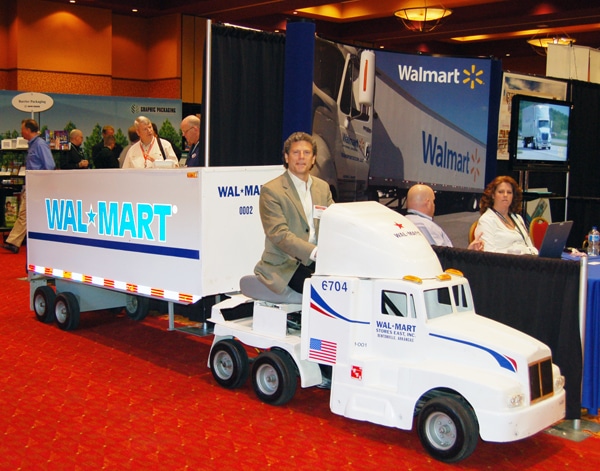
Over the past few years, Wal-Mart has successfully shed its image of fueling America’s thirst for low-cost consumption to become a leader in the emerging field of sustainability. Recently, I had the opportunity to speak about product stewardship at Wal-Mart’s 6th Annual Sustainability Expo in Bentonville, Arkansas. My message was that companies have a unique responsibility to be stewards of their products across the entire lifecycle, and that government can be a good partner. While that message was embraced by many company leaders, I also ran into a tsunami of market-based mania that fears change and uncertain outcomes.
Bentonville is a mix between Rockwell-like farmland with horses and cattle roaming in fenced-in plains…and company row houses. The Expo was located at a hotel that became a Mecca for hundreds of Wal-Mart suppliers, each touting sustainability claims that were verified by PSI partner, EPI, which after six years of Expos, still found the need to correct the claims for two-thirds of the vendors prior to the show. Every commodity association was there – paper, aluminum, plastic, glass, metals. Every consumer packaged goods company was represented, like Colgate-Palmolive, Kraft, Unilever, and P&G. Companies were selling eco-packaging, defined in innumerable ways. And the Product Stewardship Institute was there, with our spiffy table-top display.
Coupled with the vendor booths were three morning presentations, one after the other, two at a time. The rest of the day was free to view the exhibits and mingle. I presented at one of the sessions (twice) and sat in on several of the others. Wal-Mart puts a tremendous amount of effort into defining sustainability for itself and its suppliers. Wal-Mart’s Scorecard compares suppliers on a range of sustainability criteria so that buyers can make decisions based on environmental factors as well as the usual price, quality, and other variables, although I did not hear anything about social criteria (child labor, worker issues, etc.) being measured. The presenters went into painstaking detail about how suppliers are to fill out their Scorecard. The room was packed, and people were paying close attention. I asked several suppliers what motivated them to make changes towards sustainability. “Because Wal-Mart’s asking us to do it,” was the reply.
Perhaps then it should be no surprise that some companies did not take kindly to being told they have a corporate responsibility in the form of product stewardship, and that there was a strong role for government. This is a crowd that runs on voluntary programs, that is motivated by the market, and wants to keep government about the size of a pinhead. They are motivated by cost savings from sustainability, and have not thought much about the environmental impacts of their products when consumers no longer want them. I took the challenge, and told them about market failures, and about the four tons of mercury going into the environment each year from the disposal of thermostats despite a decade-old voluntary industry program. I made the usual case for jobs, economic value, environmental protection, and taxpayer savings. I described how PSI developed paint legislation jointly with the American Coatings Association, and how this has resulted in the expansion of the recycled paint manufacturing sector, just as legislation on electronics spurred huge growth in the electronics recycling sector years ago.
There was much positive response to what I discussed. However, I also learned that many companies are threatened by product stewardship. One senior executive of a pharmaceutical giant knew all about the Product Stewardship Institute (PSI), including our national dialogue on medical sharps two years ago. His company is a major manufacturer of insulin and uses medical sharps as a means of delivering its medications to patients. He said he did not participate in our sharps dialogue because his company was not prepared to state its position. He complained that the dialogue was not developing solutions for real patients and that we didn’t know what patients wanted (even though we had patient advocate groups, sharps manufacturers, and other pharmaceutical companies at the table). During PSI’s two-year dialogue on medical sharps, we sketched out a statewide pilot project for the collection of sharps through various methods so we could evaluate the costs and complexities of such a model system. Unfortunately, the time and expense of developing the background information, reaching solutions, and designing a pilot came up short because the few key pharmaceutical companies (like this guy’s company) that needed to make a commitment refused to participate. Now, two years later, after billions more medical sharps have been disposed of in the trash, and after more worker injuries and added medical costs, I was told that this major company is working on an industry voluntary solution. He indicated he didn’t want any help.
Later, I saw a colleague from the American Chemistry Council and we talked about local government plastic bag bans and taxes, and how the Illinois legislation that requires producers to pay for recycling programs might be an interesting model, one that ACC and local governments in Illinois support. I then talked with one of ACC’s members and a founding member of AMERIPEN, the new lobbying group for consumer packaged goods companies. This person had attended my session, objected to EPR for packaging, objected to my slide on the benefits of EPR, and saw plastic bag bans as EPR which, by the way, she objects to.
All in all, I came away very impressed with Wal-Mart’s ability to motivate companies with the shear force of market optimism, its ability to stay on message with so many dedicated senior staff, and the results they have achieved. I also came away knowing that many companies and individuals shut down their communication because of fear about changes that product stewardship might bring. These people stop progress for themselves, their companies, and the social good. They are indicative of companies that will find themselves at the back of the pack in making the changes they need to stay competitive. They are risky investments.
I do not expect full agreement with the product stewardship message. But if a problem exists, such as waste, environmental externalities, pollution, lost jobs, and unnecessary costs, we need to put our heads together to come up with the answers. Company representatives that want government to wait until their company has an iron-clad position will only harden opposition to a joint solution.
As always, the Product Stewardship Institute is ready for discussion. We are ready to change our understanding of issues…because that is what happens when people talk to one another. But when problems persist, or if companies bury their heads, don’t expect PSI to stand by idly waiting for companies to finally decide they are ready. Where is the corporate responsibility in that? Where is the individual responsibility and personal commitment needed to take care of problems that products cause? If you work for a company and you don’t act now, try explaining that to your grandchildren.
by Tom Rhoads, Executive Director of the Onondaga County Resource Recovery Agency in New York State
We can never get too many good news stories in this day and age. The Chilean miners’ rescue is certain to be one of the top stories of the year for 2010. I was born in a mine town, and although I never spent a full day working underground, I have toured several deep mines. The darkness is absolute when the lights go off. You literally cannot see your hand in front of your face. To be trapped thousands of feet underground is, for me, incomprehensible. To carry any faith in rescue after days of no contact was marvelous and probably a genuine life saver.
I recently read that these miners were harvesting copper ore that was less than one percent copper. Copper is a common metal, but its value has risen enough to drive men 2,300 feet below the earth’s surface. In previous accidents at this very same mine, men died for ore with one percent copper.
Many other metals and minerals are hotly pursued across the globe. Mines in remote Canada and Indonesia have become targets of billion dollar investment takeovers. China made recent world news and sent ripples down economic spines when it declared a suspension to the export of so-called rare earth minerals (those needed in everyday electronics, communication devices, and high-tech batteries and magnets common to many tools and most high-efficiency transportation.)
Can you guess where I am headed? In the United States, only about 60 percent of the U.S. population even has access to basic curbside recycling for containers and printed materials. (USEPA, 2008). In New York, I travel through several areas that offer no curbside recycling for packages, containers, and printed materials. Zero recycling. You see, recycling and recycling infrastructure have a cost. That cost is in addition to the cost of trash disposal. The regional agency I work for, the Onondaga County Resource Recovery Agency (OCRRA), uses the revenues we earn from trash disposal and recovered energy from the trash to pay for the entire program. OCRRA’s disposal fee is more than the cost of landfill disposal, but OCRRA’s tipping fee covers the costs and benefits of Household Hazardous Waste Events, recycling infrastructure, battery collections, free recycling assistance and supplies for businesses, Earth Day Litter Clean-Up, OCRRA’s newsletter, and much, much, more. Even the curbside blue bin for recyclables is paid for with the trash disposal tipping fee. The cost of these programs puts pressure on OCRRA’s tipping fee and the resources of many other local governments providing similar programs. And as we continue to reduce the amount of trash through waste reduction and recycling programs, OCRRA (like many other local governments) is actually penalized for its recycling efforts with reduced revenue in its primary funding source – trash disposal fees.
We constantly reflect on how to pay for waste reduction and recycling programs. But there is a better question to consider: what does it cost us not to recycle? When we send miners into remote and deadly environments, because it costs a little more up front to develop recycling infrastructure, is that really the way to keep score? If China has a lock on minerals needed for the next generation of economic growth or energy-efficient technology, can our children (and their children) really afford us tossing away cell phones, batteries, or old electronics that are far richer in mineral content than ore from a mine?
I hope you agree that these and other similar questions need to be asked when we discuss the cost to recycle, or how to pay for a system that places a priority on reduction, reuse, recycling, and recovery before landfilling. Extended Producer Responsibility laws for e-waste have been tremendous vehicles to fund e-waste recycling infrastructure across the U.S. EPR strategies also have worked in Canada and Europe for other recyclables as well – including packaging and printed materials.
The faith of the Chilean miners to be rescued was probably their life saver. Faith in rescue, leadership during the crisis, oh yeah – and a $20,000,000 rescue effort watched by the world for 69 days; those were the story lines in Chile in 2010. Perhaps we can also consider that product stewardship by the manufacturer (thereby better engaging the consumer) for waste reduction and recycling is the form of leadership needed to avoid another crisis-making headline in the future.
An amazing thing is taking place in Wisconsin. Not only is Governor Scott Walker attacking unions, but he has tried to eliminate municipal recycling by getting rid of the requirement for local governments to run recycling programs and all state funding for them. He has done so while showing no understanding of its ramifications. A serious public backlash has included both Republican and Democratic legislators, and the Governor’s plan might well be thwarted. But perhaps we should take a closer look at what is taking place in Wisconsin. We see overwhelming public support for recycling, but a Governor who does not want taxes to pay for it. This sounds an awful lot like product stewardship to me.
During these lean budget times, government agencies across the country have reduced staff, which threatens their ability to protect public health and the environment from the negative impacts of waste disposal. By shifting the responsibility to finance and manage recycling from taxpayer-funded government programs to manufacturers and consumers, we get the environmental protection benefits we seek, but we also free up billions of dollars that government agencies have paid to protect the public from product impacts. We also place the financial incentive for reducing waste impacts squarely with those who know best how to reduce them – the manufacturers.
Governor Walker has raised an interesting question – Why should government pay for recycling programs? On one hand, these programs provide a significant public benefit. They keep waste from filling landfills; reduce impacts from waste-to-energy plants; and often provide businesses with lower-cost materials for manufacturing new products. They also create more jobs than disposal. Recycling, in other words, creates business opportunities while also saving energy, reducing greenhouse gas impacts, and protecting the environment. And if cutting off state funding leads to more landfilling of materials, local governments will largely bear the increased costs for garbage disposal. There are no cost savings for a recyclable bottle, newspaper, or milk jug that goes into the trash. In fact, the cost for disposal in many Wisconsin communities exceeds the cost of recycling. So, if the Governor wants to pass recycling costs onto local governments, it could indeed result in a tax increase in many areas, particularly if the materials now going for recycling are disposed!
Recycling provides public benefits. But why should government pay the cost to reduce the impacts from private business operations? Aren’t we then subsidizing businesses for creating waste? And aren’t businesses passing onto government what should be their costs? What incentive does that give manufacturers to reduce the waste they create once consumers no longer need their products, along with the associated cost it imposes on society? Not a whole lot.
So, while the Wisconsin Legislature should restore funds for recycling, it should also heed the Governor’s impulse to reduce taxes and develop a comprehensive state product stewardship plan. Wisconsin’s electronics law, passed in 2009, is a good first step. But there are many products to go before we sleep. The Legislature should get cracking now on its plan.
You know when your parents grow up and you realize that they’ve been listening to you all along?! On Tuesday, my Mom attended a packed-house ‘listening session’ on the new Maine governor’s controversial proposals for regulatory reform. These proposals have made news around the country, as all of us who have been following Maine’s leadership on product stewardship watch with bated breath to see what will happen under this new administration.
Mainers are speaking out, and showing up in droves at listening sessions around the state. My Mom ended up handing in her prepared remarks in writing after three hours of waiting to deliver them yesterday. I’m proud of her and other Mainers who are not policy wonks steeped in “product stewardship” and “EPR,” just people who have common sense, passion for family and community, and the perspective of how time and our actions change the places we love, both for better and for worse.
Even though we don’t talk “EPR,” “waste hierarchy,” and “federal preemption” much around the dinner table, these are the themes I hear loud and clear in my mom’s remarks, below. She taught me to stand up for myself and my beliefs, take responsibility for my actions, and clean my room every Saturday morning. To me, these themes are also present in her remarks. Maybe it’s really that I’ve been listening to her all along!
Go Mom, and go Maine.
Karen Fletcher
Freeport , Maine
February 9, 2011
Regulatory Fairness and Reform Committee
Public Hearing
Senator Courtney and Committee members:
My name is Karen Fletcher. I am a resident of Freeport, Maine. I am here today representing myself.
I want to begin by thanking you for your public service…and for your participation in the continuing process of trying to ensure regulatory fairness. I am in favor of transparency, fairness, effectiveness and efficiency…goals that are part of the stated intent of your committee. These goals must be fair for ALL of Maine…and not just for the one sector.
I am NOT in favor of reforms that benefit an individual segment of our society at the expense of our air, our water, our quality of life, and our own health and well being as well as that of future generations.
When I read Phase I of Governor’s Regulatory Reform proposals on the Governor’s website, I marked it up with many, many notes, some question marks, and quite a few exclamation points. I am here today to share my fear that this current round of regulatory reform could lead to roll backs to the “bad old days.” Given the restrictions on time, and the more eloquent speakers here today, I will address two areas that arise in more than one of the proposals.
- Standards: The governor’s regulatory reform proposals discuss having Maine’s regulations “conform” to Federal standards. I believe that Maine should consider Federal standards to be minimum standards and that we should meet them. But I also believe that Maine should exceed those standards when our individual and unique needs require that we do so. Federal standards have to accommodate the great diversity of the United States. Maine standards have to be sure to continue to protect the uniqueness of our environment and the needs of our people. If that means that we have a higher standard…good for us! (Using this same logic, I support the option of municipal standards that might exceed state standards.)
- Consumer Products: The governor’s regulatory reform proposals also call for reviewing all recycling and take back statues ensuring that “manufacturers do not have to pay to recycle their consumer products”. As I read this section…and I ended up with many exclamation points… there were two images that came to my mind. One was from the past: the open, burning dump that we used to go to every Saturday morning when we moved to Maine 34 years ago. (I am proud to say we have a very active recycling center). The other image was from that very morning: I had been working on our income tax forms and had to replace the ink cartridge in the printer. When I opened the package there was a mailer to return the used cartridge for recycling. How great was that! It was easy for me to do the right thing; I thought good thoughts about the manufacturer (Hewlett Packard); and it was certainly better for the environment. Oh, and, I have no illusion that anyone other than I paid for the cost of the mailer as I am sure the manufacturer passed that cost along to me.
In conclusion, as you continue the process of reviewing the proposed changes in regulations, please, please, please be sure that you keep Maine moving forward with regulatory reforms that build on the environmental protections that have been developed over decades by bipartisan, cooperative, efforts engaging all sectors of our society.
Thank you for the opportunity to share my concerns.
Last week, in the President’s State of the Union address, he challenged the nation to tap into our entrepreneurial spirit so we can better compete against China, India, and other countries that have invested heavily in their own country’s future. He spoke of a role of government that is nuanced – one that can work with the market, where government can guide development through policies that make us more competitive.
Product stewardship seeks limited governance that sets broad parameters for market competition. It seeks a greater role for the private sector, shifting the management and financial burdens from often inefficient government practices to those driven by market forces. Managing products that we call “waste” is nothing but inefficiencies in the market. It is a market failure. And that failure has resulted in billions of dollars of taxpayer costs to subsidize businesses whose products are manufactured and sold without consideration for their social and environmental costs.
How is it possible that telephone directories are still produced and distributed across the United States at the current rate? No one knows for sure how many people still use them, although most people I talk to don’t, except perhaps my over-80 parents and a few die-hards. Over 660,000 tons of directories get plunked onto our doorsteps, pathways, driveways, and vestibules each year. Less than a quarter are recycled. All must be collected and recycled or disposed of by government and paid for by government, with complaints being dealt with by government. That is the same Government that Tea Party leaders want to get out of business and get out of the business of business. It is time to heed their call.
Phone books keep getting delivered at their current rate of excess because the external costs of managing the directories after they are kerplunked is paid for by taxpayers, all $64 million of it. Whether we use one or not, we are all subsidizing telephone companies like AT&T and Verizon, and independent directory publishers like Dex and Yellow Book. Not only are we paying financially for their inefficient ways, but these companies are not covering the true cost of their impacts on our environment. They do not pay for the greenhouse gas impacts that the production of directories causes, or the stress on our water or air as the result of factories producing books no one wants, or emissions from trucks that transport them, deliver them, and pick them up, or pollution from the facilities that recycle them or dispose of them.
I picked on phone books here because they are visible and a clear waste if no one wants them. But this argument can be made on all products produced worldwide. Some companies have taken steps to reduce the lifecycle impacts of their products, and these leaders should be applauded. Others have taken a lead on turning materials from used products into usable commodities.
The United States can be a global leader in competitiveness. We are still the world’s market powerhouse. Product stewardship can maintain this strength through the efficient use of our nation’s resources, whether they are mined from the earth or mined from our households and businesses after use. Product stewardship policies seek good governance, not NO governance. Government should not “get out of the way” and let business run rampant. Haven’t we seen that movie before with the crises from banking, housing, and credit card deregulation? The government’s role in good product stewardship programs is limited to setting parameters for industry, guiding it, enforcing against those who cheat and want a free ride, and encouraging companies that are the true leaders of innovation to succeed.