
I wanted to share the endorsed comments I provided for the Product Stewardship Institute at the DEA’s public hearing yesterday. Thank you to the 119 endorsers for helping me to deliver the message that these considerations for the DEA’s rulemaking process are widely supported by groups concerned about the future and improvement of drug take-back programs around the country. The DEA, EPA, FDA, ONDCP, CMS, and USPS were all present. Congressman Jay Inslee from Washington opened the second day.
In two days of comments by both federal agencies and members of the public (including local government, state government, waste companies, reverse distributors, data companies, environmental organizations, law enforcement, pharmacies and pharmacists, drug abuse prevention groups, poison control, academic institutions, the pharmaceutical industry, and on incredibly moving grieving father), a number of themes were repeated by multiple presenters:
- Communities need a range of options for secure disposal of controlled substances and other pharmaceutical drugs. Those mentioned included collection at pharmacy and other community locations, mail-back from the home, and HHW.
- Take-back programs (including all methods described above) should be able to include both controlled and non-controlled substances without sorting them.
- Take-back programs must be convenient and accessible to the public.
- Security to prevent diversion is critical, including tracking of containers, tamper evident seals, locked containers, and other such measures.
- Regulations should not require that individual pills/vials/etc. be counted and logged.
In addition, the question of who should pay for take-back programs was brought up many times in spite of the fact that this important question lies outside of the DEA’s responsibility under this rulemaking. There were many references to needing “public-private partnerships,” support/sponsorship from companies, and/or calling on the pharmaceutical industry to fund take-back programs. The importance of reducing drug waste was also mentioned. We look forward to seeing and commenting on the DEA’s proposed rule-making in the near future.
by Scott Cassel, CEO and Founder of PSI
Protecting vulnerable populations from environmental, health, and safety risks is a critical goal shared by many in the electronics recycling industry. It is a cornerstone of the R2 Practices, one of the new certification standards for the electronics recycling industry.
Some have asked why, then, doesn’t R2 establish outright bans on exports of electronic scrap to developing countries and on the use of prison labor?
The answer has to do with economic opportunity. The stakeholders that developed R2 designed a set of requirements that call for equal environmental, health and safety protections no matter the location or situation. Importantly, the R2 requirements do so in a manner that does not curb the business opportunities of law-abiding, state-of-the-art companies and their workers in developing countries. And, with respect to prison labor, they do so in a manner that does not diminish the vocational training opportunities of people that are incarcerated.
The R2 Practices
During the multi-stakeholder development of The Responsible Recycling “R2” Practices for use in Accredited Certification Programs for Electronics Recyclers, aka the “R2 Practices”, stakeholders addressed critically important issues relating to the environmental, health, safety (EHS), and security performance of electronics recyclers and their downstream vendors. The comprehensive standard contains provisions for best practices in a number of operational areas including: an EHS management system, downstream due diligence, adherence to legal requirements including those covering exports, and reuse and refurbishing activities.
The resulting document—the R2 Practices—serves as the basis for the R2 Certification Program. Electronics recyclers can contract with one of a handful of registrars (certification bodies or CBs) to become certified to R2. This rigorous, two-phase audit process requires the recycler to exhibit conformity to each of the R2 Practices’ many performance and management system requirements.
R2 and Exports of End-of-Life Electronics Equipment to Developing Countries
Developing countries can be home to both atrocious, and “state-of-the-art”, electronics recycling and refurbishing operations. In these countries, as well as internationally, there is a desire to shift electronics recycling and refurbishing away from the former and into the latter types of operations. This accomplishes environmental, health and safety goals while also promoting good jobs in some of the areas of the world most in need of economic opportunity.
To ensure exported electronic scrap ends up at state-of-the-art facilities, three key criteria need to be met. First, shipments of exported electronic scrap must be sent and received in accordance with the laws of the exporting and importing countries. Illegal shipments all too often end up causing serious harm to health and the environment in the worst of recycling and refurbishing operations.
Second, all receiving facilities must be evaluated on a regular basis to ensure that they are employing best technologies and practices. In Asia and other parts of the world, there are a number of state-of-the-art electronics recycling and refurbishing facilities that rival those in the U.S. in terms of technology and materials management.
Third, all equipment must be accurately characterized on the shipping manifest. Too often, e-scrap exports are characterized as “reusable” to avoid the added scrutiny and legal requirements that apply to “waste”. This creates a loophole which can allow scrap to be inappropriately sent to a facility that is not capable of safely handling it.
R2 effectively addresses each of these criteria. It prohibits the shipment of end-of-life electronic equipment containing toxic materials to developing countries unless the shipment is legal under the laws of both the exporting and importing countries. It requires that the receiving facility conforms to key R2 requirements and employs technologies appropriate for the materials it processes. Furthermore, “reusable” electronics equipment containing toxic materials is subject to these same requirements unless it has been tested and its key functions are working properly. Finally, all shipments must be accurately labeled.
Through these requirements, the stakeholders that developed R2 achieve the goal of protecting vulnerable populations while supporting legal, safe, environmentally-sustainable, economic development in developing countries.
R2 and Prison Labor
UNICOR (also known as Federal Prison Industries) maintains operations in a number of manufacturing industries, including: textiles, office furniture, industrial products, commercial fleet asset services (commercial vehicle remanufacturing), electronics manufacturing and electronics recycling. The company was established by Congress “to create a voluntary real-world work program to train federal inmates” – thereby helping them obtain employment upon release from prison. To this end, the UNICOR electronics recycling program has been successful, as electronics recycling firms have experience hiring formerly incarcerated people from the UNICOR program.
A few years ago, some prisoners at UNICOR worked in unsafe settings in electronics recycling facilities. Unfortunately, employees of less sophisticated recycling operations in the private sector have, and may continue to be, exposed to similar dangers. More recently, in December, 2009, The National Institute of Occupational Safety and Health issued a report that found no health problems linked to electronics recycling operations at the four UNICOR facilities it investigated.
Regarding the issue of prison labor, the stakeholder group that drafted the R2 Practices decided not to develop different requirements for different categories of workers. Rather, the R2 Practices set forth extensive requirements covering on-site environmental, health, and safety; and they apply to all workers in a facility, be they employees, consultants, volunteers, or prisoners. As a result, R2 does not prevent prisoners from safely learning new skills that will help them find employment upon their return to society.
The future of R2
R2 offers a practical and equitable approach to addressing the areas of exports and prison labor. And as the industry continues to evolve, so too will the R2 Practices. Similar to the spirit of the standards development process, R2 Solutions is inviting stakeholders from all industry sectors, including NGOs, to shape the future of the standard so it can continue to effectively address the needs and concerns of the industry.
by Scott Cassel, CEO and Founder of PSI
The Product Stewardship Institute turned 10 years old on December 6th! Some of you might remember our very first national Product Stewardship Forum in 2000 in Boston when Secretary Bob Durand of the Massachusetts Executive Office of Environmental Affairs launched PSI into existence.
The past three months have been a boom time for product stewardship. Who would have known that in 10 short years we would be able to say that there are now over 60 producer responsibility laws in 32 states covering 9 products? Key legislation passed at the local, state, and federal levels all in one week in October, with Seattle’s phone books law, California’s paint and carpet laws, and President Obama’s signing of revisions to the Controlled Substances Act. The recent Resource Recycling conference witnessed numerous references to the relevance of product stewardship and its relation to traditional recycling and waste management. And the Global Product Stewardship Council convened its inaugural conference in Sydney Australia. We are definitely on a roll!
However, laws do not guarantee results. As we continue to color in the PSI legislative map with more laws, we also need to shift our attention to program performance, and to move our bulls-eye target away from solely being on end-of-life management to the entire lifecycle of a product. PSI’s mission is to reduce the health and environmental impacts of products all across a product’s lifecycle, with manufacturers, retailers, and consumers taking greater responsibility. That is what PSI means by product stewardship. Extended producer responsibility, with its focus on end-of-life management, is just one tool to achieve this goal. It is time to expand our horizons.
For now, we want to celebrate the success of the movement and acknowledge the thousands of individuals that have brought about this massive change in how we manage waste in America. Over the next few months, we will reach out to you on ways you can engage with us to recognize the progress we have made together, as well as to chart the path forward toward a sustainable future. There is certainly more to come!
Sincerely,
Scott Cassel
Executive Director / Founder
Product Stewardship Institute
by Marcia Deegler, Director of Environmental Purchasing for the Commonwealth of Massachusetts
Governor Deval Patrick signed an Executive Order in October, 2009 that Establishes an Environmental Purchasing Policy for the Commonwealth and directs all state agencies to procure goods and services that conserve natural resources, reduce waste, protect public health and the environment, and promote the use of clean technologies, recycled materials, and less toxic products. By purchasing Environmentally Preferable Products, Commonwealth agencies will reduce the environmental impact of state operations and use the state’s purchasing power to encourage manufacturers and service providers to adopt high environmental standards into their products and operations.
The Commonwealth purchases an estimated $600 million of goods and non-construction services per year, which result in environmental and public health impacts related to the production, transport, use, and disposal of these products and services. This new policy requires all Commonwealth Executive Departments to reduce their impact on the environment and enhance public health by procuring Environmentally Preferable Products and services (EPPs) whenever such products and services are readily available, perform to satisfactory standards, and represent best value to the Commonwealth. EPPs include products and services that: contain recycled materials; conserve energy or water; minimize waste; are less toxic and hazardous; reduce the generation, release, or disposal of toxic substances; protect open space; and/or otherwise lessen the impact of such products or services on public health and the environment. The consumption of EPPs as a result of this policy should also serve to lower life-cycle costs, promote local economic development of these industries, encourage product stewardship and serve as a model for businesses, institutions, and individual residents.
The Commonwealth’s central procurement office, the Operational Services Division, and its Environmentally Preferable Products Procurement Program (EPP Program) have already made progress in integrating environmental and sustainability considerations into the many statewide contracts used by Commonwealth agencies, cities, towns, schools and others to procure the majority of their products and services. The EPP Program conducts activities in partnership with the Executive Office of Energy and Environmental Affairs (EEA), Department of Energy Resources (DOER) and Department of Environmental Protection (MassDEP) and endeavors to green the purchasing practices of the state in recognition of the fact that procurement is an effective strategy for addressing environmental concerns and protecting public health. Acknowledging their high rate of success over the years, the Executive Order specifically tasks the EPP Program with working with agencies to implement the directives and places a particularly strong focus on identifying purchasing opportunities for reducing the use of toxic substances and materials.
This new policy actually came on the heels of a Massachusetts-lead multi-state contract for Green Cleaning Products and Programs, the largest public cooperative undertaking to date to expand the use of environmentally preferable cleaning products in public facilities across several New England states. The contract offers Massachusetts public entities competitive pricing by aggregating the purchasing volume from the participating states of Connecticut, New Hampshire, Vermont and New York, while reaching out to local distributors and manufacturers of all sizes throughout the region in an effort to stimulate local economic growth.
While implementing the use of green cleaning products and practices promises to save money for the Commonwealth, equally important is the fact that the contract specifically requires virtually all chemicals offered under the contract (with the exception of disinfectants and sanitizers) to be third-party certified by either Green Seal or EcoLogo. The purpose of this requirement is to provide purchasers with the assurance that all green product claims – as well as a high level of product cleaning performance – have been verified by independent lab testing. In order to be awarded a contract, vendors also were required to offer training programs and tools to effect and monitor the department’s transition to green products and offer only supplies containing recycled content or other environmental attributes.
Third-party certifications and standards (e.g. Green Seal, EcoLogo, and Underwriters Laboratories), independent registration systems (e.g. EPEAT, WEEE) and other independent testing methods are increasingly becoming an important component in specifying products and services within the state contracting process. In lieu of an organization or company “claiming” to comply with industry standards, obtaining a third-party certification means they have made a commitment to invite an external third party to verify that their product or service does indeed comply with a particular standard. Third-party certification is a scientific process by which a product, process or service is reviewed by a reputable and unbiased third party to verify that a set of criteria, claims or standards are being met. Such certifications may also incorporate extended producer responsibility requirements within the criteria of the standard.
The advantages of requiring third-party certifications in contract bids and purchasing decisions are shared by the purchasers as well as the manufacturers and suppliers. For purchasers, a third-party certification provides a measure of conformity; it reduces the time, expense and technical expertise needed to analyze product claims for green and/or for performance and provides purchasers with independent laboratory tests backed up by a written assurance that the product meets the standard. Equally as important, using such certifications and standards sends a clear message to industry as to what a government or organization is looking for in the way of a green, high performing product.
For manufacturers and suppliers, the use of third-party certifications and standards in bids and contracts limits supplier risks and eliminates the need and expense of continually repeating tests to verify compliance with individual specifications. Third-party certifications and consensus-based standards can also eliminate the need for government to create bureaucratic laws and regulations that may restrict market access and delay the introduction of new technologies by innovative companies.
OSD now offers thousands of EPPs on literally dozens of statewide contracts. As these contracts are renewed and re-bid, the use of third-party certifications and industry standards are increasingly being used as required criteria in order to be awarded a contract. The purchases of EPPs have grown from about $5 million in 1995 to over $250 million for FY2009. The cost savings calculated as a result of these purchases amounts to over $1.5 million annually.
by Sarah Westervelt, the e-Waste Project Coordinator at the Basel Action Network (BAN) and the Recycling Coordinator for the Electronics TakeBack Coalition
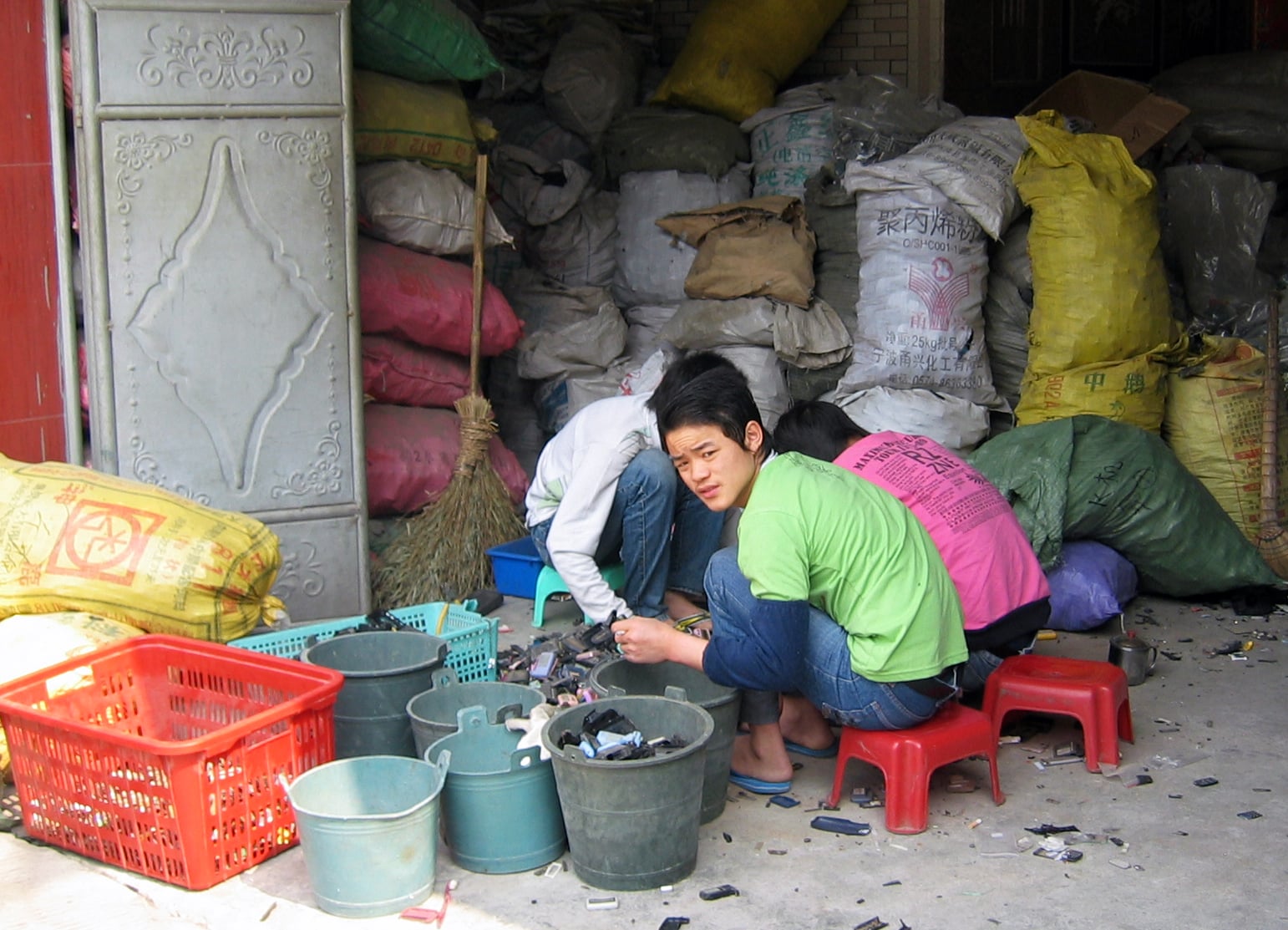
For years, there has been little more than pilot programs, pledges and a great deal of concern about what electronics recyclers are actually doing with the e-waste they collect. While federal regulations exempt much of this waste stream, the relatively new electronics recycling industry has been plagued by unscrupulous companies that profit largely by exporting scrap or untested/non-working equipment to countries that cannot legally trade in hazardous waste with the US, as defined in a United Nations treaty called the Basel Convention.

© Basel Action Network 2008.
As of this year there are not one, but two accredited certification programs for electronics recyclers in the US, both of which are recognized by the US EPA – the e-Stewards Certification program and the Responsible Recycling (R2) Certification program. The question is, what are the differences, and which one of them will best serve your needs? Having two programs requires some homework on the part of customers or officials.
To get to the bottom of this question, it is important to compare the standards themselves, as well as the rigor of the verification system (i.e. the certification bodies which certify that recyclers conform to a particular standard, and the accreditation bodies that oversee their work.)
Let’s start with comparing the verification systems. Both R2 and e-Stewards certification programs utilize the ANSI-ASQ National Accreditation Board as their accreditation body. ANAB is one of the top three accreditation bodies in the world, and is the largest, most respected in the United States.
Next, let’s look at the certification bodies (CBs) that are accredited by ANAB to certify to either R2 or the e-Stewards Standard. Each of the programs has three certification bodies that are accredited to certify to their respective standards. An important question is how rigorous and consistent the auditor training is for each program, with the goal of having a high level of confidence that the auditors across all the CBs consistently understand the standard they are auditing to and program requirements. Without an owner for the standard or host organization until this fall, the R2 program has not had a sole auditor training program since its inception, resulting in a variety of auditor trainings for the different CBs. The e-Stewards program requires that all auditors must successfully complete a 3-day training provided by SAI Global, one of the top professional training organizations.
Finally, and central to every certification program, are the standards that define requirements for the companies attaining certification. The R2 Practice document, which was finalized without support from the environmental community, is 13 pages long, with no guidance document, but it comes with an audit checklist. The e-Stewards Standard, created by the Basel Action Network in conjunction with leaders in the recycling and refurbishment industries, and supported by 70 organizations, is 49 pages long. It has a 67 page companion guidance document, but no auditor check list. Based on the shear length of the two standards, it is easy to understand that one spells out much more comprehensive requirements for the recyclers.
There are two basic types of requirements in each of the standards. One set of requirements is for the environmental management system (EMS), which involves a Plan-Do-Check-Act system for identifying, documenting, and reducing the environmental impacts of the business operations. The R2 Practices has one page of general requirements that an R2 recycler’s EMS must meet . The e-Stewards Standard has the 8-page global standard for environmental management systems, called ISO 14001, imbedded in it, so that all certified e-Stewards are also certified to ISO 14001.
Within this framework of an EMS, both standards require some minimum performance requirements, which are the second basic type of requirements in these two standards. Performance requirements are industry-specific restrictions of or prescriptions for certain activities. Along with the EMS requirements, this is where the two standards differ dramatically.
The chart below summaries some of these differences:
| Does the Standard… | R2 Practices | e-Stewards Standard for the Responsible Recycling and Reuse of Electronics |
| …Allow toxic materials in solid waste landfills & incinerators? | Yes. If circumstances beyond the control of the R2 recycler disrupt its normal management of the toxic materials, it may utilize solid waste disposal facilities, to the extent allowed under applicable law. | No, as it was deemed inappropriate for heavy metals and other hazardous materials to be disposed of in solid waste disposal facilities. |
| …Ban the export of toxic materials to developing countries? | No. R2, in principle, calls for only allowing the export of equipment and components containing ‘focus materials’ to countries that legally accept them, but does not ban them from rich to poorer countries. | Yes. Based on the international definitions found in the Basel Convention, toxic materials bound for recycling or disposal are not allowed to go from developed to developing countries, consistent with the Amendment to the Basel Convention, already ratified by 65 countries, including the European Union. |
| …Require accountability for toxics throughout final processing? | Limited. | Yes, with detailed performance requirements for downstream audits, documentation, and restrictions for initial and on-going accountability. |
| …Allow untested or non-working equipment to be exported to developing countries for refurbishment (which can transfer hazardous waste)? | Yes. | No. |
| …Have detailed minimum requirements for occupational health and safety? | Left to the R2 recycler to determine. | Yes, developed with a great deal of input from state occupational health and safety experts. |
| …Allows the shredding of mercury-containing devices? | Yes, “if they are too small to remove safely at reasonable cost, and workers are protected…”, and if the mercury-containing materials are sent to licensed facilities that utilize technology designed to manage it. | No. There are no safe levels of mercury, and currently no shredders that can capture all mercury vapors. Shredding mercury disperses it into the shredded mixed materials, the workplace, and the environment. |
| …Prohibit the use of prisoners to recycle toxic electronic waste? | No. | Yes. |
While having two certification programs requires some due diligence, most people welcome the arrival of new mechanisms for holding an industry accountable for managing a toxic waste stream.
Check out the companion post to this blog piece by John Lingelbach of R2 Solutions.
© Basel Action Network 2008.
PSI interviews Dave Galvin from the King County Department of Natural Resources in Washington State, and Board President at PSI.
PSI: What is the #1 product stewardship issue that needs to be addressed?
DG: I always come back to the “cradle-to-cradle” concept: all products should be able to be sorted into one of two categories, those that are compostable and those that are not. The latter group (what McDonough and Braungart called “technical” materials) should belong to the manufacturer who made them, and should be taken back and reused in infinite recycling loops. If we can get this concept to be widely accepted, the details will fall into place.
PSI: What brought you to the environmental movement?
DG: Birds. I’ve been a birder since I was nine years old. When I was 11 I read “Silent Spring,” and it turned me into an environmentalist even before that term was coined.
PSI: Who was your greatest influence?
DG: I was fortunate as a kid to have three wonderful mentors: a naturalist, a local land conservationist, and an ahead-of-her-time environmentalist. The first two, Linaea Thelin and Ben Nichols, were local icons not widely known beyond the town; the third some of this blog’s readers might know from her pioneering work in New England environmentalism: Nancy Anderson.
PSI: What could the environmental movement do better?
DG: Become so mainstream that it is no longer a movement. That means being meaningful to all different types of people and part of their core values: children’s health, things like that. The “environment” for too long was conveyed as something out there, a national park or a habitat to be preserved. Instead, we should be promoting the environment as all around us, where we live, and make it as fundamental as eating and breathing. We have progressed in this direction over the years, but we still have a ways to go to connect environmentalism with social justice, family-wage jobs, poverty-eradication and core American values.
PSI: What is the environmental movement doing right?
DG: Moving in the direction I just noted above.
PSI: On a scale of 1 to 10, with 1 being not at all and a 10 being zero waste, how good a recycler are you?
DG: 6, maybe 7.
PSI: What is the 1 gadget from “the future” you’d like to see in real life?
DG: Completely compostable stuff that is now made up of plastics or mixed materials that can’t even be recycled. Compostable packaging, compostable toys, compostable building materials. I know that’s not just 1 gadget, but that’s a concept I’ve long envisioned. Compostable stuff would not contain hazardous chemicals beyond what are already present in nature.
PSI: What 1 thing do you do better than anyone else you know?
DG: Throw an axe. (I won the Northeast woodsmen’s championships one year, many years ago…)
PSI: What would be the title of your autobiography?
DG: In balance: a journey not a destination.
PSI: What would you be if you could be anything else?
DG: A bird — I’ve always thought it would be cool to fly and look at the world from over the treetops. Which species? Something like a kingfisher, a bird with attitude.
PSI: What is your proudest accomplishment?
DG: Raising two bright, caring kids who are so concerned about the environment and have such a world view that they give me hope for the future.
Dave Galvin is program manager for the Hazardous Waste Management Unit in King County (Seattle, Washington), part of the multi-agency “Local Hazardous Waste Management Program in King County.” This program addresses household and small business hazardous wastes in the Seattle metropolitan area. Dave began working in this subject area in 1979 and was the one who coined the term “household hazardous waste.” He was the founding president of the North American Hazardous Materials Management Association and is the current president of the Product Stewardship Institute’s board. He has also worked on stormwater and combined sewer overflow controls, trace organic chemicals in wastewater, pesticide-reduction, and Endangered Species Act listings of salmon, along with his decades of attention to hazardous wastes.
by Scott Cassel, CEO and Founder
For my summer vacation, I went to check out the worst environmental disaster in the history of the United States. That’s right, straight down to the Gulf to see for myself the havoc reeked on birds dripping in oil, dolphins belly up for miles, and beaches lapping waves of petrodollars on deserted shores. Well, except for the deserted shores, I didn’t find many overt signs of man-made mayhem. Instead, what I found was much more subtle. At ground zero in Grand Isle, Louisiana, I was in the eye of prevailing counter-forces in modern day America, where Big Oil has a stranglehold on Big Fishing, and both are sitting heavy on those employed by each industry, blaming government for intervening while pleading with government to preserve their way of life.
Complicated? You bet. Hypocritical? Sure. Human? All too.
The BP oil spill has shown the world the worst of what can happen when producers seek short-cuts to maximize profits, when government abdicates its regulatory role, and when residents are so reliant on a limited number of industries to make a living that they put their health behind job security.
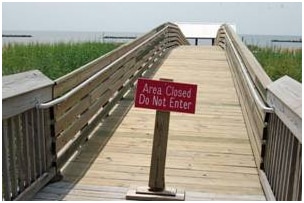
One of the many closed beaches along the coast of Louisiana
That is the struggle in the Gulf right now. Tourism is way down. There is a moratorium on offshore oil drilling until the federal government says it is safe. And commercial fishing has been closed in a large swath of the Gulf waters. BP is paying out claims for lost income at a snail’s pace, while pressuring the federal government to declare the area safe for fishing and oil drilling. And the people living in the Gulf just want to go back to doing what they do best – fishing and drilling for oil, or supporting those two industries. After Hurricane Katrina, this oil spill is no big deal. They have been through it all. No oil spill is going to stop their lives after a hurricane killed thousands of people, wiped out entire towns, and drenched 80 percent of New Orleans. Americans are tough, and those living in Louisiana and Mississippi are some of the toughest, proudest, and most resilient Americans I have met.

Evidence of the impact the spill had on marine life
But this spill is creepy. Yes, we all saw pictures of oil-drenched birds, and I did see one pelican soaked in oil, several dead fish, and tar balls the size of quarters all along the beach, even after the beach was declared safe for swimming. But visible signs of the oil spill have been largely contained. Following the uncontrolled gushing of the well, the impacts have been masterfully managed. But it is what we don’t see that is of significant concern. And because we don’t see it, there is a rush by BP to say that it does not exist. And these hurricane-ravaged people want to believe it.
But not all. I read about local commercial fishermen who criticized the government for moving too quickly to open up areas for fishing because they fear that the remaining oil and chemical dispersant make the fish unsafe to eat. A native who owned a kayak business showed me an odd substance he had never seen before that washed up on shore, and he guessed it was dispersant. I read an op-ed from a Louisiana State University entomologist warning about the dearth of
These cautious locals and other experts are the counter-weight to the rush to getting back to business-as-usual. They are concerned about the long-term impacts of oil and the dispersant on bird nesting areas, fish reproduction, and human health. And so am I.
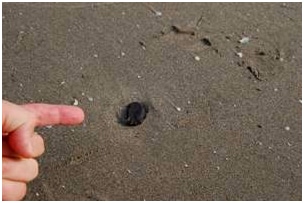
Just one of the many tar balls appearing on shorelines along the Gulf Coast
While many in the Gulf understandably just want their lives back, others know that the fight against Big Oil has just begun. The pressure to reopen the Gulf to lucrative offshore drilling is intense. The drive to reopen fishing grounds has picked up to a gale-wind force. BP will do everything in its power to cut its losses and pay out businesses for lost income in exchange for a commitment not to sue in the future. They want to turn the page and their PR machine is in overdrive. But this oil spill is not only about an acute impact. It is about long-term repercussions in a complex ecosystem.
To understand what this spill means to BP, consider that the day after several segments of beach in Grand Isle were declared safe for swimming, I saw mature palm trees being transplanted into their rightful place in the sand, welcoming residents back. A half mile down the beach, a heavy duty construction operation was still scooping sand, sifting it through special equipment to remove hydrocarbons, and replacing it back on the beach.
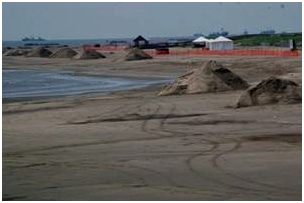
Closed beach
To understand what this oil spill means for America, throw a giant rock in a pond. The area of the initial splash gets back to normal fairly quick. But the concentric rings of impact spread outward in an ever wider path as it spreads across the pond, lapping onto shore. The BP oil spill was a giant boulder dropped in the Gulf, and it will be a decade or two before the repercussions of its wake fully come to rest. BP should commit to funding scientific studies by independent researchers with a guarantee that results will be shared with scientists and the public for at least the next 10 to 20 years. They should put money into an escrow account, so that if impacts are later detected, they have the resources to clean it up or pay out further claims. They should pay current claims and keep open the possibility of further payments as long-term studies are conducted and impacts understood.
This oil spill is about producer responsibility, and I cannot think of a more quintessential producer than BP. It is time to resist the force of a reckless company and teach BP the meaning of social responsibility.
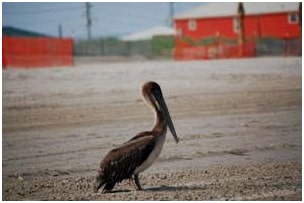
Lone pelican covered in oil awaiting rescue