

How do you build a successful thermostat collection program in a short period of time?
Public/private partnerships.
That’s exactly how a new initiative was recently launched in Oklahoma. Covanta Tulsa, Locke Supply, the Oklahoma Department Environmental Quality (ODEQ), the Thermostat Recycling Corporation (TRC), and the Product Stewardship Institute (PSI) teamed up to start a new state-wide collection program in a relatively short period of time.
Covanta has a long history of caring about the proper disposal of mercury-containing items, and the need for a collection program in Oklahoma was evident. Using the positive relationships we have built in the many years we have operated in the state, we were pleased to be the catalyst that brought these diverse groups together to provide a convenient way to responsibly recycle mercury-containing thermostats. Thanks to the collaborative work of the five aforementioned organizations, citizens and contractors are now able to deliver intact old thermostats to any Locke Supply location for recycling free of charge.
The thermostat recycling initiative in Oklahoma began with a brief meeting with Fenton Rood of ODEQ to develop a state-wide solution for thermostat recycling that could supplement periodic household hazardous waste collection days that are held in some communities. From there, we decided to look for a retail storefront solution that would allow ubiquitous collection during normal business hours. Locke Supply, with their numerous locations around the state, was the perfect fit.
Thermostat recycling containers are now in place at convenient and accessible locations throughout Oklahoma. When full, containers will be shipped to TRC for proper disposal and recycling. In an attempt to incentivize collection even further, Locke Supply obtained participation from a few of their new thermostat suppliers to offer a “bounty” program: bring in an old thermostat with mercury switches and Locke Supply will provide a $10 coupon for a programmable replacement thermostat.
Mercury thermostat recovery and recycling offers everyone the opportunity to eliminate a toxic material from the waste stream, while incentivizing the purchase of electronic thermostats that allow for more efficient heating and cooling. By identifying a diverse group of organizations with common interests, Covanta has now proudly provided one more way to protect the state’s land, air and water from unnecessary pollution.
Matt Newman joined Covanta Energy in 2008 and has over 25 years experience in the energy industry which includes renewable energy, electricity generation, asset optimization, risk management and fossil fuel management. In his current position, Mr. Newman is responsible for all business aspects for the Covanta Tulsa Renewable Energy, LLC, as well as carrying additional responsibilities for the South Region of Covanta Energy’s extensive fleet of Energy from Waste facilities in the United States. For additional information, Matt may be reached at mnewman@covanta.com.
Looking to start a thermostat collection program like this one in your area? Contact PSI for guidance at suna@productstewardship.us or (617) 671-0616.
By Resa Dimino, Senior Advisor for Policy and Programs at the Product Stewardship Institute

Extended producer responsibility (EPR) policy was offered as a policy solution to address all of these concerns. Assigning responsibility for recycling to the manufacturers of electronics would ensure that an infrastructure developed to handle this growing, and toxic, waste stream. It would also provide accountability for the way materials are handled – what IT or TV company wants to see its brand name featured in the next e-waste export expose? So, between 2003 and 2010, twenty-five states passed laws requiring e-scrap recycling, with twenty-three of those being EPR laws.
No two e-scrap EPR laws are exactly the same, but they do fall into a few categories. The first program, established in Maine, relies on local governments to collect electronics, and requires manufacturers to pay for any of their branded equipment that comes back through the system. Connecticut followed suit with a similar model years later. Oregon, Washington and Vermont offered variations on that theme by creating statewide programs (that typically operate through a contract with the state) that arrange for the recycling of all of the materials collected through what the state determines is a convenient collection system.
Meanwhile, a number of other states—led by Minnesota, but including Illinois, Indiana, New York, Wisconsin, Pennsylvania, New Jersey and Rhode Island – followed the “set the goal and let industry figure out how to get there” model of EPR. They each established performance goals and allocated responsibility to manufacturers to collect enough e-scrap to meet those goals. The trouble is, it’s hard to figure out where to set those goals to drive aggressive programs. On top of this, the costs of recycling have increased, so manufacturers are not enthusiastic about paying for more than they need to.
In an article recently published in E-Scrap News, PSI lays out the challenges some states are facing with e-scrap laws. As we address these challenges, we learn more about how to implement EPR in the US. We learn about critical issues, including: how much government involvement do we need to ensure a functional system? What policy mechanisms are needed to support an effective market-based recycling system? How should costs be allocated? What is the right balance between regulation and program flexibility?
The answers to these questions vary from state to state, but it is clear that the lessons we are learning now will serve us well as we seek to fix the struggling programs, and design new ones in the future.
Resa Dimino is a Senior Advisor for Policy and Programs at PSI. She works as a consultant with more than 20 years of experience in recycling policy, programs and business development. Prior to launching her consulting practice, Resa was the Director of Legislative Programs at WeRecycle!, an E-Stewards certified electronics recycler headquartered in Mt. Vernon, NY, and worked to develop collection networks in Northeast states that have electronics EPR legislation. For additional information, Resa can be reached at resa@productstewardship.us.
Resa will be speaking about EPR and electronics on a panel at the Institute of Scrap Recycling Industries (ISRI) Convention on Friday, April 24, 2015. She will be presenting in the session titled, “Extended Producer Responsibility (EPR) – Where is it going?”.

As an organization, PSI has hit its stride. As we approach our 15th year, we are moving from adolescence and the Constant Present to implementing our fourth long-range plan for the future. We have a solid new board of directors that includes a balance of geography (East, West, Midwest, South), politics (red, blue, and purple), and skill sets – all 100 percent committed to advancing product stewardship programs across the U.S.
We have an equally committed staff of 9 dynamic individuals, supported by over a dozen interns and consultants, who juggle multiple projects, fundraise, promote our accomplishments, and assist in passing and implementing product stewardship laws and programs on about 20 product categories!
PSI’s membership and partnership programs have steadily increased from 150 in fiscal year 2009 to over 400 today, representing an active, vibrant, and expansive product stewardship professional network of individuals from agencies, businesses, organizations, universities, and non-U.S. governments. PSI’s finances have also improved slowly but steadily over the past 14 years, and this past year was the first time we broke through the million dollar revenue mark. Our funding strategy has always been to diversify, and we have been successful in maintaining a balanced portfolio of memberships, partnerships, private and public consulting, foundation funding, and other revenue.
The EPR movement in the U.S. has also matured. There are now 82 EPR laws on 11 product categories, with at least one law in 33 states. Over the past six months, there have been many EPR “firsts”:
- Vermont passed the nation’s first primary battery law.
- Colorado passed its first product stewardship law (the eighth paint law in the nation).
- Two major household battery industries representing single-use and rechargeable markets jointly developed draft legislation, preparing for the introduction of bills in several states in 2015.
- There has been acknowledgment by carpet manufacturers that they have a responsibility nationally to fund the recycling of their post-consumer scrap carpet.
- And, as our colleague Matt Prindiville of Upsteam pointed out on our recent Annual Membership/Partnership Conference Call, the consumer packaged goods companies have also acknowledged their responsibility to recycle their packaging.
Moreover, several additional EPR laws have a chance of passing by the end of the year.
PSI has had a hand in all of these developments, at times to a significant degree, and has been instrumental in fueling the movement. And by PSI, I mean the large coordinated network that makes us who we are today (believe it or not, we’re not just a bunch of capable staff in a hip office in Boston’s South End 🙂 !). We, collectively with all of you, are able to experience this social change because we have built a strong coalition among government officials, businesspeople, environmental activists, academics, and the general public.
This change is inevitable. It makes sense. Manufacturers make stuff, so they should be responsible for managing that stuff. But we all benefit from that stuff, so we have roles too. Defining those roles and providing a vision for the End Game is what PSI does well. We know how to involve others, and we know that all stakeholders have important interests, unique technical information, and experience.
We have all done a good job at starting new EPR programs. We need to do a better job at recognizing that new programs will always need corrective action. Product stewardship programs are new in the U.S. and globally. We need to learn from our experiences and apply what we’ve learned to make our programs better.
Last, my trip to Japan in June to present a summary of the EPR programs in the U.S. to 130 global EPR experts at the Organization of Economic Cooperation and Development (OECD) was eye-opening, and a great privilege. I came away with an understanding that all of us—those in developed as well as developing nations—hold the pieces to a giant waste management puzzle. But we are not always connected. For example, while some in the U.S. want to ban the export of scrap electronics, government officials in India, China, and Malaysia want to build capacity through education and training to move the informal recycling sectors in their countries to healthy formal sectors – keeping desperately needed jobs. These are two pieces to the puzzle – our e-scrap and their recyclers – that so far have not been adequately connected.
I hope that you all get a chance to kick back a bit this summer, recharge, and reconnect to the people and things you love. Rest assured that, somewhere in our vast EPR network, there is the hum of activity, advancement, and accomplishment. This engine of product stewardship will never rest. But you should.
For those of us in the environmental movement, it might seem as if we are on a long hike, which keeps going and going and going, from peak to peak, and valley to valley. The landscape looks familiar, the challenges commonplace. There are times to rest, and times to move, times to seek shelter, and times to book it across wide open fields. And then there are times when you sit back and notice that you have come a long way, and that the process was enjoyable, and that the long days of trudging in mud got you to a place of beauty, and that the view is nothing like you could have imagined.
On July 1, I attended an event at a Sherwin Williams paint store in Branford, Connecticut, to mark the start of Connecticut’s paint stewardship program. Before Governor Dannel Malloy placed the first gallon of paint into the collection container, he spoke of the importance of keeping paint out of our storm drains and the Long Island Sound, and praised the industry for their product stewardship efforts. Dan Esty, Commissioner of the Department of Energy and Environmental Protection, talked about the “new world of product stewardship” and how the paint program kick off represents the “next step in Connecticut’s move to building the waste management system of the 21st Century.”

Connecticut Gov. Dannel Malloy places a can of paint in a recycling bin in a symbolic kick-off to the PaintCare Program. (L to R: American Coatings Association President Andy Doyle; Connecticut State Sen. Ed Meyer; Connecticut State Rep. Pat Widlitz; and Gov. Dannel Malloy.)
One after the other, speakers walked to the makeshift podium at the corner of the paint store, amidst the colored strips of lavender and mauve, and praised the new paint program and its ability to save resources, save money, and create jobs.
There was a good feeling, and rolling out right in front of me, like a video documentary, was a paradigm shift of immense proportions, as Important People, from the Governor and his Administration, to key legislators, retailers, and paint manufacturers, praised the collaborative nature of this innovative program.
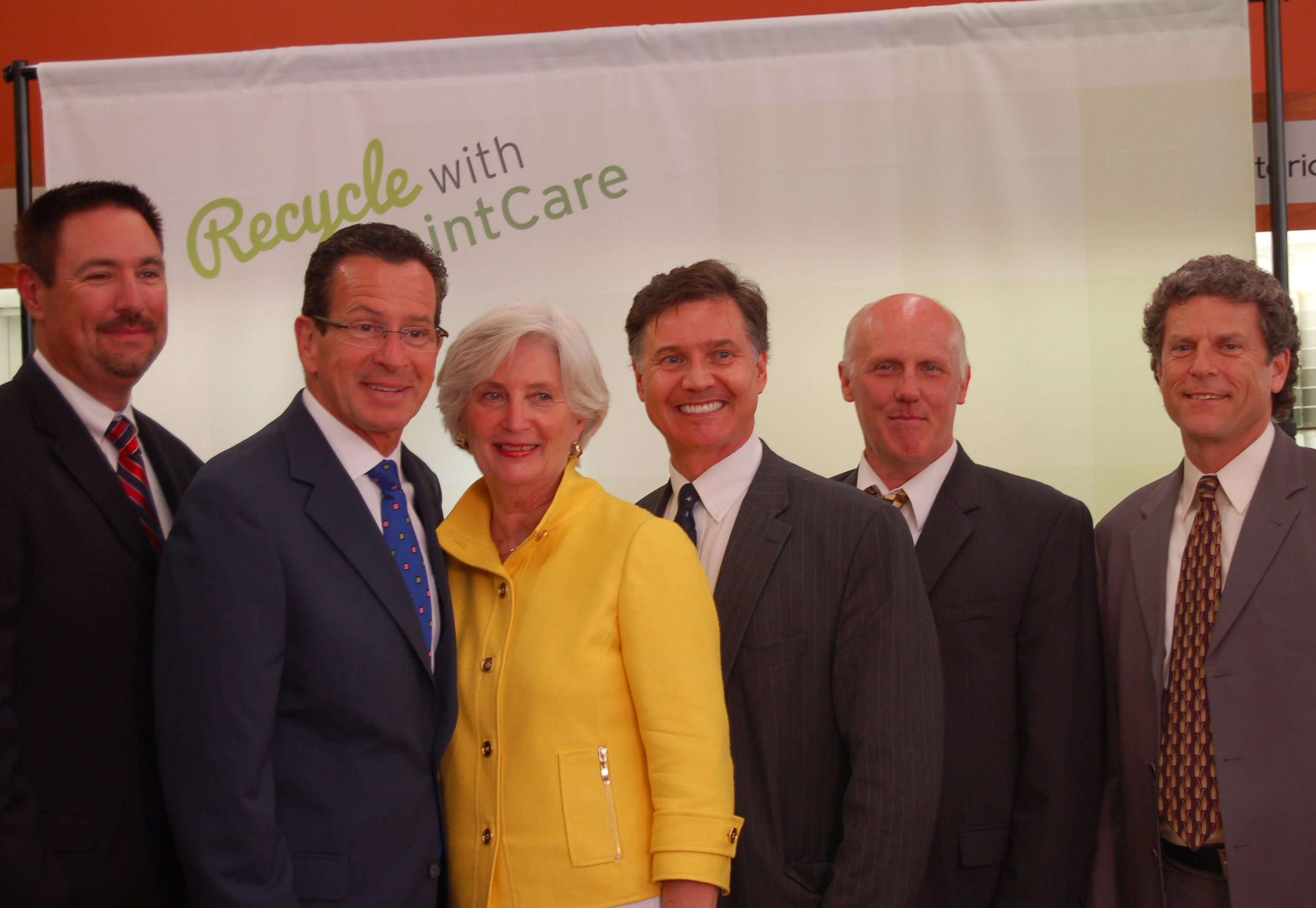
(L to R: Sherwin-Williams District Manager Tom Kelly; Connecticut Gov. Dannel Malloy; Connecticut State Rep. Pat Widlitz; Connecticut Dept. of Energy and Environmental Protection Commissioner Dan Etsy; Connecticut Dept. of Energy and Environmental Protection Environmental Analyst Tom Metzner; Product Stewardship Institute Chief Executive Officer Scott Cassel)
Tom Kelly, Sherwin Williams District Manager, mentioned the calls he already received on the first day of the program from residents seeking a place to bring leftover paint. “They come in just to drop off paint, but then see a clean store, and that we have what they need, and they leave a customer,” he said. Andy Doyle, President of the American Coatings Association, pledged the “support and backing of America’s paint industry” to recycle all the state’s leftover paint. The two chief bill sponsors – Sen. Ed Meyer and Rep. Patricia Widlitz – applauded the Governor and his team, as well as the industry, for their collaborative approach to finding a solution to a significant environmental problem, calling it “something really special.” They talked about the “terrific concept of producer responsibility” in which “paint manufacturers come up with their own plan to recycle.” State Rep. Lonnie Reed said that “…building in recycling and end-of-life elements into all of our products is important, and a sign of things to come.”

(L to R: American Coatings Association President Andy Doyle; Product Stewardship Institute Chief Executive Officer Scott Cassel)
As I stood there listening, it struck me that product stewardship has become commonplace in Connecticut. PSI laid the groundwork for paint product stewardship in Connecticut and across the nation by convening paint manufacturers, retailers, state and local governments, and others in national meetings to hash out the agreements that led to this very moment. But the paint program in Connecticut would not have happened if each of the local stakeholders at that press event did not seize on the opportunity they were presented. The paint industry has now transformed itself from an industry that once saw consumers as the reason for leftover paint to one that has taken a leadership role to make sure leftover paint is recycled.
As our nation debates immigration reform, marriage equality, and voting rights, we can all sense shifts in public opinion that represent sea changes of immense proportion. This year marks a watershed moment in the product stewardship movement. To date, eight producer responsibility laws have passed this past year on four products in eight states: pharmaceuticals (Alameda County, CA; King County, WA); paint (Maine, Minnesota, and Vermont); mattresses (Connecticut and Rhode Island); and thermostats (New York). No, the entire country has not embraced producer responsibility; that will take decades. But we now have Governors and Commissioners speaking about an industry’s responsibility to manage its own waste, and an industry speaking glowingly about its partnership with regulatory agencies that allow it to assume its rightful responsibility.
This is the paradigm shift that many of us predicted in 2000 when the Product Stewardship Institute was created on that cold December day in Boston when over 100 government officials assembled to talk about a little known concept called product stewardship.
The times have changed. Sometimes it is nice to sit back and enjoy the show, and revel in the enjoyment that your hard work has provided to others. For many of us, now is that time.
Last weekend I had the joy and good fortune to watch my daughter graduate from college. Few of my previous life experiences have matched that prideful day.
At Wesleyan University, on commencement day, a commitment to social justice dripped from each graduate’s gown. A stream of red and black marched by the round-topped star-gazing observatory as African drummers pounded soulful renderings under a tent. Professors and other dignitaries mingled around lawn chairs, and flags whipped in the cold wind.
Receiving an honorary degree was former Wesleyan graduate, Majora Carter, whose efforts to economically revitalize poor urban areas are profoundly “Wes.” So was her speech. Her message: Get ready to be uncomfortable. That’s right! Anyone who wants to shake up the status quo will have enemies, even brutal opposition. You will know who your friends aren’t, she said.
As someone who wears product stewardship lenses inside his gl
Over the past 13 years, this space has yielded dividends. In the past two weeks, three new producer responsibility laws have passed – Connecticut’s first-in-the-nation mattress law, and paint laws in Minnesota and Vermont (the 5th and 6th states to pass paint stewardship legislation so far). These laws do not pass solely because of PSI. In many ways, they would never pass if it was all up to us, or up to any one stakeholder. It takes a strong coalition that gets built over time. Starting and maintaining those coalitions is what PSI does – and it often starts in a very uncomfortable place, where we need to convince all stakeholders that the heavy lifting needed to change the status quo is worth the effort.
Thanks to all of our partners for great success these past two weeks, and we hope for many more victories that result in resource savings, job creation, and taxpayer savings. I am starting to like this feeling of being a little less uncomfortable.
Flying high above the Atlantic on my way home from a week of travels to Canada and Scotland, I pondered how America can be such a powerful world leader in technology, the economy, and the military, but so unenlightened regarding trash. We pride ourselves on innovation, bold risk-taking, fierce independence, and toughness. Yet, we are well behind our Canadian and European comrades regarding strategies to turn our country’s waste problem into an opportunity to recover valuable materials, create recycling jobs, and reduce costs. In fact, our corporations display a fear and trepidation of the future that is downright troubling.
What is so disappointing is that most corporations selling products into the U.S. market are operating within much more sophisticated solid waste programs than we have in the U.S. Although we have made progress in managing some problem wastes (e.g., electronics, mercury thermostats and lighting, and paint), the Canadians and Europeans have us beat in so many product areas, particularly packaging.
In Ottawa, Ontario, I moderated and presented on a panel called “Policy Shaping the Landscape” at the PAC NEXT annual conference that PSIco-sponsored. In front of several hundred corporate powerhouses like Unilever, P&G, Nestle, Walmart, Kraft, and Target, my fellow panelists and I discussed the mix of strategies needed to manage all packaging waste in Canada by 2015 – voluntary industry initiatives, extended producer responsibility (EPR), and other regulations. That same conversation is not yet happening in the U.S. And the U.S. representatives of those same corporate powerhouses are avoiding even having that conversation.

September 28, 2012—Scott Cassel speaks at PAC NEXT in Ottawa, Ontario.
As our first session panelist, Michael Goeres, executive director of the Canadian Council of Ministers of the Environment (CCME), provided the context for Canada’s national focus on packaging. According to Goeres, it started in 1989 with the National Task Force on Packaging. The issue reignited during the debate on packaging EPR that started in 2000. And it resurfaced, yet again, with the 2009 Canada-wide Action Plan for Extended Producer Responsibility and Canada-wide Strategy for Sustainable Packaging,which created a central platform on which to implement EPR laws throughout Canada by 2015. Goeres also discussed CCME’s initiative to work with industry to reduce packaging waste, which culminated in the recent announcement of the Design Guidelines for Sustainable Packaging, a voluntary joint initiative between Éco Entreprises Québec (a PSI Sustaining Partner) and the Sustainable Packaging Coalition.
In contrast to our Canadian counterparts, the U.S. Environmental Protection Agency (EPA) does not consider waste management to be a federal government issue, but rather a state and local government issue. After a request from state and local agency officials to help solve the growing waste problem, the EPA held five meetings on packaging waste between 2010 and 2011 and even released a report. However, it pulled out soon thereafter, leaving regional EPA branches to follow up.

September 28, 2012—PAC NEXT panelists at Chateau Laurier in Ottawa, Ontario.
The next speaker on our panel, John Coyne, is a Unilever vice president and chairman of Stewardship Ontario, the industry-led product stewardship organization that takes pride in its implementation of Ontario’s six-year old Blue Box EPR program. Of the 1,500 businesses represented by Stewardship Ontario, John said: “…we are dedicated to supporting our member companies’ drive to innovate – to contribute to making their businesses, packaging, and products more environmentally sustainable and more readily recyclable. We lead through development and investment.”
Here are a few other things he said:
- “By any measure, the Blue Box is defined and regarded as both a success and a symbol…75 percent of Ontario residents say they consider the Blue Box their primary pro-environment effort …People like it. It makes them feel good about their contribution. More importantly, people use it.
- “By embracing innovation, by harnessing creativity, by building on our achievements and accomplishments, we aim to be a global leader in responsible product stewardship. At all times, we never lose sight of the fact that our primary job is to meet collection and diversion targets and to prevent waste from filling landfills and fouling waterways.”
- “We need to ensure that the success of the Blue Box fuels further innovation – which, in turn, will help make the program even more successful.”
Ironically, many of the same companies that are members of Stewardship Ontario are also members of the U.S-based Grocery Manufacturers Alliance (GMA), which hired the consulting firm SAIC to issue a report last month that criticized the Blue Box EPR program as inefficient and ineffective. Go figure.
The last speaker on my panel, Meegan Armstrong of the British Columbia Ministry of the Environment, touted the province’s commitment to manage, by 2017, all products under an EPR system that promotes private sector initiative and innovation.
As if that three-speaker session was not enough of a contrast with the U.S., next, I spoke on a panel at the Scottish Waste and Resources Conference in Glasgow, Scotland, where my fellow panelists and I discussed the interplay between voluntary and regulatory solutions.

Oct. 3, 2012 — Scott Cassel speaks in Glasgow, Scotland about PSI’s experience forging agreements between stakeholders for both voluntary and regulatory product stewardship programs.
The Scottish government has just introduced packaging regulations that are more aggressive than the existing packaging law in place in the U.K., of which Scotland is a part. However, Zero Waste Scotland, an independent organization funded by the Scottish government, is tasked with implementing the packaging law through both EPR and voluntary solutions. The recycling rate in the U.K. far exceeds that of the U.S., but—to Scotland—that rate is unacceptably low. They want to do more.
America, we have a problem. If our corporations continue to refuse even to have the discussion with other U.S.-based stakeholders about how we are to reduce waste, save taxpayers money, create recycling jobs, and achieve our joint objectives by both voluntary and regulated solutions, then we will have no one to blame but ourselves for wasting economic opportunities.
As Americans, we should be leading in the creation of innovative waste management solutions, as we do in other areas of the economy, rather than burying our future in the rubble of our own fear.
Twelve years ago, when PSI was getting off the ground, my personal vision was that government and industry representatives could have meaningful discussions about waste policy outside the legislative arena, and develop joint policies, regulations, and laws to protect human health and the environment. I was tired of the traditional unilateral government approach to pass laws over the fierce objections of industry. Collaboration, after all, can achieve far better results than forcing anyone to do anything.
Fast forward twelve years, to today. While there are many stellar individual examples of corporate leaders finding ways to reduce their product impacts, far more companies have chosen to thwart attempts at having an open conversation about their environmental and social responsibility. In an ironic twist of self-fulfilling prophesy, most companies that hate regulation and want smaller government only become “greener” through the threat of legislation.
In an ironic twist of self-fulfilling prophesy, most companies that hate regulation and want smaller government only become “greener” through the threat of legislation.
PSI works on about 18 product categories, and has invited manufacturers, retailers, and other businesses associated with every one of these products to discuss how to reduce their health and environmental impacts. The only industries to fully engage in these discussions are paint (through the American Coatings Association) and rechargeable batteries (through Call2Recycle).
The International Sleep Products Association would not bring any members to our two open national mattress dialogue meetings, refused to provide contact information, and would not discuss strategies to solve the problem.
The majority of U.S. consumer packaged goods (CPG) companies were invited to attend our three technical packaging calls that recently addressed both voluntary and regulated strategies to reduce, reuse, and recycle packaging and printed material, including non-EPR systems. Only a few participated, and they have not invited PSI to attend any of their discussions. The truth is that most CPG company representatives in the U.S. are so new to the issue of packaging waste and recycling that they do not know what to do. There are many in this field, including PSI, who have been working on these issues for years, and can provide insights and opportunities for productive discussion among all stakeholder groups. However, this can only happen if these companies do not close ranks and only discuss strategies among themselves.
The National Electrical Manufacturers Association came to PSI five years ago seeking EPR legislation on mercury thermostats because they did not want to continue paying for the recycling of thermostats from free-riding companies not contributing to the industry-funded thermostat recycling program. After six months of multi-stakeholder negotiations and after all issues were negotiated, they walked away from the agreement and have since opposed all thermostat legislation except bills that codify their voluntary program.
No wonder why environmental groups have sharpened the saw against these companies. We have now come full circle to the point where PSI began – governments are left with little choice but to force legislation on industry, or accept whatever programs industry wants to do. That is truly a sad waste of all of our time and energy.
Yet the world turns, and PSI will react to this reality. We will continue to seek out corporate leaders, like those on our Advisory Council, at the American Coatings Association, and at Call2Recycle. And we will continue to support and strengthen voluntary programs as well, since many states will not support legislation under any circumstances. But the truth is that PSI is being forced into the same antagonistic fight in state legislatures that we wanted to avoid when we were created in 2000.
I had hoped that data, logic, discussion, and human interaction would breed relationships that would entice companies to transcend their natural inclination to maintain the status quo. We are now entering the fall, and many governments are getting ready for the 2013 battle in state legislatures across the U.S. …unless someone would rather talk…
Is anyone out there? Hello?
For the 11th year in a row, Massachusetts has failed to pass electronics EPR legislation. It is now 12 years since the Commonwealth became the first state in the country to ban the disposal of lead-bearing cathode ray tubes, sparking the electronics recycling industry in the U.S…and placing the financial burden to manage electronics on Massachusetts cities and towns. It was the classic ban without a plan. Unlike the stellar U.S. women gymnasts who earned Gold in London yesterday, our country fails miserably at passing legislation that will keep gold and other valuable materials out of our country’s landfills and incinerators.
What a waste. What a shame. To watch our great and mighty companies offshore jobs, complain about it being the only choice they have, but do little to create thousands of green jobs that are there for the asking if they would engage with PSI and other stakeholders to develop extended producer responsibility (EPR) laws and other strategies that meet their own interests.
The powerful corporate self interest that has blocked movement on product stewardship and EPR in the U.S. is the same one that unknowingly is weakening itself, just as the U.S. auto industry’s fight against fuel efficiency standards weakened itself, causing the need for a government bail-out.
I just finished yet another book that chronicles ways that U.S. companies and policy makers are failing to take actions that will strengthen our economy, instead resulting in the slow decline of U.S. economic power. Edward Luce’s Time to Start Thinking shows what the product stewardship movement experiences on a smaller scale – a failure to launch. Look no further than the microcosm of the product stewardship field, where many unenlightened companies fight against policies that will save billions of dollars for U.S. taxpayers, reduce waste, and generate thousands of recycling jobs.
These companies operate under the guise of groups like the Product Management Alliance, which evaluates EPR laws by showing that the laws that they weaken actually don’t perform well. How enlightening! The powerful corporate self interest that has blocked movement on product stewardship and EPR in the U.S. is the same one that unknowingly is weakening itself, just as the U.S. auto industry’s fight against fuel efficiency standards weakened itself, causing the need for a government bail-out.
As I wake up this morning to yet another failed attempt to pass an e-waste bill in the all-Democratic Massachusetts Legislature (and with its Democratic Governor), I wonder what this failure is all about…was Dell so bent on passing a bill that ensured that any goals included would already be met before the law went into effect? Or was the House leadership frozen in political gridlock on matters far removed from the bill itself? It is clear that there was no consensus on the bill, but how can stakeholders be so far apart for so long that we cannot figure out a way to act in all of our own self interest?
Close your eyes…and envision a time when we in the U.S. really went for the gold…like those women Olympic gymnastic heroes of today. Rather than burying our gold in the ground and mining raw materials in an endless cycle of waste, we owe it to ourselves to find a way to break out of this malaise together.
John E. Sununu, former U.S. Senator from New Hampshire, wrote an Op-Ed that appeared in the June 5 Boston Globe in which he touted last week’s private launch of a rocket into space as heralding the dawn of private investment in a domain that was previously solely that of government. Why then can’t the post office be privatized, he asks.
I wonder the same thing. The U.S. Postal Service did not respond well to the writing on the wall over the past 20 years, as the need for their letter carrier services gave way to faxes and the Internet. I tried to get USPS representatives interested in becoming a reverse distribution network for collecting used products for recycling, but they couldn’t grasp the concept. Their most common function now is to pass on costs to local governments to recycle or dispose of unwanted marketing queries and catalogues.
But I also wonder why those who support the private sector taking over the responsibility for government functions have such a hard time when it comes to trash or, should I say, the products that ultimately become trash. Companies derive profits from making and selling products, and it is accepted that these companies should internalize these profits. Why then should the costs of managing those products after they are consumed be externalized to society? Why should these costs become government’s costs? After all, we (all taxpayers) pay for this, not the companies that make or sell the products. In most places in the country, there is no differentiation between a computer, a piece of paper, an aluminum can, or a sofa. Stick it on the curb or bring it to the dump and you pay the same price. Government has little influence over product design to make a couch that weighs half as much but still performs the same. But the private sector does…if only given the incentive.
Government’s role traditionally has been to clear the streets of trash to protect public health and safety. However, over the past 40 years, government has also invested billions of dollars nationally in creating an infrastructure to collect and recycle used products, resulting in millions of dollars of private sector profits. This, too, is government’s traditional role. In his new book, Time to Start Thinking, Edward Luce recounts how government paved the way for the private sector to profit from the Internet through billions of dollars of taxpayer investment. Thomas Friedman, in his new book, That Used to be Us, laments the lack of government investment now in new energy efficient technologies that can pave the way for private sector investments in the next generation of clean energy technology.
Government paves the way by investing in the future of the country. But there is a time when it should step aside for the private sector to take over. State and local governments have invested enough in developing the infrastructure that is now serviced by waste management and recycling companies. This public sector investment has yielded millions of recycling jobs, a reduction in environmental impacts, and cost savings. The investment has paid off.
But we are at a critical juncture. Government does not have the funds to invest any more. It is time for the private sector to internalize post-consumer product costs and to invest in sustainable products and collection systems that recover valuable materials for the manufacture of new products. This transition to a more sustainable economy is rooted in our ability to forge a lasting partnership between the private sector and government.
I am with John Sununu on this one. He forecasts a person’s typical response to change by clinging to the status quo. Look at it this way. Everything that we buy will be transformed to some degree. We change the things we buy by using them. Therefore, we are all agents of change. It is time to change how waste is managed in this country.
Calling all private sector small government advocates – we are ready for you.
For once, there was good news about jobs. Real American jobs.
The front page headline of The Boston Globe’s business section on April 16 read: “Recycling industry poised for hiring.” The article highlighted the recent report by the Environmental Business Council, MassRecycle, and SkillWorks (a nonprofit that funds workforce initiatives) that predicts the growth of over 1,200 recycling jobs in Massachusetts in the private sector alone. This growth would be added to the 14,000 current recycling jobs in 2,000 Massachusetts companies with a payroll approaching $500 million annually.
Wow! Such great news. Finally, business, government, and environmental groups should be swinging arm in arm, humming This Land is Your Land.
Let’s take it a step further. Extended producer responsibility (EPR) laws create recycling jobs by signaling to investors that the supply of recycled materials will be available. In the first year of E-Cycle programs in Washington and Oregon, three new processing and recycling facilities opened. Implementation of their E-Cycle programs resulted in electronics collection and processing job growth of 64%, supporting 360 jobs or 12.6 jobs per 1,000 tons of electronics processed, well above the less than 1 job per 1,000 tons from traditional disposal. Collection rates rose to 38.5 million pounds in Washington and 19 million pounds in Oregon.
Since EPR laws increase material supply and recycling, businesses should be loving EPR too, right?
Then why would the Hartford Business Journal equate the 2012 Connecticut mattress EPR bill as bad for business? About EPR, the Journal says: “If you think about the logical extensions of that doctrine, the world as we know it ends.” They are not being kind. Of course those of us working on EPR know that the world as we know it must change. We cannot continue to waste resources and place the burden on government and taxpayers.
But the Journal shows how different many in the business community view EPR. They acknowledge the problem that mattresses cannot be disposed of in landfills and incinerators, and that it costs a great deal to manage them properly. And they acknowledge that the bill would create jobs, citing companies ready to set up shop in the state, the way that a paint recycler immediately announced plans to come to the state after Connecticut passed its 2011 paint EPR law.
But they object to businesses being held responsible for resolving the problem. “Somewhere the responsibility of the individual user has been lost in a nanny-state fantasy that business is responsible for all ills…Isn’t this exactly the kind of big-picture societal problem that governments are supposed to solve?”
I want to thank the Journal for framing these questions. I really mean it. We now know where to start the discussion. Government is definitely not equipped to handle product waste by itself, despite their extensive expertise in waste management and recycling. Pure and simple – they do not have the funds. And it is not fair to ask all taxpayers to pay for the consumption of others.
EPR systems require that state and local governments, manufacturers, retailers, and consumers all play a role in the responsible management of products and the materials of which they are made. And, yes, individuals who buy the products should pay for their recycling or disposal, and producers should make it easy for those consumers by incorporating these costs into the product purchase price. Until the full cost of managing products is internalized, we will continue to have a nanny-state where government picks up the cost to dispose of products.
But why do businesses so vehemently resist the changes that many agree need to be made? What responsibility does the business community have in reducing environmental impacts and reducing government waste management costs that result in higher taxes?
On the other side, what is the extent of government’s reach? What added costs do governments impose because they are involved in ways that they should not be?
We all want jobs. We want a clean environment and a reasonable quality of life. Then why is it so hard to take responsibility for changes needed to bring about these outcomes? Are we just too darn stubborn to consider a change to our current situation, no matter how much better we have the power to make it? I really think that this is most of the challenge.