
The Product Stewardship Institute was founded in 2000 to establish cooperative agreements with stakeholders to reduce the lifecycle health and environmental impacts from consumer products. Most advocates at the time pointed their fingers only at producers, suggesting that the responsibility was solely theirs. Instead, PSI said the responsibility was shared among all stakeholders, but that producers had primary responsibility for financing and managing the system. This nuanced framing of the product stewardship movement as having a lead actor with a strong supporting cast helped the movement take hold in the U.S.
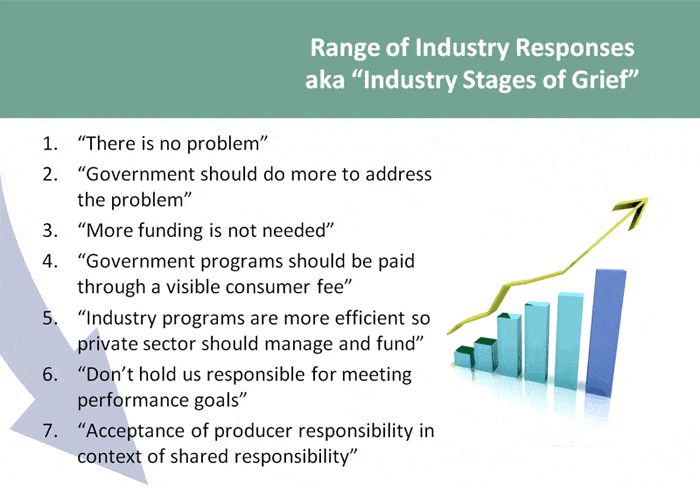
Over the past decade, PSI has knocked on the proverbial door of over 15 industry sectors and offered to work collaboratively to reduce the unintended lifecycle impacts resulting from their products. Companies, like the people who run them, have responded in a variety of ways. These responses usually fit within a trajectory of perspectives that reflects the culture of the industry sector and the individuals who lead them. Whether and how these perspectives change through discourse is also a reflection of the industry, its leadership, and external influence and circumstances. In general, PSI’s experience is that the perspective of most industry sectors proceeds along the following path during the course of a dialogue: (1) there is no problem; (2) government should do more to address the problem; (3) more funding is not needed; (4) government programs should be paid for through a visible consumer fee; (5) industry programs are more efficient so the private sector should take programmatic control; (6) don’t hold us responsible for meeting performance goals.
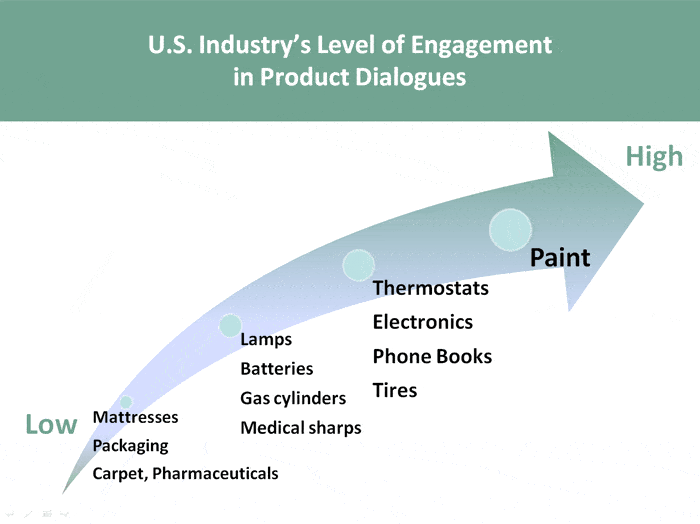
Of the industries we work with, only two manufacturers – paint and rechargeable batteries – have fully engaged government, and both were responding to the threat of legislation. Perhaps the paint industry learned from previous legislative battles on lead paint and volatile organic compounds and saw how it could benefit from the unified national process that PSI offered. Maybe the rechargeable battery industry learned that collaboration with governments was needed to implement its own voluntary producer responsibility program. Whatever the case, the rest of the industries have either refused to engage in a constructive dialogue about the problems caused by their products or they engaged for a period of time, sometimes up to six years, before digging in against further discussion.
The six phases above have been called Industry Stages of Grief by my colleagues in the British Columbia Ministry of the Environment. These phases represent the progression of perspectives that most corporate executives go through when they are confronted with problems caused by their products. No company likes to be told that their products cause pollution and add to the financial strain of governments. None wants to be asked to change its business practices, since change will always mean an investment of resources. The key is whether a company or an industry sector is willing to learn, and also believes it can convince other stakeholders of its viewpoint. I have found that all stakeholders have the potential to change their positions once they engage in dialogue. This change of perspectives happened at every one of PSI’s dialogues, no matter which industry sector we engaged. Government officials learned as much as their industry colleagues, and all positions were influenced as a result.
To be sure, there are companies that are engaging with external stakeholders and have figured out how to make social and environmental sustainability a key component of their business models. For many others, it is difficult to break from the pack.
The Industry Stages of Grief outlined above is a general guide. Manufacturers enter at different places along this trajectory, and proceed at different speeds. All stakeholder viewpoints must evolve to some degree for negotiations to be successful. It takes a commitment of resources for groups of individuals who represent divergent viewpoints to jointly embrace a common idea. There is a dynamic tension that occurs in negotiations. For the dialogue to succeed, the pace of change must meet the expectations of the stakeholders, particularly the governments that now pay a huge cost to manage waste. Progress must be fast enough to keep them from unilaterally legislating. On the other hand, if these regulators proceed too quickly, before strong coalitions can be formed to support the desired changes, they risk not only alienating the industry groups they want to engage but other key stakeholders as well.
Gilles Goddard, an industry representative from Canada, uses the following phrase to capture the delicate dance of negotiations: “You can’t pull a flower to make it grow.” Negotiations take time, perseverance, and the right individuals who want to reach an agreement. Timing is a key element. If government pushes too hard or pulls too fast, it can ruin the chance for success. But if industry moves too slowly, it can also sour the opportunity for an agreement, and result in unilateral government legislation.
Honest dialogue anyone? Is there anybody out there?