
Brendan Adamczyk, Associate for Policy and Programs
One year ago, PSI’s Sydney Harris noticed a troubling trend around the country: states and municipalities were rolling back regulations on single-use plastics due to fears of surface transmission of COVID-19. Wanting to understand the magnitude of this trend, Sydney launched PSI’s COVID-19 Impacts on U.S. Plastics Policy Tracker, chronicling delayed legislation, lifted bag bans and fees, and bans on reusable bags on city, county, and state levels. She also included impacts on bottle deposits, other single-use plastics (such as polystyrene takeout containers), and relevant major news coverage. I joined PSI’s team in June and have worked over the past nine months to keep the tracker up to date.
In the year since, we have learned from health experts across the globe that reusables are just as safe as single-use plastics. The plastics industry promoted the idea that plastics reduce exposure to COVID-19 as early as mid-March 2020, requesting that the U.S. Health and Human Services Department speak out in support of single-use plastics. This is one example in a long history of plastics producers misleading the public about the benefits of plastics and their role in the plastic pollution crisis– a crisis that has only deepened as a result of COVID-19, with consumption of single-use plastics rising by up to 300% while plastic pollution in the oceans continues to climb.
Ongoing Impacts of COVID-19
The impacts of COVID-19 on single-use plastics regulations have been severe and spread out across the country, as one can see by looking at the map below. In 2020, nine of the ten states with bottle deposit programs (all states except Hawaii) temporarily suspended collections. Interruptions lasted for months, with the last state (California) resuming collection at the end of August. Beyond these programs, 72 waste-reduction policies were delayed, lifted, or suspended because of the pandemic. On top of this, 16 new policies were enacted that restricted the use of reusable bags and containers. Overall, these 88 policy impacts spanned 23 states and the District of Columbia and are comprised of:
• 21 delayed plastic bag bans or fees;
• 26 lifted plastic bag bans;
• 15 lifted plastic bag fees;
• 16 new policies that barred customers from using reusable bags or takeout containers; and
• 10 suspended or lifted policies banning plastic straws or polystyrene cups and takeout containers.

As of today (April 1, 2021), 25 of the 88 policies, or 28 percent, remain affected, all of which are bans or fees on plastic bags that continue to be either delayed in implementation or are still suspended. In addition, eight jurisdictions withdrew previously planned bag or polystyrene ban legislation, most notably Colorado, Maryland, and New Hampshire, all of which pulled bag bans. In part due to the now-debunked myth that reusable bags transmit COVID-19, Ohio and Pennsylvania passed statewide preemption laws that prevent municipalities from banning plastic bags through the middle of 2021. The state of Pennsylvania is currently being sued by a group of municipalities, led by Philadelphia, who want to maintain their ability to ban bags at the local level. The graphs below illustrate how these policies were spread across cities, counties, and states and how many of them continue to be impacted one year after the start of the pandemic.
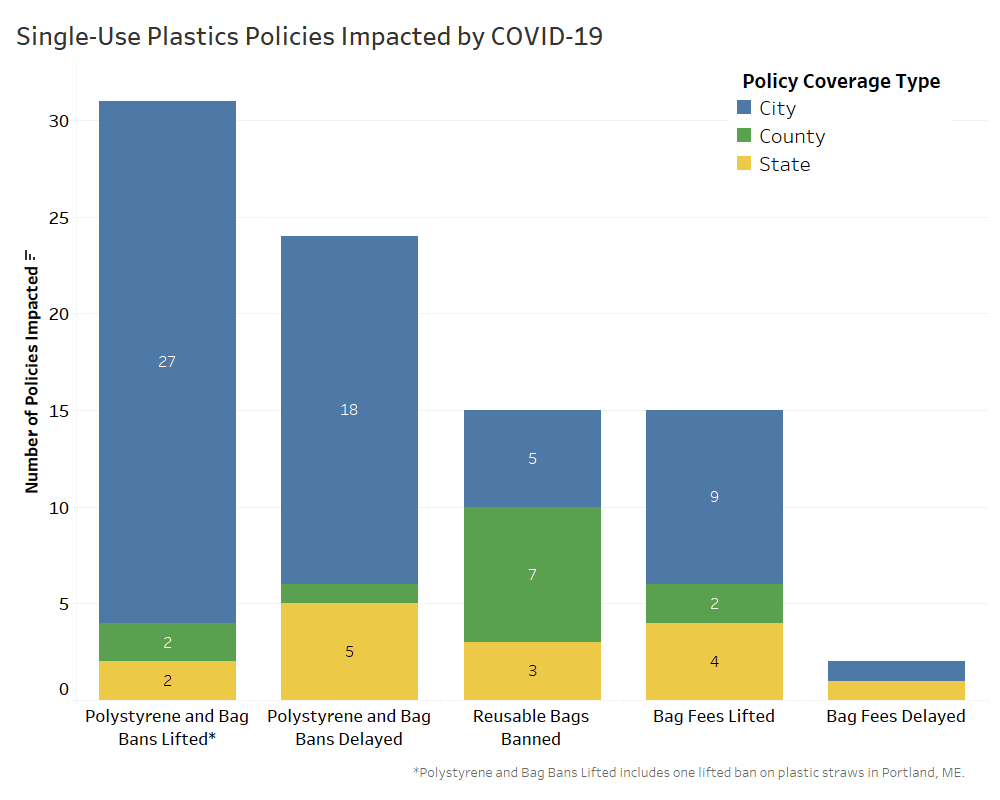
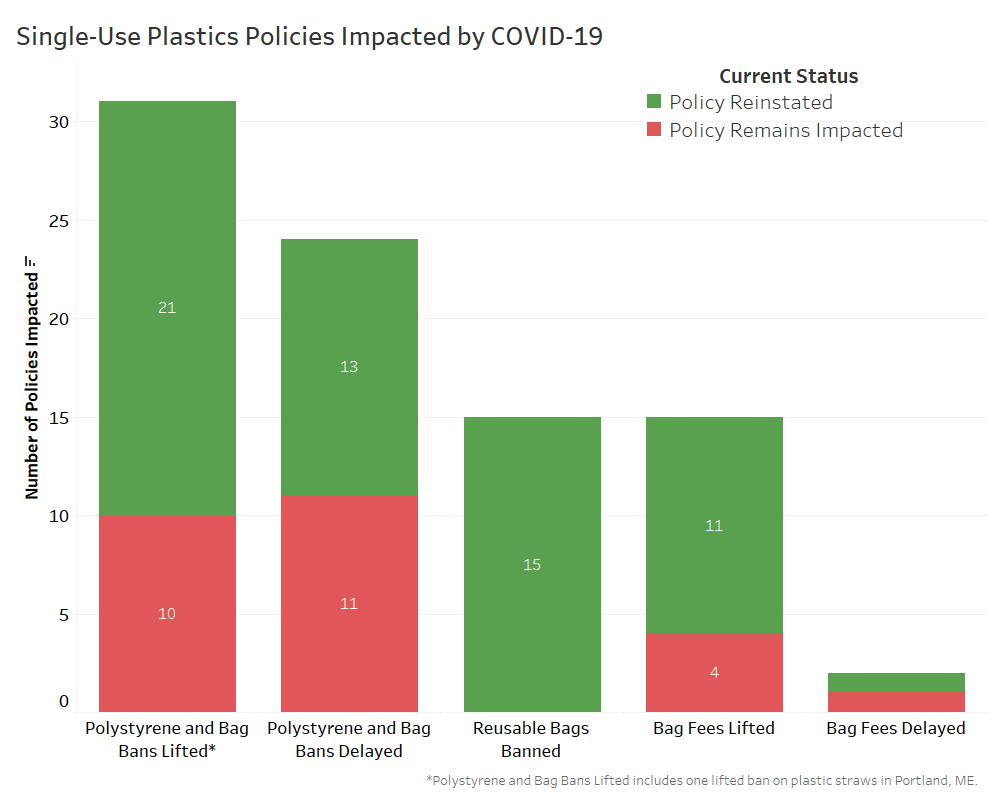
Even amidst the pandemic, however, it has not all been bad news for plastics regulation. During the past year, six jurisdictions passed bans on plastic bags, including New Jersey’s robust ban on both plastic and paper bags. Additionally, eight previously-passed bans on plastic bags or polystyrene containers took effect despite the pandemic, including bag bans in three states – Delaware, Vermont, and Virginia – as well as a ban on expanded polystyrene in Maryland.
Looking to the Future
In the wake of COVID-19, which also had major impacts on the U.S. recycling system in the beginning of the pandemic and will pose ongoing challenges in the future, it is clear that change is sorely needed. PSI advocates for Extended Producer Responsibility (EPR) legislation that holds producers accountable for their products and packaging by shifting the financial and management burden of recycling from taxpayers and local governments to consumer brands. Globally, EPR for packaging has helped solid waste programs stay resilient in the face of COVID-19, with a study conducted by Éco-Entreprises Québec finding that curbside recycling experienced fewer pandemic-related disruptions in Canadian provinces with EPR than those without. This is true despite Canadian programs facing the same challenges as the U.S. did, including a 30% increase in residential trash volume and employee shortages throughout the pandemic.
In the United States, momentum for EPR legislation for packaging and paper products has greatly increased. At least 13 bills across 10 different states have been introduced or are expected to be introduced in the 2021 legislative session, as well as two bills on the federal level: the CLEAN Future Act, an overarching climate bill that includes EPR elements, and the Break Free from Plastic Pollution Act, a waste reduction bill centered around a packaging EPR model, which was informed directly by PSI’s model and would overhaul the U.S. waste management system.
For now, while some policies and recycling programs remain affected, PSI will be no longer be updating our COVID Impacts Tracker as most of the country has returned their single-use plastic policies to pre-pandemic status. Instead, we are focusing our energy on the EPR bills above. The lessons we have learned over the past year are important. But it is now time to look forward, knowing we have the policy tools to drive genuine change in the U.S. waste management system. EPR for packaging and paper products will stabilize and improve our recycling programs and push our country away from single-use plastics towards a circular economy built on closed-loop recycling. EPR legislation is a policy whose time has come.